
Most traders quit because they don’t know when to walk away. If you can lock in gains and cut losses, you stay in the game longer. In this guide you’ll learn practical forex trading exit strategies, step‑by‑step tips, and real‑world examples you can use today.
Understanding Exit Strategies: Foundations for Forex Traders
Forex trading exit strategies are the rules you set before you open a trade. They keep emotions out of the decision‑making process. When you have a clear exit plan, you know exactly where you’ll take profit or stop loss, and you stick to it.
Why does this matter? Because most retail accounts lose money when they trade without a plan. IG notes that 71% of CFD traders lose money, often because they close trades too early or let losers run too long. A solid exit plan reduces that risk.
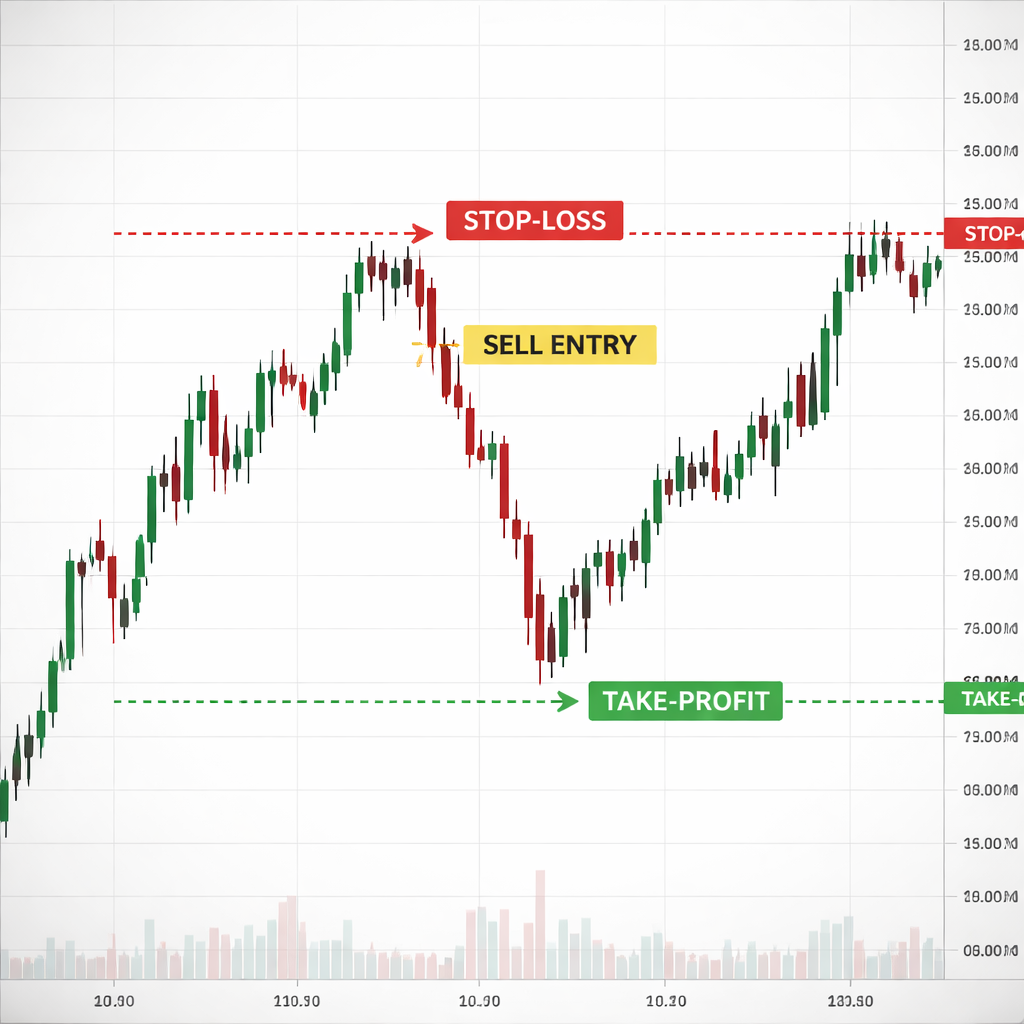
There are two basic ways to exit a trade: take profit and cut loss. A take‑profit order closes the trade once price hits a pre‑set level that gives you a win. A stop‑loss order does the opposite – it closes the trade when the market moves against you past a level you can’t afford to lose.
Both orders can be set as soon as you enter a trade. This helps you avoid the fear‑driven moves that many new traders make. For a long position, your stop‑loss sits below your entry price; for a short, it sits above.
Think about it this way: an exit plan is like a safety net. It protects you from a sudden market swing that could wipe out your account. It also locks in profit when the market moves in your favor.
Actionable tips:
- Set a stop‑loss at a level where you’d be comfortable losing the trade.
- Place a take‑profit at least twice the distance of your stop‑loss (a 1:2 risk‑reward ratio).
- Write these levels in your trade journal before you click “buy” or “sell”.
For more on swing‑trading ideas, check out Forex Swing Trading Strategies: A Practical Listicle for Traders. You can also read IG’s guide on exit strategies here and learn about the three common exit methods here.
Step 1: Define Your Profit Target and Risk Tolerance
Before you press “enter”, decide how many pips you want to make and how many you can lose. This is the core of any forex trading exit strategies plan.
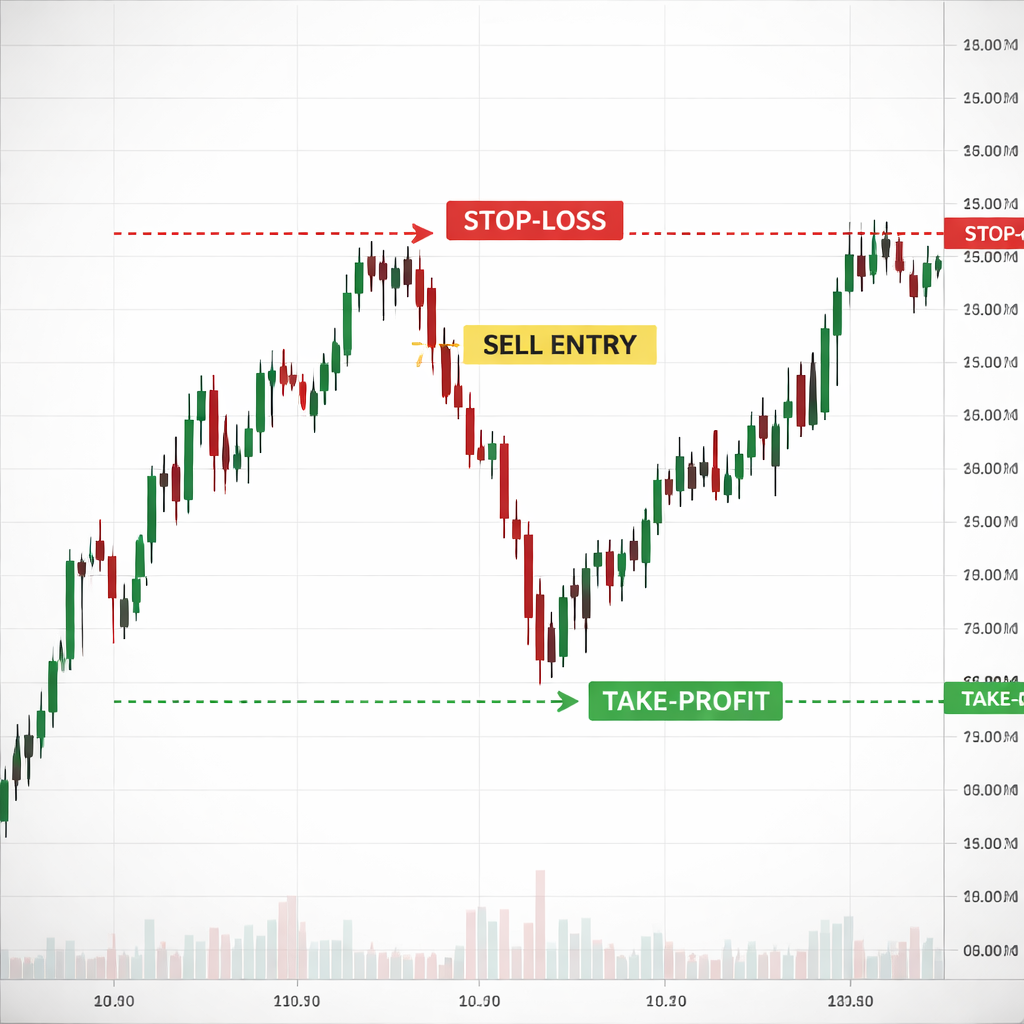
Start by calculating your risk‑reward ratio. If you risk 50 pips, aim for at least 100‑150 pips of profit. A 1:2 or 1:3 ratio gives you a buffer even if you’re right only a third of the time.
Next, match that ratio with your personal risk tolerance. If a 50‑pip loss feels too big, shrink your position size or widen your stop‑loss using a volatility measure like ATR. The key is to stay comfortable with the amount you could lose on a single trade.
Here’s a quick way to set the numbers:
- Identify the recent swing high and low on your chart.
- Place your stop‑loss a few pips beyond the swing low (for a long trade) or high (for a short).
- Measure the distance in pips; double it for your take‑profit.
Imagine you’re trading EUR/USD on a 4‑hour chart. The last low is 1.0800. You set a stop‑loss at 1.0775 (25 pips). Your take‑profit would be at 1.0850 (50 pips) for a 1:2 ratio.
Why does this help? Because you’ve turned a vague idea of “make money” into a concrete plan. When the market moves, you’ll know exactly where to exit.
Actionable tips:
- Write your stop‑loss and take‑profit levels in a notebook before you trade.
- Use a calculator to check your risk‑reward ratio each time.
- Adjust position size so the monetary risk matches your account size (e.g., 1% per trade).
IG also explains how to set these levels in a disciplined way here and offers a short video on the topic here.
Step 2: Implement Trailing Stops and Break‑Even Levels
Once a trade moves in your favor, you want the exit plan to move with it. That’s where trailing stops and break‑even levels come in. They are part of many forex trading exit strategies because they lock in profit while still giving the market room to run.
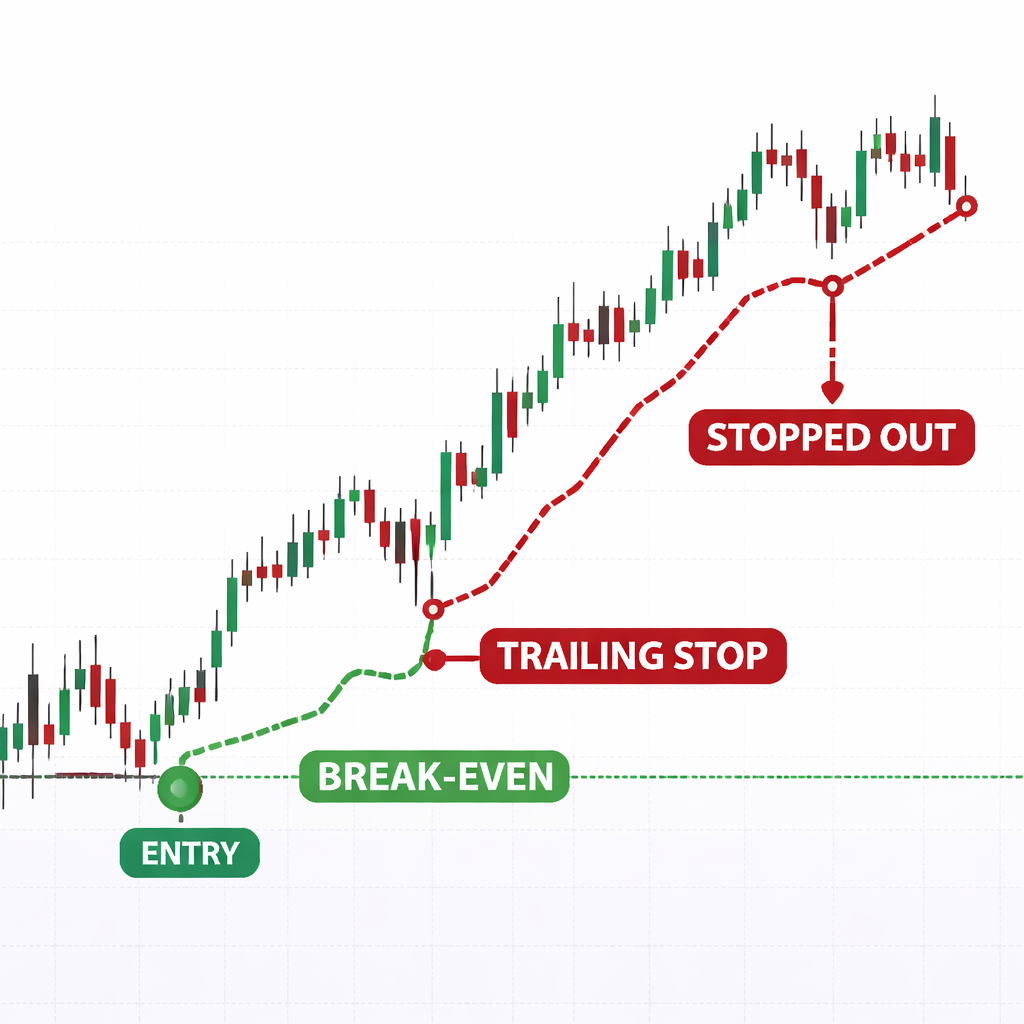
A trailing stop is a stop‑loss that follows the price at a set distance. If the market keeps rising, the stop rises too. If the market turns, the stop stays where it was, cutting the trade at the last safe level.
Break‑even is the point where your profit equals your loss. When you hit that point, you move your stop‑loss to your entry price. This removes the risk of turning a winning trade into a loss.
Defcofx explains that a simple trailing stop can be set at a fixed number of pips or based on a volatility indicator like ATR. For example, you might trail by 1.5 × ATR. If the ATR on EUR/USD is 30 pips, your trailing stop would be 45 pips behind the current price.
Here’s a practical walk‑through:
- Enter a long EUR/USD trade at 1.1000 with a 30‑pip stop‑loss.
- Set a trailing stop at 40 pips. When price reaches 1.1080, the stop moves to 1.1040.
- If price then falls to 1.1040, the trade closes, locking in 40 pips of profit.
Why use these tools? Because they let you stay in a trend without watching the chart every minute. They also help you avoid the “panic sell” that many traders do when the market dips.
Actionable tips:
- Use a trailing stop that’s at least 1× ATR to avoid being stopped out by normal noise.
- Move to break‑even as soon as the trade has gained the amount you risked.
- Combine a partial profit take with a trailing stop on the remaining lot.
Read more about how trailing stops work at Defcofx’s guide on forex exit strategies. For a deeper dive, also see this article on dynamic exits.
Step 3: Choose the Right Exit Method for Different Market Conditions
No single exit method works all the time. Good forex trading exit strategies match the method to the market’s mood – trending, ranging, or volatile.
When the market is in a clear trend, a trailing stop or moving‑average stop often works best. The trend gives you room to let winners run, and the stop follows the price.
In a ranging market, fixed profit targets near the next support or resistance level are safer. The price bounces between two levels, so you can set a take‑profit at the top of the range and a stop‑loss just beyond the bottom.
When volatility spikes – for example around a news release – many traders use an ATR‑based stop. The ATR tells you how far the price usually moves, so you can size your stop to avoid getting knocked out by normal swings.
Below is a quick comparison of three common exit methods and when to use each.
| Method | Best For | Key Advantage | Typical Setting |
|---|---|---|---|
| Trailing Stop | Strong trend | Locks in profit as price moves | 1–2 × ATR or fixed pip distance |
| Fixed Take‑Profit | Ranging market | Simple, clear target | Near next support/resistance |
| ATR‑Based Stop | High volatility | Adapts to market noise | 1.5 × ATR from entry |
Money‑TMX notes that a disciplined exit plan helps you stay focused during volatile periods. It also says that setting clear exit targets prevents panic selling.
Imagine you’re trading GBP/JPY during a UK CPI release. The ATR spikes to 150 pips. You could set a stop at 225 pips (1.5 × ATR) to give the trade breathing room while still protecting capital.
Actionable tips:
- Identify the market condition first (trend, range, news).
- Pick the exit method that matches that condition.
- Review your choice after each trade to see if it fit the market.
For more on handling volatility, read Money‑TMX’s article here and also their piece on smart exit planning here.

Conclusion: Building a Consistent Exit Routine
Strong forex trading exit strategies turn good ideas into real profit. By defining clear profit targets, using trailing stops and break‑even levels, and matching the exit method to the market’s mood, you give yourself a repeatable routine that limits loss and grows wins.
Remember to write your plan before you trade, stick to your risk‑reward rules, and review each trade in your journal. Over time the routine will become second nature, and you’ll see fewer emotional exits.
If you want to keep building your skill set, explore more guides on the FX Doctor site or try the free forex trading course they offer.
FAQ
What is the best way to set a stop‑loss for a swing trade?
Place the stop‑loss a few pips beyond the most recent swing low (for longs) or swing high (for shorts). Use a risk‑reward ratio of at least 1:2, and adjust the size so the monetary loss fits your account risk tolerance. This keeps the trade within your forex trading exit strategies plan and avoids large, unexpected losses.
How do I decide between a trailing stop and a fixed profit target?
If the market shows a clear trend, a trailing stop lets you capture more upside while protecting gains. In a ranging market, a fixed profit target near the next resistance or support gives a cleaner exit. Look at the price action, identify the condition, then pick the method that matches the situation as part of your forex trading exit strategies toolkit.
Can I use the Average True Range (ATR) for stop placement?
Yes. ATR measures recent volatility, so setting a stop at 1–1.5 × ATR helps you avoid being stopped out by normal market noise. For example, if the 14‑day ATR on USD/JPY is 30 pips, a 45‑pips stop gives the trade room to breathe while still protecting your capital. This is a solid component of many forex trading exit strategies.
When should I move my stop to break‑even?
Move to break‑even as soon as the trade has gained the amount you risked. If you risked 50 pips, shift the stop to your entry price once you’re up 50 pips. This removes the chance of turning a winning trade into a loss and is a key step in disciplined forex trading exit strategies.
How often should I adjust my profit target?
Review the target when the market shows a new swing high or low, or when a major news event is about to hit. If the price breaks a strong resistance, you can raise the target to the next level. Adjustments keep your forex trading exit strategies aligned with real‑time market structure.
Is it okay to close a trade early if I feel uneasy?
Emotions should not drive your exits. If you feel uneasy, check your plan: does the price still respect your stop‑loss or profit target? If the trade is still within the parameters you set, stay the course. Cutting a trade early without a rule usually harms long‑term performance, which is why a solid forex trading exit strategies framework matters.
What role does position sizing play in exit planning?
Position size determines how much money you lose if the stop is hit. By keeping each trade’s risk to a small percentage of your account (often 1‑2%), you ensure that a single loss won’t wipe out your capital. This works hand‑in‑hand with your forex trading exit strategies, letting you stay in the game after a string of bad trades.
For more ideas on related topics, you can explore AI Video Editing Tutorial: A Simple Guide for Business Owners, How to Master AI Video Editing for Social Media, Photo Booth Rental for Graduation Party: A Step‑by‑Step Guide, Birthday Party Photo Booth Rental Guide for 2026, How to Choose the Perfect Prom Photo Booth Rental for an Unforgettable Night, Your Complete Guide to Photo Booth Rental Temecula for Unforgettable Events, Photo Booth Rental Murrieta: A Complete Guide for 2026 Events, How to Choose the Perfect Wedding Photo Booth Rental: A Step‑by‑Step Guide, Everything You Need to Know About 360 Video Booth Rental, Mirror Photo Booth Rental: 7 Must‑Know Tips for an Unforgettable Event, How to Choose the Best Corporate Event Photo Booth Rental for Your Business, and Your Complete Guide to Photo Booth Rental San Diego.