
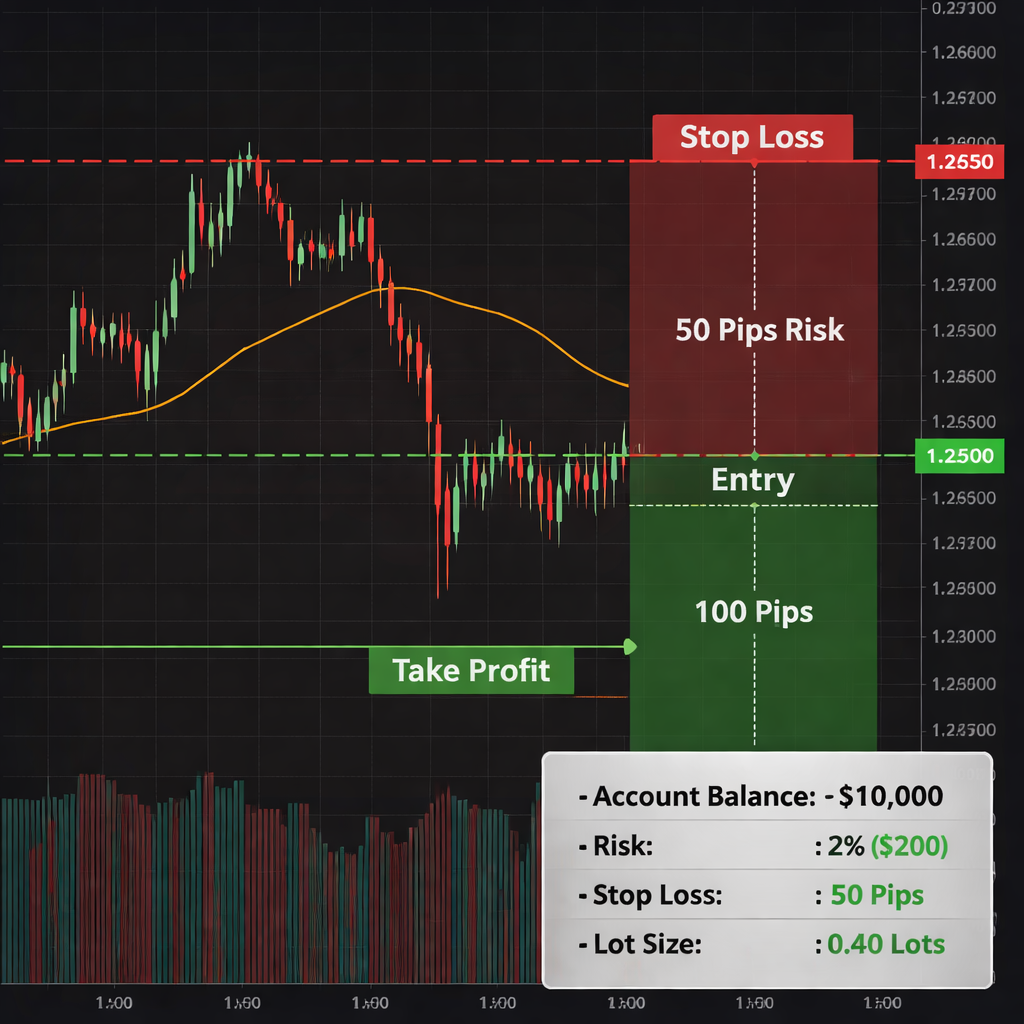
Imagine you’re looking at a EUR/USD chart. The price has just broken above a recent high. Your gut says “buy,” but you also know that a single loss could wipe out weeks of practice. You decide to open a trade, but you set a stop loss far away, hoping the market will keep moving up. A sudden news spike hits, the stop gets hit, and you lose $200 on a $2,000 account. That sting could have been avoided. The difference isn’t the trade idea – it’s the plan you follow. In this guide we’ll walk through a full forex trade management strategies template. You’ll see how to set risk, size positions, pick exits, use trailing stops, review results, and keep your mind in check. Follow each step and you’ll turn a risky gamble into a disciplined routine.
Step 1: Define Your Risk Per Trade
Every solid forex trade management strategy starts with a clear risk rule. Think about it this way: you decide how much of your account you’re willing to lose before you even look at the chart. Most pros risk 1‑2 % of their capital per trade. If you have a $10,000 account, a 1 % rule means you never lose more than $100 on any single position.
Why does this matter? Because losing a few trades in a row is normal. If each loss is capped at 1 %, a string of ten losses only shaves off 10 % of your capital, not 50 % or 80 %.
Here’s what I mean: you set a stop loss based on market structure, not on a random number of pips. For a buy trade, you might place the stop just below the most recent swing low. For a sell, just above the swing high. This ties your risk to the chart’s natural barriers.
Two key tools help you lock in this rule:
- Stop‑loss orders – they close the trade automatically once the price hits your defined level.
- A written risk rule – jot it down in a notebook or a digital doc so you can review it later.
Using a stop loss every time removes emotion. You won’t be tempted to “move the stop” when the market jitters. As OnsaFX explains, a solid risk rule lets you survive volatility, news spikes, and unexpected moves.
Another reason to stick to the rule is leverage. High leverage can turn a small price move into a big loss. By keeping risk low, you can use modest leverage and still stay safe.
And if you ever wonder how to choose the exact %‑risk, start with 1 % and adjust as you grow more confident.
Below is a quick checklist you can copy into your trading plan:
- Define % of account risk per trade (1‑2 %).
- Identify stop‑loss level based on swing points.
- Write the rule in a dedicated risk‑management page.
Finally, remember that risk is the foundation of all forex trade management strategies. Without it, the rest of your plan crumbles.
And for a visual walk‑through, watch this short video:
Also, check out Forex Trading Plan Template PDF: A Step‑by‑Step Guide for Traders for a ready‑made worksheet you can fill in.
Step 2: Calculate Position Size
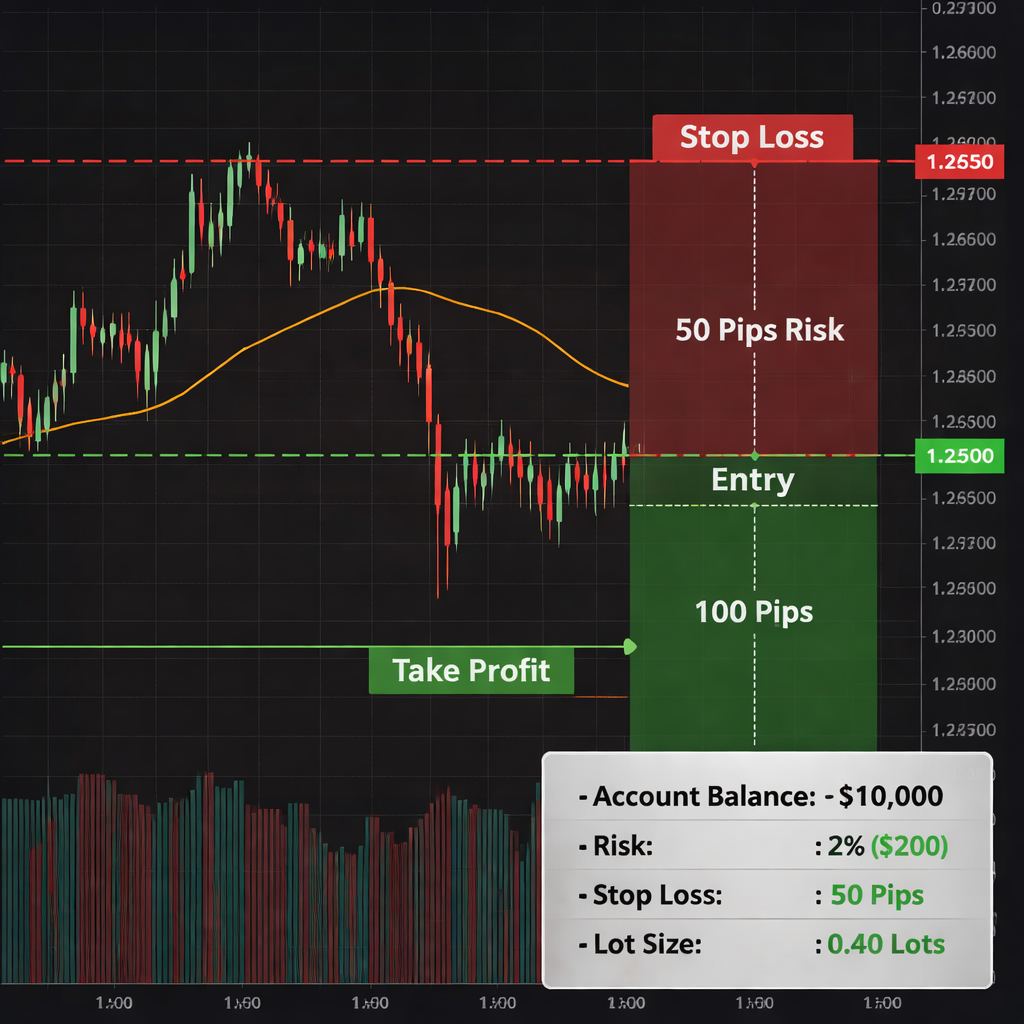
Once you know how much you’ll risk, the next part of any forex trade management strategies plan is sizing the lot. The math is simple: Dollar risk ÷ (Pip distance × Pip value per lot) = Lots.
Let’s say you risk $100 and your stop is 50 pips away. If a standard lot gives a $10 pip value, the formula is $100 ÷ (50 × $10) = 0.2 lots. That means you open a mini‑lot (0.2) instead of a full lot.
Why does this matter? Because the stop distance changes with market volatility. A wider stop needs a smaller lot to keep dollar risk the same. This keeps your account safe even when the market is noisy.
Two practical tips:
- Use a position‑size calculator – many free tools exist online.
- Re‑calculate for every trade – never reuse the same lot size if the stop distance changes.
For more on why position size matters, see OnsaFX’s risk‑management guide. It stresses that “correct position sizing ensures that even if a trade hits the stop loss, the loss remains within your predefined risk percentage.”
And here’s a quick example you can try on a demo account:
- Account: $5,000
- Risk per trade: 1 % ($50)
- Stop distance: 30 pips
- Pip value (0.01 lot): $0.10
- Lots = $50 ÷ (30 × $0.10) = 1.66 × 0.01 = 0.166 lots (≈0.2 mini‑lot)
Keep a record of each calculation in your journal – it helps you see how risk and size interact over time.
And remember, the goal of any forex trade management strategies is to keep your dollar risk steady, no matter how many pips you give the trade.
Step 3: Establish Clear Exit Targets
Knowing when to get out is just as vital as knowing when to get in. A solid forex trade management strategies plan always sets profit targets before the trade is opened.
One common method is the fixed take‑profit. You decide on a risk‑to‑reward ratio, such as 1:2, and place the target twice the distance of your stop. If your stop is 30 pips, your take‑profit sits at 60 pips.
Why use a fixed target? Because it removes guesswork. You don’t have to watch the market constantly; the trade will close automatically when the price hits your level.
Another tool is partial profit taking. Close 70 % of the position at the first target, then let the rest run. This gives you a safety net while still allowing upside potential.
Dynamic exits like trailing stops move your stop as the price advances. This lets winners run in trending markets while protecting gains.
Price‑action exits rely on candlestick signals – for example, an engulfing candle that shows reversal. If you see that after a move, you may exit even before the original target.
Time‑based exits are useful for short‑term scalpers. If a trade hasn’t moved after three candles, you close it to free up capital.
Two sources back these ideas. Defcofx outlines several exit methods and stresses that “a good exit plan is just as important as the entry.” Another article from the same site notes that “fixed take‑profit and stop‑loss is the most beginner‑friendly forex exit strategy.”
Here are three actionable exit‑planning steps:
- Choose a risk‑to‑reward ratio (1:2 is a good start).
- Set a primary take‑profit and a secondary partial‑close level.
- Decide if you’ll add a trailing stop once the price moves 1.5 R in your favor.
And remember to write these targets into your trade‑management sheet before you click “buy” or “sell.” That way you stay objective.
Step 4: Apply Trailing Stops Effectively
Trailing stops are a dynamic version of the stop‑loss. Instead of staying static, the stop moves forward as the market moves in your favor.
But they only work if you set them at a logical distance. A common mistake is to trail by a fixed number of pips that doesn’t match current volatility. The result? You get stopped out by normal market noise.
One way to avoid this is to use the Average True Range (ATR) as a guide. If the 14‑period ATR on the 1‑hour chart is 15 pips, set the trailing stop at 1.5 × ATR (about 22‑23 pips). This gives the price room to breathe while still protecting profits.
Another method ties the trail to market structure. When the price creates a new higher low in a uptrend, move the stop just below that low. This is a “structural trail” that follows real price action, not a random number.
Why does this matter for forex trade management strategies? Because it lets you stay in a winning trade longer without constantly monitoring the chart. The stop does the work for you.
Two helpful reads explain this in depth: FXNX’s guide to dynamic stop‑loss shows how to pair ATR with position sizing, and another paragraph in the same article warns against “mental stops” that can be missed in fast markets.
Practical tip: after the trade moves 1 R in your favor, shift the stop to break‑even. Then, as the price climbs, switch to the ATR‑based trail.
And always remember to adjust your lot size when you widen the stop. A wider stop means a smaller lot to keep dollar risk constant.
Step 5: Review Performance and Adjust
Even the best forex trade management strategies fail if you never look back. Treat your trading like a small business – you need data to improve.
Start by keeping a detailed trade journal. Record entry, exit, lot size, risk %, and the reason you took the trade. Also note your emotional state. Over time you’ll see patterns.
Two great resources explain what to track. ForexTrainingGroup lists the top 12 metrics you should review, from net profitability to average winning trade. TradeWithThePros stresses the importance of journaling emotions alongside numbers.
Here’s a simple table you can copy into Excel or Google Sheets:
| Metric | What to Look For |
|---|---|
| Win Rate | Should be above 40 % if R‑ratio is 1:2+ |
| Average R | Sum of (Profit ÷ Risk) per trade |
| Max Drawdown | Keep below 20 % of account equity |
| Holding Time | Matches your style – scalper < 1 h, swing > 1 day |
After you gather a month’s worth of data, answer these questions:
- Did I stick to my 1 % risk rule?
- Did my trailing stops improve my average R?
- Which exit method gave the best results?
Based on the answers, tweak one element at a time. Maybe you need a tighter ATR multiplier, or a different profit‑target level. Small, measured changes keep your system stable.
And finally, schedule a weekly review session. Set a calendar reminder, treat it like a meeting, and stick to it.
Step 6: Incorporate Risk Management Psychology
All the numbers in a forex trade management strategies plan mean nothing if your mind won’t follow them. Discipline is the glue that holds everything together.
One common trap is “FOMO” – the fear of missing out. You see a move and jump in without checking your risk rule. The fix? Pre‑write a checklist that includes the risk step. If the checklist isn’t complete, you don’t trade.
Another is revenge trading after a loss. The urge to win back $100 can push you to risk 5 % on the next trade. That breaks the 1‑2 % rule and often leads to bigger losses.
Research from Dukascopy notes that “professional traders prioritize risk management over opportunity pursuit.” They also stress that a written trading plan is essential for discipline.
Here are three mind‑set habits to adopt:
- Start each session with a short breathing exercise – it lowers stress.
- Use a journal entry titled “Emotion Check” for every trade.
- Set a daily loss limit. When you hit it, stop trading and review.
And remember, discipline is not about being emotionless. It’s about recognizing feelings and not letting them drive the trade.
Two more points from the same source: keep your trading environment clean, and avoid trading when you’re tired or hungry. Small physical factors can sway decisions.
Finally, treat your trading plan like a contract with yourself. Sign it, stick to it, and only amend it after a thorough review.

Conclusion
Building a robust forex trade management strategies template isn’t a one‑off task. It starts with defining a tiny risk per trade, calculating the exact lot size, and setting clear exit points. From there you add trailing stops that move with market volatility, review your results with solid metrics, and finally train your mind to obey the rules.
When each piece works together, you turn a risky hobby into a disciplined craft. Use the checklist, the position‑size calculator, and the journal template we discussed. Keep your risk low, your stops logical, and your emotions in check. Over weeks and months you’ll see steadier results, less stress, and a clearer path to growth.
If you want a ready‑made document to copy, grab the Forex Trading Plan Template PDF and start filling it today. The journey to consistent trading begins with a single, well‑planned trade.
FAQ
What is the best way to decide my risk % per trade?
Start with 1 % of your account equity. Calculate the dollar amount, then place your stop where the chart shows a clear invalidation point. If the stop is 40 pips away, adjust lot size so the loss never exceeds $100 on a $10,000 account. Review the rule weekly and adjust only if your account grows significantly.
How do I calculate position size when the stop distance changes?
Use the formula: Dollar risk ÷ (Stop distance × Pip value per lot). For example, with $50 risk, a 25‑pip stop, and a $0.10 pip value for a mini‑lot, you’d trade 0.2 mini‑lots. Re‑run the calculation each time you enter a new trade to keep dollar risk constant.
Should I use a fixed take‑profit or a trailing stop?
Both have merits. A fixed take‑profit works well in ranging markets; a trailing stop shines in strong trends. Many traders start with a 1:2 risk‑to‑reward fixed target, then switch to a trailing stop once the trade moves 1.5 R in their favor. Test both on a demo account to see which fits your style.
What ATR multiplier is ideal for my trailing stop?
Most traders use 1.5 × ATR for normal sessions. During high‑volatility news, raise it to 2 × ATR or more. The goal is to give the market room to breathe while still protecting gains. Adjust the multiplier as the ATR changes; don’t set it once and forget.
How often should I review my trade journal?
Do a quick daily review of the last five trades, then a deeper weekly review of all trades. Look for patterns in win rate, average R, and emotional notes. If you see a recurring mistake, create an action plan to fix it before the next week.
What mental habits help me stick to my risk rules?
Begin each session with a short breathing or meditation routine. Write a “risk checklist” and sign it before you trade. Set a daily loss cap – if you hit it, stop trading and review. Over time these habits build a discipline that protects your capital.
Can I use these forex trade management strategies on other markets?
Yes. The same risk‑per‑trade, position‑size, exit, and psychology principles apply to commodities, indices, and stocks. Adjust the pip value to the contract size of the new market, but keep the 1‑2 % risk rule and a clear exit plan.
Where can I find a ready‑made forex trading checklist?
You can download a free PDF at Forex Trading Checklist PDF: A Practical Guide for Traders. The checklist includes risk, entry, exit, and journal items to help you stay consistent with your forex trade management strategies.
For more on creating videos, see AI Video Editing Tutorial: A Simple Guide for Business Owners. To learn about photo booth rentals for events, check out Photo Booth Rental for Graduation Party: A Step‑by‑Step Guide, How to Choose the Perfect Prom Photo Booth Rental for an Unforgettable Night, Birthday Party Photo Booth Rental Guide for 2026, How to Choose the Perfect Wedding Photo Booth Rental: A Step‑by‑Step Guide, How to Choose the Best Corporate Event Photo Booth Rental for Your Business, Everything You Need to Know About 360 Video Booth Rental, Mirror Photo Booth Rental: 7 Must‑Know Tips for an Unforgettable Event, Photo Booth Rental Murrieta: A Complete Guide for 2026 Events, Your Complete Guide to Photo Booth Rental San Diego, and Your Complete Guide to Photo Booth Rental Temecula for Unforgettable Events.