
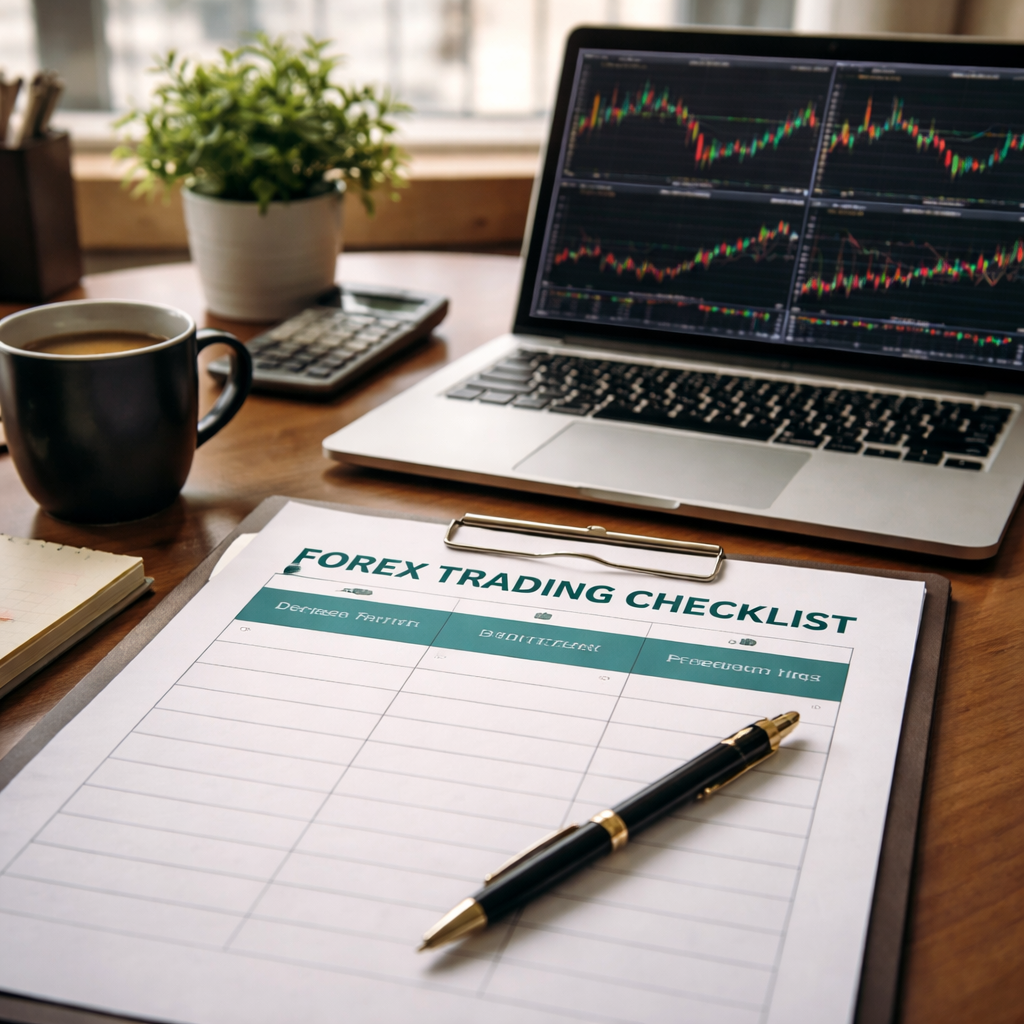
Let me be honest: when you first open a forex platform, the flood of charts, news, and numbers can feel overwhelming. Ever wondered why some traders seem to glide through the chaos while you’re still hunting for the right entry? That’s where a solid checklist steps in.
A forex trading checklist pdf is essentially a printable cheat‑sheet that captures the exact steps you need to run before, during, and after each trade. It forces you to pause, think, and verify—no more “I‑just‑felt‑it‑was‑right” moments. Imagine having a single page that asks, “Did I size my position according to my risk tolerance?” and “Have I checked the economic calendar for upcoming releases?” before you click “buy”.
For aspiring traders learning the fundamentals, the checklist often starts with market‑session awareness—knowing whether you’re in the London, New York, or Asian overlap. Then it moves to technical‑analysis basics: are you seeing a clear trend, is support holding, and does the candlestick pattern confirm your bias? By ticking these boxes you turn intuition into a repeatable process.
Experienced traders use the same idea but add layers like multi‑timeframe confluence, risk‑reward ratio verification, and a quick mental review of trade psychology (“Am I feeling overconfident?”). A well‑designed pdf lets you skim those items in seconds, even when you’re glued to a fast‑moving chart.
And here’s a practical tip: download a blank template, print it, and keep it beside your monitor. When a potential setup appears, run through the list line‑by‑line. If any box stays unchecked, walk away. This simple habit can shave off impulsive trades that drain your account over time.
At FX Doctor we’ve seen dozens of students adopt a checklist and notice a steadier equity curve within weeks. It’s not magic—just discipline captured on paper. The real power comes from consistency: every trade, good or bad, gets the same scrutiny.
So, what’s the next step? Grab a forex trading checklist pdf, personalise the sections that matter to your style, and start treating each trade like a small experiment. You’ll soon discover that the checklist becomes a trusted co‑pilot, guiding you through the noise and keeping you focused on what truly matters.
TL;DR
A well‑crafted forex trading checklist pdf lets you pause, verify every trade step, and keep emotions out of the decision‑making process, so you trade with clear logic instead of guesswork.
Download the printable template, place it beside your monitor, and run through each item before you click “buy” – you’ll quickly notice tighter risk control, steadier equity, and more confidence in every setup.
Step 1: Define Your Trading Goals
Before you ever open a chart, ask yourself what you actually want to get out of trading. Are you looking to grow a modest side‑income, preserve capital for a future purchase, or simply sharpen your analytical muscles? Pinning that down feels a bit like writing a personal mission statement, but it’s the foundation of every checklist item you’ll later tick.
Imagine you’re planning a road trip. You wouldn’t just hop in the car without a destination, right? The same logic applies to forex. Your goal sets the route, the stops, and the fuel budget.
Once you have a clear objective, break it into three bite‑size parts: profit target, risk tolerance, and time horizon. For example, a beginner might aim for a 2 % monthly return while never risking more than 1 % of account equity on a single trade. An experienced trader could target a 10 % quarterly gain with a tighter 0.5 % per‑trade risk because they have a larger capital base.
Why does this matter for a forex trading checklist pdf? Every box you check should tie back to one of those three pillars. If a potential setup doesn’t fit your risk profile, the checklist will flag it and you’ll walk away before you even think about the entry price.
Here’s a quick way to capture those goals on paper: open a fresh page in your checklist PDF and create three columns – Desired Return, Maximum Risk, and Trade Frequency. Fill them in, then refer back each time you scan a chart. It’s a tiny habit that keeps emotions in check.
And don’t forget to revisit those numbers regularly. Markets change, your capital grows, and life circumstances evolve. A quarterly review session – maybe while sipping your morning coffee – is a perfect moment to adjust the figures.
Now, let’s talk about turning goals into a concrete plan. A solid Forex Trading Plan Example PDF: A Step‑by‑Step Guide for Beginners walks you through the exact steps to align your checklist with your personal objectives. Think of it as the blueprint that turns “I want to grow my account” into “I will risk no more than 1 % per trade, aim for a 2 % monthly gain, and review weekly.”
For many aspiring traders, the biggest hurdle isn’t the market – it’s staying disciplined long enough to follow the plan. That’s where time‑blocking can help. The Pomodoro schedule for teachers classroom guide, although aimed at educators, offers a simple 25‑minute focus burst that works great for analysis sessions. Set a timer, review your goals, run through the checklist, and then take a short break. You’ll notice the mental clutter fade away.
Once your trades are logged, you might want to share insights with a community or on social media. Automating those posts saves time and keeps your brand consistent. Check out the best social media automation tools to schedule updates about your trade outcomes without breaking your focus.
If you’re curious about diversifying income streams while you trade, you might also explore investing in mortgage notes. The practical step‑by‑step guide to investing in mortgage notes explains the basics and could complement your forex earnings.
To recap, defining your trading goals is more than a box to tick – it’s the compass that keeps your checklist pointing north. Write them down, quantify them, and revisit them often. When your goals are crystal clear, the rest of the checklist becomes a simple, almost automatic, confirmation process.
Ready to put this into practice? Grab a printable version of the forex trading checklist PDF, fill in the goal section, and start your next analysis session with a purpose.
By anchoring every trade to a well‑defined objective, you’ll find yourself making fewer impulsive decisions and more confident, data‑driven moves.
Step 2: Identify Market Conditions and Instruments
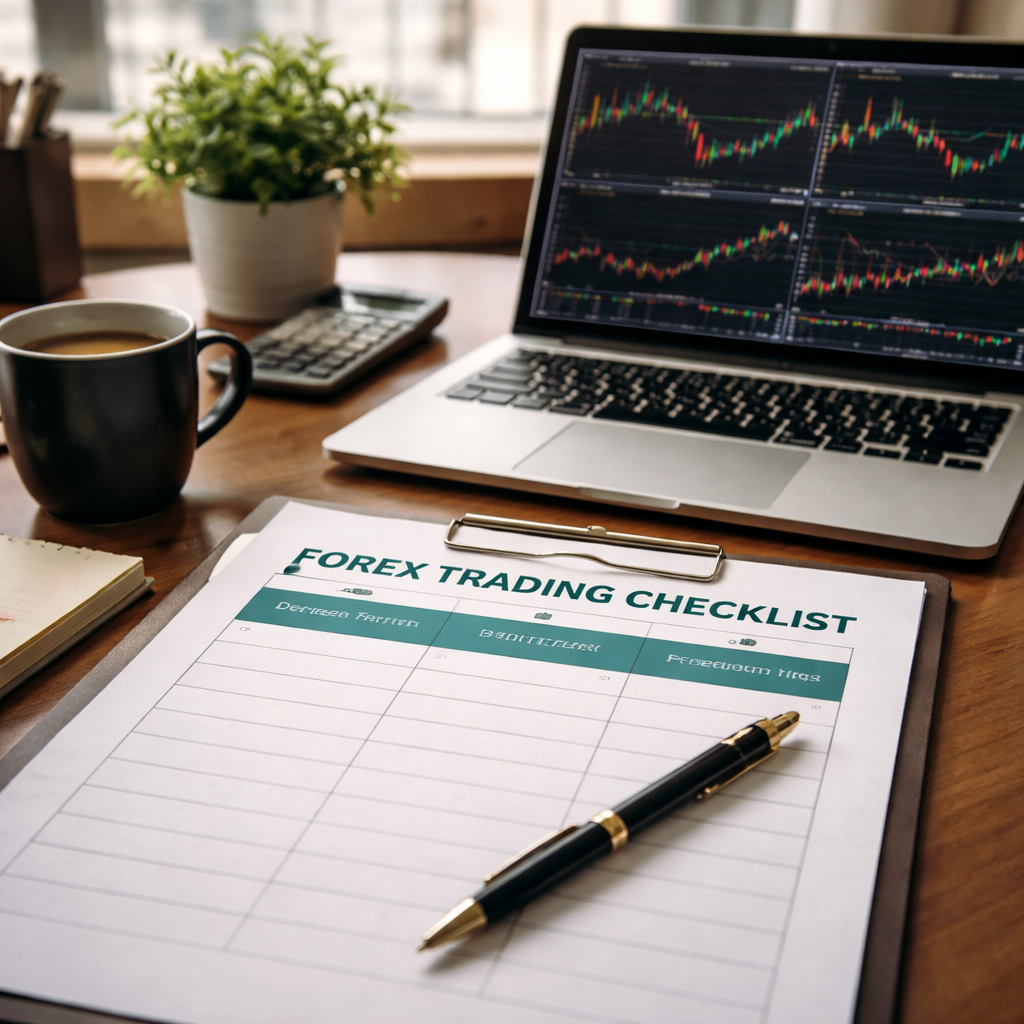
Before you even open a chart, take a breath and ask yourself: what’s actually happening in the market right now? The whole point of a forex trading checklist pdf is to force you to pause, scan the environment, and only then consider a trade.
Know the session you’re in
Forex moves in three big waves – the Asian, European (London) and North‑American (New York) sessions. Each brings its own liquidity, news flow, and typical price behaviour. If you’re trading the EUR/USD during the London‑New York overlap, you’ll see tighter spreads and more momentum than you would in the quiet Asian hours.
Put a simple checkbox in your pdf: “Is the current session the one that favours this pair?” If the answer is “no,” you might skip the setup altogether.
Spot the prevailing market condition
Markets swing between trending, ranging and volatile states. A quick visual scan – look at the last 20‑30 candles – can tell you which regime you’re in. Trending? You’ll see higher highs and higher lows (or the opposite). Ranging? The price bounces between clear support and resistance. Volatile? You get big wicks and erratic moves.
Add another line to your checklist: “Is the market trending, ranging, or choppy?” Then match your strategy to that condition. A breakout plan works in volatility, while a pull‑back entry makes sense in a clean trend.
Choose the right instrument for the condition
Not every currency pair behaves the same. Majors like GBP/USD or USD/JPY have deep liquidity and respond predictably to macro news. Exotics or cross‑pairs can be thin‑filled and swing wildly on a single data point.
Ask yourself: “Does this pair suit the current condition?” If you’re in a low‑liquidity environment, you might prefer a major pair that won’t get you stopped out by a thin order book.
Check the economic calendar
High‑impact releases – interest‑rate decisions, CPI, employment numbers – can flip market conditions in minutes. A good forex trading checklist pdf always has a reminder to glance at the calendar before you lock in a trade.
Typical checkbox: “Any high‑impact news within the next 30 minutes?” If yes, consider delaying or tightening your stop‑loss.
Instrument‑specific factors
- Spread: Wider spreads eat into your risk‑reward. Major pairs usually have sub‑penny spreads, while minors can be a few pips higher.
- Swap/rollover: If you plan to hold overnight, check the swap rate for the pair. Some brokers charge a fee that can erode a small profit.
- Trading hours: Some pairs are thin outside their primary session. A quick “Is the market open for this pair?” tick can save you from unexpected slippage.
All of these items belong in the same “Market Conditions & Instruments” section of your checklist. When you see them together, you get a clear picture of whether the trade environment matches your plan.
Putting it all together
Here’s a quick five‑step routine you can run through in a single Pomodoro sprint:
- Identify the current session (Asian, London, New York).
- Determine if the market is trending, ranging, or volatile.
- Match the currency pair to the condition – majors for low liquidity, exotics only if you understand the risk.
- Check the economic calendar for imminent news.
- Validate spread, swap and trading‑hour considerations.
If any box stays unchecked, the safest move is to step back and wait for a clearer setup. That discipline is the real power behind a well‑designed forex trading checklist pdf.
Step 3: Risk Management Parameters
Let’s be straight: risk management isn’t a tease or a nice-to-have. It’s the backbone of sustainable trading. Without solid risk controls, every win gets eaten by a bigger loss down the line.
So, what exactly goes into the risk management parameters of a forex trading checklist pdf? We’ll lay it out in practical terms you can apply in your next trade.
Set your maximum risk per trade
A simple starting rule is to risk a fixed percentage of your account on each trade. Common ranges are 0.5% to 2% depending on experience, account size, and comfort with drawdowns. The key is consistency—pick a number you can live with even after a string of losses.
For example, with a $5,000 account, a 1% risk per trade means you’re willing to lose $50 on a single setup. That sounds stingy, but it forces you to choose tighter stops or smaller positions rather than chasing big moves you can’t defend. Do you have that discipline?
Calculate position size based on risk
Position sizing is where math meets psychology. You’ll need three things: your risk per trade, the stop‑loss distance in pips, and the pip value for your chosen lot size. Pip value varies by instrument and lot size, but here’s the intuition you can apply right away.
Take EUR/USD as an example. A micro‑lot (1,000 units) often yields about $0.10 per pip. If your stop is 25 pips away, the risk per micro‑lot is roughly 25 × $0.10 = $2.50. To keep your $50 risk, you’d size up to about 20 micro‑lots (20 × $2.50 = $50). That translates to roughly 0.20 mini‑lots or 0.02 standard lots, depending on your broker’s labeling. The exact numbers vary, but the framework stays the same: risk per trade = stop distance × pip value × position size. Adjust your size until that product matches your risk budget.
Does that make sense? It’s not magic; it’s a math check you perform before you click. If your broker uses different pip definitions, adjust the arithmetic accordingly.
Stop‑loss placement and volatility awareness
Stops should reflect market noise, not just a random price point. A popular approach is to set stops beyond obvious liquidity zones or swing highs/lows, but not so far that you’re inviting a larger loss than your risk budget allows. Use volatility as a guide—ATR (average true range) or a similar measure often helps you avoid stops that are too tight or too loose.
- Place stops where the chart structure suggests buyers or sellers might actually overwhelm a move.
- Aim for a reward that’s at least 1.5–2 times your risk, if not more, to keep the math favorable over many trades.
In our experience, many traders over‑risk because their stops are placed at obvious levels rather than at logical ones tied to volatility. Are you basing stops on context, not just a number on the chart?
Account‑level risk and drawdown discipline
Don’t let a bad week erase months of progress. Set caps for daily and weekly drawdown. For example, cap daily losses at 2% of the account and weekly losses at 5%. If you hit those marks, step back, review, and resume only when you’re back in a calmer space. This keeps emotions from driving revenge trades and helps you preserve equity over time.
Trade sequencing and psychology
Think of risk management as a sequence: define risk per trade, size your position, place a stop that respects volatility, and watch your overall risk budget. If you’re tempted to chase a high‑volatility breakout after a string of losses, pause. Do you really understand the setup, or are you trying to recoup losses?
To make this practical, keep a simple risk log. Note your risk per trade, size, stop distance, and outcome. Over time, patterns emerge—you’ll see what works and what doesn’t, which is exactly what you want from a forex trading checklist pdf.
Two quick resources to deepen your practice
For a structured, field‑tested approach to checklists, see this trusted guide: Trading checklist. It reinforces the idea of documenting each risk parameter before you act.
Another solid reference to print and annotate is the same comprehensive checklist page, which you can access here: Trading checklist.
In short: define risk, size smart, respect volatility, guard your capital, and log every move. With these steps, your forex trading checklist pdf becomes a real co‑pilot, not a vague ideal.
Step 4: Execution Checklist and Order Types
Alright, you’ve already nailed your goals, market conditions, and risk parameters. The next piece of the puzzle is actually getting the trade on the screen – and making sure you do it with a clear, repeatable process. That’s where the execution part of your forex trading checklist pdf shines.
Why a dedicated execution checklist matters
Imagine you’re about to place a trade, but you’re distracted by a notification, a coffee spill, or a sudden news flash. Without a quick, visual reminder you might forget to verify a crucial detail – like the order type or the exact lot size. A few seconds of extra focus can mean the difference between a tidy risk‑reward ratio and a costly slip.
We’ve seen aspiring traders skip the “order type” step and end up with market orders that get filled at a wildly different price during a news spike. The result? The trade looks perfect on paper, but the execution cost eats the profit before you even notice.
Step‑by‑step execution checklist
Here’s a bite‑size routine you can copy into your forex trading checklist pdf. Run it right after you’ve confirmed your setup and before you click “buy” or “sell”.
- Confirm the pair and timeframe you analysed.
- Check the current spread – is it within your acceptable range?
- Choose the order type that matches the market condition (see table below).
- Enter the exact position size from your risk calculation.
- Set stop‑loss and take‑profit levels based on volatility.
- Double‑check that the order ticket reflects all numbers correctly.
- Press “Submit” and immediately note the execution price in your journal.
Sounds a bit like a ritual, but that’s the point: you turn a potentially chaotic moment into a calm, methodical one.
Order types you’ll encounter
Not every order works in every market state. Below is a quick guide that pairs the most common order types with typical scenarios. Use the “Checklist Item” column to add a tick box to your PDF.
| Order Type | Typical Use | Checklist Item |
|---|---|---|
| Market Order | Fast execution when you trust the current price and volatility is low. | ✓ Verify spread < 2 pips |
| Limit Order | Enter at a predefined price during ranging or choppy markets. | ✓ Set desired entry price and confirm it’s within support/resistance zone |
| Stop Order | Breakout entries when price crosses a key level; also useful for stop‑loss placement. | ✓ Confirm stop distance aligns with ATR‑based volatility measure |
Do you see the pattern? Each order type has a specific market condition, and each condition has a corresponding checkbox. When the box stays unchecked, you either adjust the order type or wait for a clearer setup.
Putting the execution checklist into your PDF
Open your existing forex trading checklist pdf and add a new section titled “Execution”. Below the heading, list the seven‑step routine as bullet points, then insert the table above. You can print it on a separate sheet and keep it next to your monitor – the visual cue makes it hard to skip.
One tip many of our students forget: after you hit “Submit”, glance at the order confirmation screen for at least three seconds. Make sure the filled‑in price matches the one you expected. If there’s a slippage beyond your tolerance, cancel and reassess – it’s better to lose a few seconds than a few pips.
Common pitfalls and how to avoid them
Ever placed a market order during a high‑impact news release and watched the price jump 20 pips in a flash? That’s a classic execution error. The fix is simple: add a checklist row that says “Is any high‑impact news within the next 5 minutes?” If yes, either switch to a limit order or wait until the volatility settles.
Another trap is forgetting to adjust the lot size after a partial fill. Your risk calculation assumes a full fill, but a partial fill changes the exposure. Include a line in the checklist: “Did the trade fill fully? If not, recalc risk before proceeding.”
By treating execution as a separate, documented step, you remove the “gut‑feel” element that often leads to costly mistakes.
Quick recap
Take a breath, run through the execution checklist, pick the right order type, double‑check every field, and log the result. It feels a little extra at first, but after a few weeks the process becomes second nature – and your trade journal will start showing tighter entry‑exit spreads and fewer surprise slippages.
Step 5: Review, Journal, and Continuous Improvement
After you’ve hit “submit” and the trade is sitting on the chart, the real learning starts. Most traders think the trade is over once the position is open, but the truth is the opposite – the post‑trade review is where you turn a single tick into a habit.
Do you ever finish a session and feel like you’ve just chased a feeling, not a plan? That’s a signal you need a structured review. It’s not about blaming yourself; it’s about pulling concrete data out of the fog.
Why review matters
A forex trading checklist pdf is only as good as the feedback loop behind it. When you write down what happened, you create a mirror that reflects both the good and the sloppy parts of your process. Over weeks, those mirrors line up and show you patterns you’d otherwise miss.
Think of it like a sports replay. You watch the game, then you break down each play to see where the defense broke down or where the offense shone. In trading, the “replay” is your journal entry.
Building a quick post‑trade journal
Keep the journal entry under two minutes. If it takes longer, you’ll skip it. Here’s a minimal template you can paste into any notebook or PDF:
- Trade ID / Date / Pair
- Entry price, stop‑loss, take‑profit (what you actually set)
- Reason for entry – which checklist boxes were ticked?
- Actual outcome – hit SL, TP, or closed early?
- Emotion check – “felt confident”, “got nervous”, “was distracted?”
When you fill this out right after the trade, the details are fresh and the emotional snapshot is accurate.

Now, why does that tiny emotion line matter? Because research shows that emotional spikes often precede sloppy execution. By labeling “got nervous” you give yourself a data point to match later against win‑loss ratios.
Spotting patterns for improvement
Every week, pull your journal entries into a simple spreadsheet. Add columns for “missed checklist item” and “result”. If you see three “missed stop‑loss check” notes and all three ended in a loss, that’s a red flag.
Do you notice a recurring “over‑sized position” comment? That tells you your position‑size calculator isn’t being respected. The key is to look for clusters, not isolated incidents.
Ask yourself: “What did I do differently on the trades that worked?” and “Which checklist steps were consistently ignored on the losers?” This questioning turns raw data into actionable insight.
Turning insights into checklist upgrades
Once you’ve identified a weak spot, add a new row to your forex trading checklist pdf. For example, if you keep forgetting to verify the spread, insert a box that reads “Spread ≤ 2 pips?” right before you hit submit.
Make the new item concrete and test it for a week. If the loss rate drops, you’ve just closed a feedback loop. If it doesn’t, iterate – maybe the threshold needs tweaking or you need a separate “high‑impact news” box.
Continuous improvement isn’t a one‑off project; it’s a habit. Treat the checklist as a living document that evolves with your experience. Each month, skim through the added rows and prune anything that feels redundant.
So, what’s the next move? Grab a pen, open your journal, and record the last trade you made. Highlight any checklist step you skipped. Then, update your pdf with a new box that catches that gap. Rinse, repeat, and watch your trade journal become a roadmap rather than a diary of random events.
Conclusion
So you’ve built a forex trading checklist pdf, tweaked it a few times, and started using it every day. If you’re wondering whether all that effort really matters, think about the last trade you skipped because a box was unchecked. That tiny pause probably saved you a handful of pips.
What we’ve seen at FX Doctor is that the most consistent traders treat the checklist like a living notebook – they add, prune, and revisit it each month. The habit of writing down each step turns vague intuition into something you can actually measure.
Ready to make the next move? Grab a fresh sheet, print your current checklist, and spend five minutes marking any gaps you noticed in the past week. Then, add a concrete row – maybe “Spread ≤ 2 pips?” or “High‑impact news within 30 min?” – and stick it on your monitor.
Remember, the checklist isn’t a magic wand; it’s a disciplined routine that keeps emotions in check and forces you to ask the right questions before you click. Over time those questions become second nature.
Give it a try today and watch how a simple PDF can turn a chaotic trading session into a clear, repeatable process. Your future self will thank you.
Frequently Asked Questions
What exactly is a forex trading checklist pdf and why should I use one?
A forex trading checklist pdf is a printable one‑page document that lists every step you need to verify before, during, and after a trade. It forces you to pause, look at market conditions, confirm risk parameters, and lock in your execution plan. By turning intuition into a repeatable routine, the checklist helps you avoid missed steps that can cost pips and keeps emotions from hijacking decisions.
How often should I update my checklist?
Treat your checklist like a living notebook. Review it at the end of each week, add rows for anything you missed, and prune items that no longer add value. Many traders find a monthly deep‑dive useful: compare your journal notes, spot patterns, then tweak the PDF accordingly. The goal is to keep it lean yet comprehensive enough to catch new market quirks as your style evolves.
Can a checklist work for both beginners and experienced traders?
Absolutely. Beginners benefit from the structure – it turns a chaotic first‑trade experience into a step‑by‑step ritual. Experienced traders use the same framework but add layers like multi‑timeframe confluence or specific news‑impact checks. The core idea stays the same: a concise list that forces you to validate every assumption before you click “buy” or “sell”.
What are the essential sections every forex trading checklist pdf should have?
Start with market‑session awareness, then add a quick market‑condition filter (trending, ranging, volatile). Follow with instrument‑specific checks – spread, swap, liquidity. Next, insert risk‑management items: position size, stop‑loss distance, risk‑per‑trade %). Finally, include execution steps – order type, entry price, confirmation of numbers – and a post‑trade journal prompt. Keep each row to a single checkbox for speed.
How do I avoid “checkbox fatigue” when the list gets long?
Keep the PDF to one page if possible. Group related items under clear sub‑headings and use visual separators so your eyes can skim. If a step feels redundant, test it for a week; if you never tick it, consider removing it. Remember, the checklist is a tool, not a bureaucratic hurdle – simplicity wins over exhaustive detail.
Is it okay to customize the checklist for different currency pairs?
Yes, tailoring matters. Major pairs like EUR/USD usually have sub‑penny spreads, so you might set a “Spread ≤ 1 pip” rule, whereas exotics may need a “Spread ≤ 3 pips” threshold. You can also add pair‑specific news filters – for GBP you’d watch the Bank of England releases, for AUD you’d watch RBA minutes. A flexible PDF lets you swap rows in and out without rewriting the whole thing.
What should I do if I consistently miss a step on the checklist?
First, note the missed item in your post‑trade journal – that creates a data point. Then, ask why it slipped: was the market too fast, or did the layout hide the box? Adjust the PDF’s visual hierarchy or add a reminder row like “Did I verify spread?” If the problem persists, consider a pre‑trade timer (e.g., a 30‑second pause) to force a quick scan before you act.
Additional Resources
If you’re still looking for a little extra boost after building your own forex trading checklist pdf, you’re not alone – most traders keep a stash of go‑to references.
First, grab the free template we share on FX Doctor. It’s a one‑page PDF you can edit in any program, pre‑filled with the essential sections we covered: market session, risk limits, execution steps, and post‑trade journal prompts. Plug your numbers, print it, and keep it beside your monitor.
Second, consider joining a trader‑focused forum or Discord community where members post their checklist screenshots. Seeing how others arrange the same boxes can spark ideas for visual hierarchy, colour‑coding, or even a quick “pre‑trade timer” reminder.
Third, a few well‑written books still stand the test of time. “Trading in the Zone” by Mark Douglas dives deep into the psychology behind checklist discipline, while “The Art of Currency Trading” offers concrete examples of spread and news‑filter checks.
Finally, don’t forget to revisit the economic calendar regularly – a reliable source like the official central‑bank releases page ensures you never miss a high‑impact event that would invalidate a checklist item.
Pick one or two of these resources, try them out this week, and see how much smoother your pre‑trade routine feels. Your next trade could be the proof that a tiny extra step makes a big difference.