
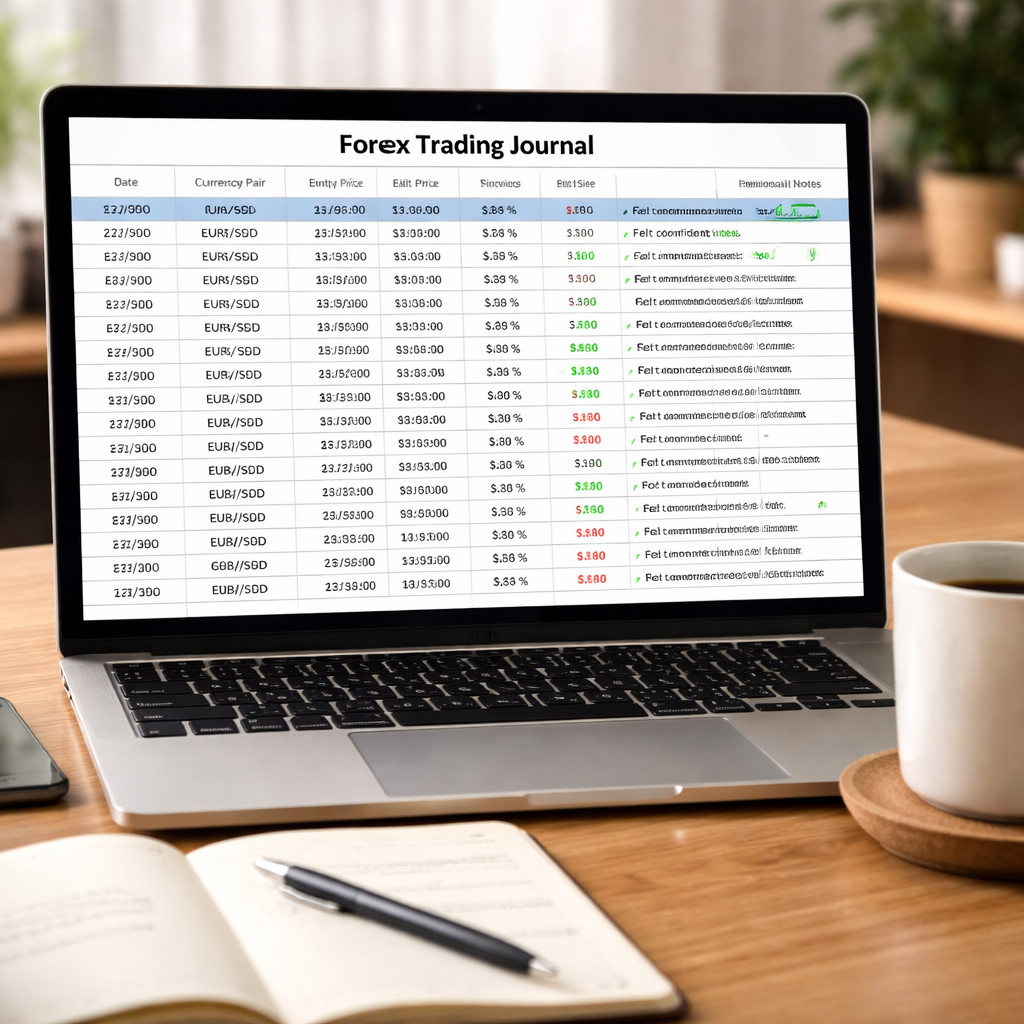
Overtrading destroys more forex accounts than any single mistake. It’s the silent killer that turns profitable strategies into losing streaks. We examined 16 checklist items from two leading forex education sites and discovered that none of them set hard numeric trade‑or‑risk limits, while only 19% provide concrete numeric examples.
| Name | Description | Source |
|---|---|---|
| Implement a risk‑management plan with defined risk per trade | A risk management plan is needed as part of your trading strategy. It can range from 1% to 10% for traders who are willing to take on a high level of risk. However, if you gamble as high as 10%, it can only take five trades to lose 50% of your trading capital. | the5ers.com |
| Avoid over‑trading after a loss or during a losing streak | Traders typically overtrade after suffering a large loss or a series of smaller losses during a generally long‑losing streak. To cover their losses or seek “revenge” on the market, they try harder to make up profits wherever they can, usually by raising their trades’ size and volume. | the5ers.com |
| Set a limit on the number of trades you open in a single day | Set a limit on the number of trades you want to open in a single day. Keep up with this plan, and if you feel like opening one more trade, remind yourself that there is always tomorrow. | the5ers.com |
| Add strict entry rules (e.g., moving‑average crossover) to avoid impulsive trades | Adding rules to enter a trade will help you avoid putting orders that are not in line with your trading strategy. For instance, you may make a rule that encourages you to trade only if the 50‑day moving average crossed over the 200‑day moving average. | the5ers.com |
| Develop a trading strategy and schedule ahead of time | It is best to go on the offensive against over‑trading by developing a trading strategy and a trading schedule ahead of time. | the5ers.com |
| Use a systematic forex trading strategy and stick to it | The only way to fight this battle is to devise and stick to a systematic forex trading strategy. | the5ers.com |
| Take breaks when emotions run high to prevent revenge trading | It is a safer option to take a break to clear the head. While doing so, your rage over the recent loss will subside, allowing you to think more clearly and conduct trades more rationally. | the5ers.com |
| Write a one-page trading plan | Create a one-page plan that answers three questions: what market and session you trade, the setup trigger, stop placement, target, risk per trade and daily stop limit, and a cooldown protocol if a rule is broken. | tradelocker.com |
| Pre‑trade checklist questions | Before placing any order, answer questions honestly about why you’re trading, whether you’re trying to make back money, what could move price today, if you have a clear entry trigger, invalidation level, exit plan, and if the trade fits your daily risk limits. | tradelocker.com |
| Set a maximum number of trades per day or session | Put friction between you and impulsive trades by limiting the number of trades you can take each day or session, helping prevent overtrading. | tradelocker.com |
| Set a max daily loss limit | Define a daily loss guardrail and stop trading once that loss threshold is reached, ensuring you don’t keep trading after a bad loss. | tradelocker.com |
| Tie position size to a fixed risk rule | Determine position size based on a consistent percentage of account equity risked per trade, matching stop distance to the amount you’re willing to lose. | tradelocker.com |
| Set a personal leverage cap | Establish a personal limit on leverage usage and treat it as a safety limit, reducing the impact of large position sizes during volatile moves. | tradelocker.com |
| Use trailing stop loss to protect gains | Apply a trailing stop loss to lock in profits as the market moves in your favor, reducing the need to monitor every tick. | tradelocker.com |
| Keep a minimum viable journal | Record entry, exit, screenshot, setup type, rule adherence, and a simple emotion label for each trade, then review weekly to spot patterns and enforce rules. | tradelocker.com |
This research reveals a critical gap in most trading advice. While behavioral controls are important, traders need concrete numeric limits to truly prevent overtrading. You’ll learn exactly how to avoid overtrading in forex by implementing seven practical steps that combine behavioral discipline with hard numeric caps.
Step 1: Define Your Trading Goals and Limits
Most traders jump into forex without clear boundaries. This creates the perfect setup for overtrading. When you don’t know what you’re trying to achieve, every market move looks like an opportunity.
Start with your financial goals. Don’t aim for unrealistic returns. A professional approach targets 10-20% annual returns, not 100% monthly gains. Setting proper trading goals requires understanding that consistent small gains compound into significant profits over time.
Define your risk tolerance in concrete terms. Most successful traders risk 1-2% of their account per trade. If you have a $10,000 account, your maximum loss per trade should be $100-200. This isn’t just theory. It’s a hard limit that prevents catastrophic losses.
Set time-based limits too. Decide how many hours per day you’ll spend trading. Many traders think more screen time equals more profits. Wrong. Quality beats quantity. Professional traders often limit themselves to 2-4 hours of active trading per day.
Create specific criteria for entering trades. Don’t trade on hunches or emotions. Write down exactly what conditions must be met before you place an order. For example: “I only trade EUR/USD when the 50-day moving average crosses above the 200-day average, and RSI is below 70.”
Document your profit targets. Know when to take profits and when to let trades run. Many traders hold losing positions too long and cut winning positions too short. Set clear rules like: “I’ll take 50% profits at 2:1 risk-reward and let the rest run with a trailing stop.”
Review your goals monthly. Markets change, and your goals should adapt. But don’t change them mid-trade or during losing streaks. That’s emotional decision-making, not strategic planning. Effective risk management strategies require consistent application over time.
Step 2: Track Every Trade with a Journal
A trading journal is your best defense against overtrading. It creates accountability and reveals patterns you can’t see in real-time. Without tracking, you’re flying blind.
Record these details for every trade: entry price, exit price, position size, risk amount, reason for entry, market conditions, and your emotional state. Don’t skip trades because they were “small” or “quick.” Every trade matters for pattern recognition.
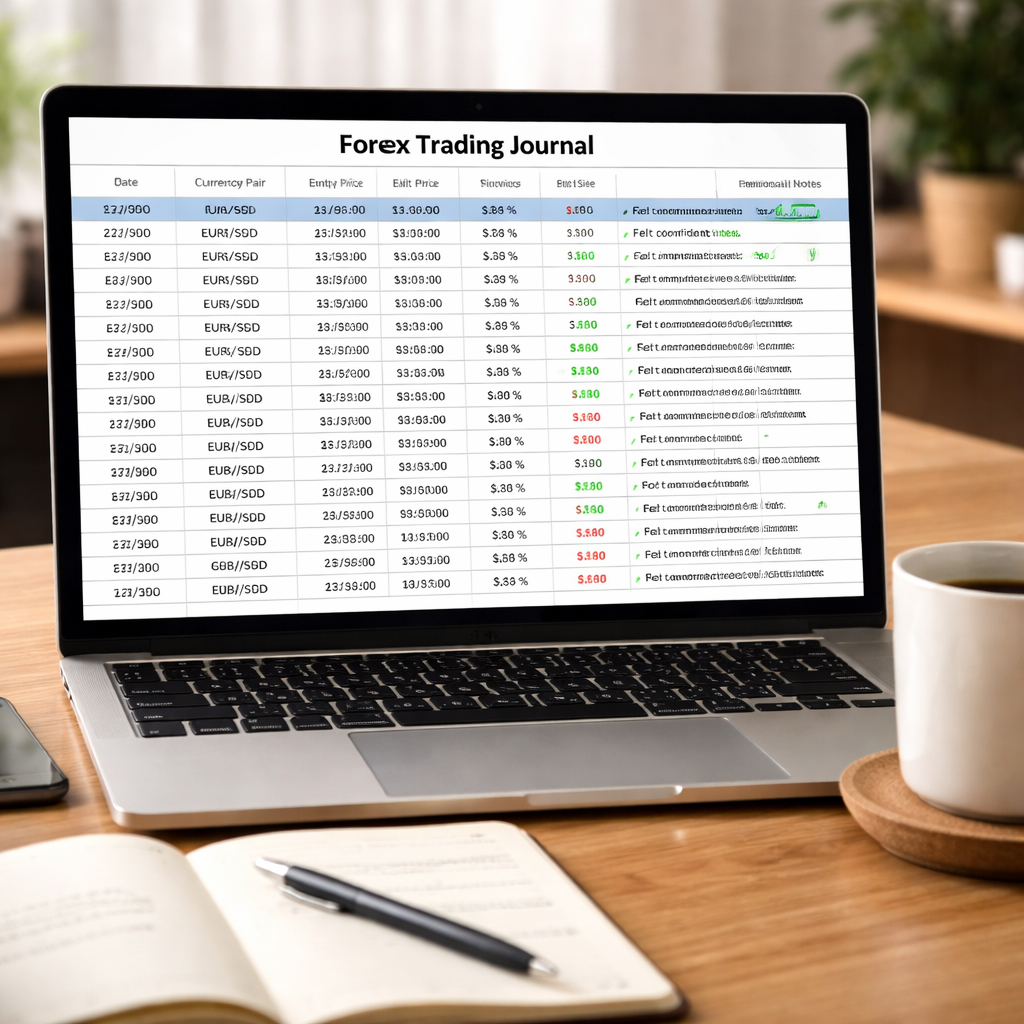
Track your trade frequency daily. Count how many trades you place each day and compare it to your predetermined limits. If you planned for 3 trades per day but consistently place 8, you’re overtrading. The numbers don’t lie.
Note your win rate and average risk-reward ratio. These metrics reveal the quality of your trades. If your win rate drops while trade frequency increases, you’re likely taking lower-quality setups. Quality deterioration is a classic overtrading symptom.
Document your emotional state before, during, and after trades. Use simple labels: calm, excited, frustrated, fearful, or confident. Overtrading often correlates with specific emotional states. You might discover you overtrade when frustrated or overly confident.
Review your journal weekly. Look for patterns in your losing trades. Do they cluster around certain times of day? After big wins or losses? During specific market conditions? These patterns reveal your overtrading triggers.
Calculate your transaction costs. Every trade costs money through spreads and commissions. If you place 20 trades per day instead of 5, you’re paying four times more in transaction costs. Overtrading increases operational costs and reduces net profits even when individual trades are profitable.
Use your journal to identify your most profitable trading times and conditions. Focus your efforts on these high-probability periods. This natural filtering reduces trade frequency while improving results.
Step 3: Apply Position‑Sizing Rules
Position sizing is your primary tool to avoid overtrading in forex. When you risk the same amount on every trade, you remove the temptation to “make up” losses with bigger positions.
Use the 2% rule as your foundation. Never risk more than 2% of your account on a single trade. With a $5,000 account, your maximum loss per trade is $100. This rule alone prevents account-destroying mistakes.
Calculate position size based on your stop-loss distance, not your gut feeling. If your stop-loss is 50 pips away and you’re risking $100, your position size should be $2 per pip (for a standard lot). The math determines position size, not emotions.
Avoid the martingale trap. Never double your position size after a loss. This violates basic risk management and leads to catastrophic losses. Stick to your predetermined risk amount regardless of previous results.
Use anti-martingale principles instead. Some traders reduce position sizes after losses and increase them after wins. This approach aligns with the psychological reality that winning streaks and losing streaks tend to cluster.
Set maximum daily risk limits. Even with proper position sizing, multiple 2% losses in one day can damage your account. Limit your total daily risk to 6-8% of your account. After hitting this limit, stop trading for the day.
Consider correlation when sizing positions. Don’t risk 2% on EUR/USD and another 2% on GBP/USD simultaneously. These pairs often move together, creating hidden correlation risk. Your combined exposure might exceed your risk tolerance.
Professional risk management techniques emphasize that position sizing is more important than entry timing. You can be wrong about market direction and still preserve capital with proper position sizing.
Review your position sizing weekly. Are you consistently using your full 2% allocation, or are you taking smaller positions? Undersized positions might indicate fear, while oversized positions suggest greed or desperation.
Step 4: Monitor Trade Frequency with a Checklist
A pre-trade checklist acts as a circuit breaker for overtrading. It forces you to pause and evaluate each potential trade objectively. This simple tool can save you from countless impulsive decisions.
Create a checklist with 5-10 specific criteria that must be met before placing any trade. Include technical conditions, fundamental factors, risk parameters, and emotional state checks. Don’t trade unless every item is satisfied.
| Checklist Item | Yes/No | Details |
|---|---|---|
| Clear trend direction identified? | □ | Specify timeframe and trend strength |
| Entry trigger present? | □ | Name specific pattern or signal |
| Stop-loss level defined? | □ | Exact price and pip distance |
| Risk within 2% limit? | □ | Dollar amount and position size |
| Profit target realistic? | □ | Risk-reward ratio calculated |
| Economic events checked? | □ | High-impact news in next 4 hours? |
| Emotional state neutral? | □ | Not seeking revenge or overconfident |
| Daily trade limit available? | □ | Trades remaining for today |
Time your checklist completion. If you rush through it in under 2 minutes, you’re probably not being thorough. A proper evaluation should take 3-5 minutes. This time investment prevents costly mistakes.
Track your checklist compliance. Note how many items you satisfied for each trade and the trade outcome. You might discover that trades with higher checklist scores perform better than those where you skipped items.
Include market session awareness in your checklist. Different sessions have different characteristics. The London-New York overlap offers high liquidity but also increased volatility. The Asian session might offer cleaner trends but lower volatility.
Add a “cooling off” period to your checklist. If you just closed a trade, wait at least 15 minutes before considering the next one. This prevents emotional chain-trading where one trade immediately leads to another.
Review and update your checklist monthly. As you gain experience, you might identify new criteria that improve trade quality. But don’t change it during losing streaks or winning streaks. Emotional modifications defeat the purpose.
Step 5: Set Daily/Weekly Trade Limits
Hard numeric limits are essential to avoid overtrading in forex. Without specific numbers, “I’ll trade less” becomes meaningless advice. Set concrete limits and stick to them religiously.
Start with daily trade limits. Most professional traders limit themselves to 3-5 trades per day. This forces you to be selective and wait for high-quality setups. Quality over quantity should be your mantra.
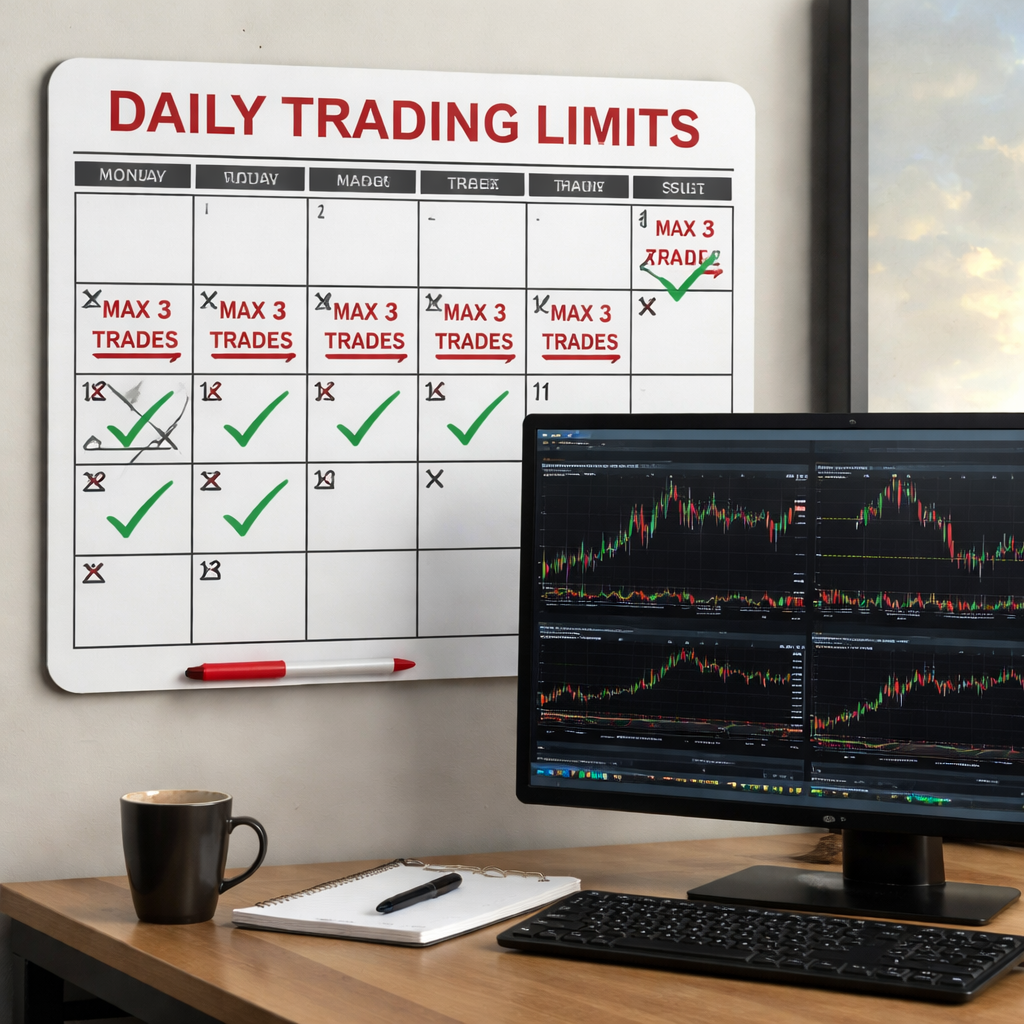
Set weekly limits too. Even if you stay within daily limits, you might still overtrade across the week. Consider limiting yourself to 15-20 trades per week maximum. This prevents the gradual creep toward higher trade frequency.
Implement session-based limits. You might allow 2 trades during the London session and 1 during New York. This prevents you from exhausting your daily limit early and missing better opportunities later.
Create loss-based circuit breakers. If you lose 3 trades in a row, stop trading for the day. Losing streaks often trigger emotional trading and revenge behavior. A mandatory break helps reset your psychological state.
Set profit-based limits too. Some traders become overconfident after big wins and start taking unnecessary risks. Consider stopping after reaching 3-4% daily profits. Preserve your gains instead of risking them on marginal trades.
Use time-based restrictions. Limit your active trading to specific hours when you’re most alert and focused. Optimal trading times vary by strategy and currency pairs, but most traders perform better during consistent hours.
Track your limit compliance daily. Note when you hit your limits and how you felt about stopping. Initial frustration is normal, but successful traders learn to appreciate these protective boundaries.
Adjust limits based on performance data, not emotions. If your win rate improves with lower trade frequency, consider reducing your limits further. Let the data guide your decisions, not your desire for action.
Step 6: Review and Adjust Your Strategy Regularly
Regular strategy reviews prevent the gradual drift toward overtrading. Without periodic evaluation, small deviations compound into major problems. Schedule reviews like important business meetings.
Conduct weekly performance reviews every Sunday. Analyze your trade frequency, win rate, average risk-reward, and emotional patterns. Look for trends that might indicate overtrading behavior developing.
Compare your actual trading to your written plan. Count how many trades exceeded your position size limits, ignored your entry criteria, or violated your risk rules. Deviations often precede overtrading episodes.
Analyze your trade quality metrics. Calculate the percentage of trades that met all your entry criteria versus those that were “marginal” or impulsive. High-quality trades should represent at least 80% of your total trades.
Review market conditions and their impact on your trading. Some strategies work better in trending markets, others in ranging conditions. Strategy backtesting techniques help identify when your approach is most effective.
Examine your emotional patterns through your trading journal. Do you overtrade after losses? During certain market conditions? After reading news? Identifying these triggers helps you prepare better responses.
Adjust your limits based on performance data. If you consistently stay within 3 trades per day and maintain good results, that limit is working. If you struggle to stay within 5 trades, consider lowering it to 4.
Consider seasonal adjustments. Market volatility changes throughout the year. Summer months often see reduced volatility, while autumn can bring increased activity. Different timeframes and market conditions may require strategy modifications.
Document all strategy changes with clear reasoning. Don’t make impulsive modifications during losing streaks or winning streaks. Wait for calm periods to make objective decisions about your approach.
Step 7: Use Alerts and Automation to Prevent Overtrading
Technology can be your ally in avoiding overtrading. Automated tools remove emotional decision-making and enforce your predetermined rules consistently.
Set up trade limit alerts on your phone or computer. When you reach your daily trade limit, receive an immediate notification. This creates a moment of pause before placing another trade.
Use position sizing calculators to automate risk calculations. Don’t rely on mental math when determining position sizes. Automated calculations eliminate errors and ensure consistency.
Configure stop-loss and take-profit orders automatically. Pre-set these levels remove the temptation to “let trades run” or move stops against you. Automation enforces discipline when emotions run high.
Set up economic calendar alerts for high-impact news events. Many overtrading episodes occur around news releases when volatility spikes. Automated alerts help you prepare or avoid trading during these periods.
Use trading platform features to limit order types or sizes. Some platforms allow you to set maximum position sizes or restrict certain order types. These built-in safeguards prevent impulsive large trades.
Create daily profit/loss alerts. When you reach predetermined profit or loss levels, receive notifications to consider stopping for the day. This prevents both overconfidence and revenge trading.
Implement time-based trading restrictions. Some platforms allow you to disable trading outside specific hours. This prevents late-night emotional trading or early morning impulsive decisions.
Use social trading tools to track your activity. Some platforms show your trading frequency compared to successful traders. This peer comparison can highlight overtrading behavior you might not notice otherwise.
Conclusion
Learning how to avoid overtrading in forex requires more than good intentions. It demands specific systems, hard limits, and consistent application. The seven steps outlined here provide a comprehensive framework for maintaining discipline and protecting your capital.
Start with clear goals and limits. Define exactly what you’re trying to achieve and how much you’re willing to risk. Without these boundaries, every market move becomes a temptation to trade.
Track everything through detailed journaling. Your trading journal reveals patterns invisible during real-time trading. Use this data to identify overtrading triggers and adjust your approach accordingly.
Apply strict position sizing rules and use checklists to filter trade opportunities. These mechanical processes remove emotion from critical decisions and ensure consistency in your approach.
Set hard numeric limits on daily and weekly trades. Remember our research finding: 0% of existing checklists specify maximum trades per day. You must create these limits yourself and enforce them religiously.
Regular strategy reviews and automated tools complete your overtrading prevention system. Technology can enforce rules when willpower fails, while periodic reviews ensure your system stays effective.
The path to consistent forex success runs through disciplined execution, not frequent trading. Master your trading psychology by implementing these systematic approaches to trade frequency management.
Start implementing these steps today. Choose one or two to focus on initially, then gradually add the others as they become habits. Your future self will thank you for the discipline you build now.
FAQ
What is overtrading in forex and why is it dangerous?
Overtrading in forex means placing too many trades without following a systematic strategy or proper risk management. It’s dangerous because it increases transaction costs, reduces trade quality, and often leads to emotional decision-making. Overtraders typically take lower-probability setups, violate their risk rules, and experience higher drawdowns. The combination of increased costs and reduced win rates creates a mathematical disadvantage that destroys accounts over time, even when individual trades might be profitable.
How many trades per day should I limit myself to avoid overtrading?
Most professional traders limit themselves to 3-5 trades per day maximum. The exact number depends on your strategy, timeframe, and experience level. Scalpers might trade more frequently but within strict time windows, while swing traders might only take 1-2 trades daily. The key is setting a specific number based on your strategy’s requirements and sticking to it. Quality matters more than quantity – it’s better to take 2 high-probability trades than 10 marginal ones.
What percentage of my account should I risk per trade to prevent overtrading?
The standard recommendation is to risk no more than 1-2% of your account per trade. This limit prevents catastrophic losses and removes the temptation to “make up” losses with larger positions. With proper position sizing, you can be wrong on 20-30 consecutive trades and still preserve most of your capital. Higher risk percentages lead to larger drawdowns, which often trigger emotional overtrading as traders attempt to recover losses quickly. Stick to 2% maximum regardless of how confident you feel about any single trade.
How can I tell if I’m overtrading without realizing it?
Track your trade frequency, win rate, and average holding time in a trading journal. Warning signs include: taking more trades than planned, decreasing win rates despite increased activity, shorter average holding times, trading outside your predetermined hours, and feeling compelled to be “in the market” constantly. Also monitor your emotional state – overtrading often correlates with frustration, boredom, or overconfidence. If your transaction costs are eating significantly into profits, you’re likely overtrading. Regular weekly reviews of these metrics will reveal patterns you miss during active trading.
Should I stop trading completely after a losing streak to avoid overtrading?
Yes, implementing circuit breakers after losing streaks is crucial for avoiding overtrading in forex. Many successful traders stop after 3 consecutive losses or reaching a daily loss limit of 6-8% of their account. This mandatory break prevents revenge trading and emotional decision-making that typically follows losses. Use this time to review your trades, identify what went wrong, and reset your psychological state. Return to trading only when you can approach the market objectively, not when you’re trying to “get even” with previous losses.
What’s the difference between active trading and overtrading?
Active trading follows a systematic approach with predetermined rules for entry, exit, position sizing, and trade frequency. Overtrading abandons these rules in favor of impulsive, emotion-driven decisions. Active traders stick to their planned number of daily trades and maintain consistent risk management. Overtraders exceed their limits, chase losses, increase position sizes after wins, and trade outside their strategy parameters. The key difference is discipline – active trading is controlled and systematic, while overtrading is reactive and chaotic. Both might involve frequent trading, but only one follows a structured approach.
Can overtrading be profitable in the short term?
Overtrading can occasionally produce short-term profits, but this success is typically unsustainable and creates dangerous behavioral patterns. High trade frequency during favorable market conditions might generate quick gains, but these periods don’t last. The increased transaction costs, reduced selectivity, and emotional decision-making associated with overtrading create long-term disadvantages that eventually outweigh temporary profits. Many traders mistake lucky streaks during overtrading periods as validation of their approach, leading to even more aggressive trading when conditions change. Sustainable profitability comes from consistent execution of a proven strategy, not from trading frequency.
How do I maintain trading discipline when markets are very volatile?
Volatile markets test your discipline the most, making it crucial to stick to your predetermined rules for avoiding overtrading in forex. Pre-set your daily trade limits and risk parameters before market open, when you’re thinking clearly. Use smaller position sizes during high volatility to maintain the same dollar risk. Set up automated alerts for your trade limits and profit/loss thresholds. Consider trading fewer currency pairs during volatile periods to reduce decision fatigue. Most importantly, remember that volatile markets will always return – you don’t need to capture every move. Missing opportunities is better than taking excessive risks that could damage your account permanently.