
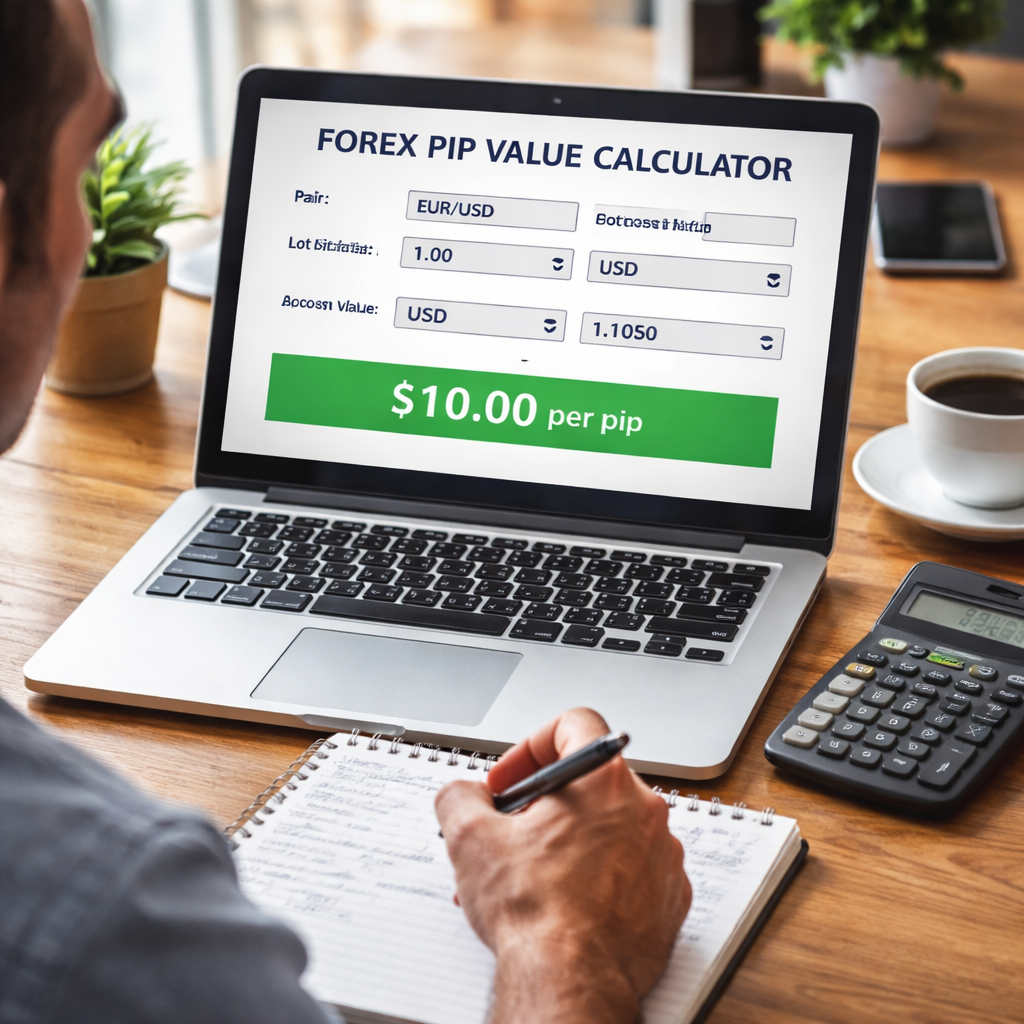
Most traders stumble on pip value before they even place a trade. It feels like a secret code you need to crack before you can measure risk.
Understanding how to calculate forex pip value is the first step to knowing how much a move costs you. It’s not magic – it’s math you can do in seconds.
Here’s the basic idea: a pip is the smallest price move a currency pair can make, usually 0.0001 for most pairs. To find its monetary worth, you need three numbers – the lot size, the exchange rate, and the pip size.
Step 1: decide your trade size. A standard lot is 100,000 units, a mini lot is 10,000, and a micro lot is 1,000. Step 2: note the current price of the pair. For EUR/USD at 1.2000, that price is your rate. Step 3: multiply the lot size by the pip size (0.0001) and then divide by the rate if the quote currency isn’t your account’s base.
For example, a 0.1 micro lot (100 units) on EUR/USD at 1.2000 gives a pip value of (100 × 0.0001) ÷ 1.2000 ≈ $0.0083. That means each pip moves your balance by less than a cent. If you trade a full standard lot, the same move is worth about $8.33 per pip.
Why does this matter? Knowing the pip value lets you size your position so a 50‑pip stop loss only risks a set percent of your account. It also helps you compare pairs where the quote currency changes, like USD/JPY where a pip is 0.01.
If you want to see how this ties into overall risk, check out our guide on How to Calculate Position Size in Forex: A Step‑by‑Step Guide. It walks you through linking pip value to stop‑loss sizing and money‑management rules.
Step 1: Understand What a Pip Is and Why It Matters
A pip is the heartbeat of every forex trade. It shows the tiniest move a pair can make.
In most pairs a pip equals 0.0001, while for JPY pairs it’s 0.01. That tiny number becomes money once you add lot size and price.
Why does it matter? Because each pip moves your account balance. Knowing the value lets you size a trade so a stop loss only risks what you’re comfortable losing.
The basic formula is simple: Pip Value = (Lot Size × Pip Size) ÷ Exchange Rate if the quote currency isn’t your account base. If it is, just multiply lot size by pip size.
Say you trade a 0.1 micro lot (100 units) on EUR/USD at 1.2000. The pip value works out to about $0.0083. A full standard lot would be roughly $8.33 per pip.
Seeing the math in action helps you avoid surprise losses.
If you like a visual calculator, Velio offers a clean online pip calculator that lets you plug in lot size and rate in seconds.
For traders who keep paper records, TableLot provides printable templates that you can fill out by hand or edit on a computer.
And when you need to print your trade journal quickly, Jiffy Print Online can ship printed pages in a day, so you can review your pip values offline.
Remember, pip values shift when you trade a pair where the quote currency isn’t USD. A quick check on a conversion tool can save you from a costly mistake.
A simple spreadsheet can do the same math; just set up columns for lot size, rate, pip size, and apply the formula.
Practice with a demo account. Seeing real‑time pip movements reinforces the numbers and builds confidence.
Once you get the hang of pip value, risk management becomes a lot less scary.
Step 2: Calculate Pip Value for Different Lot Sizes
Now that you know what a pip is, it’s time to see how the size of your trade changes its dollar worth. A pip value isn’t fixed, it grows or shrinks with the lot you pick.
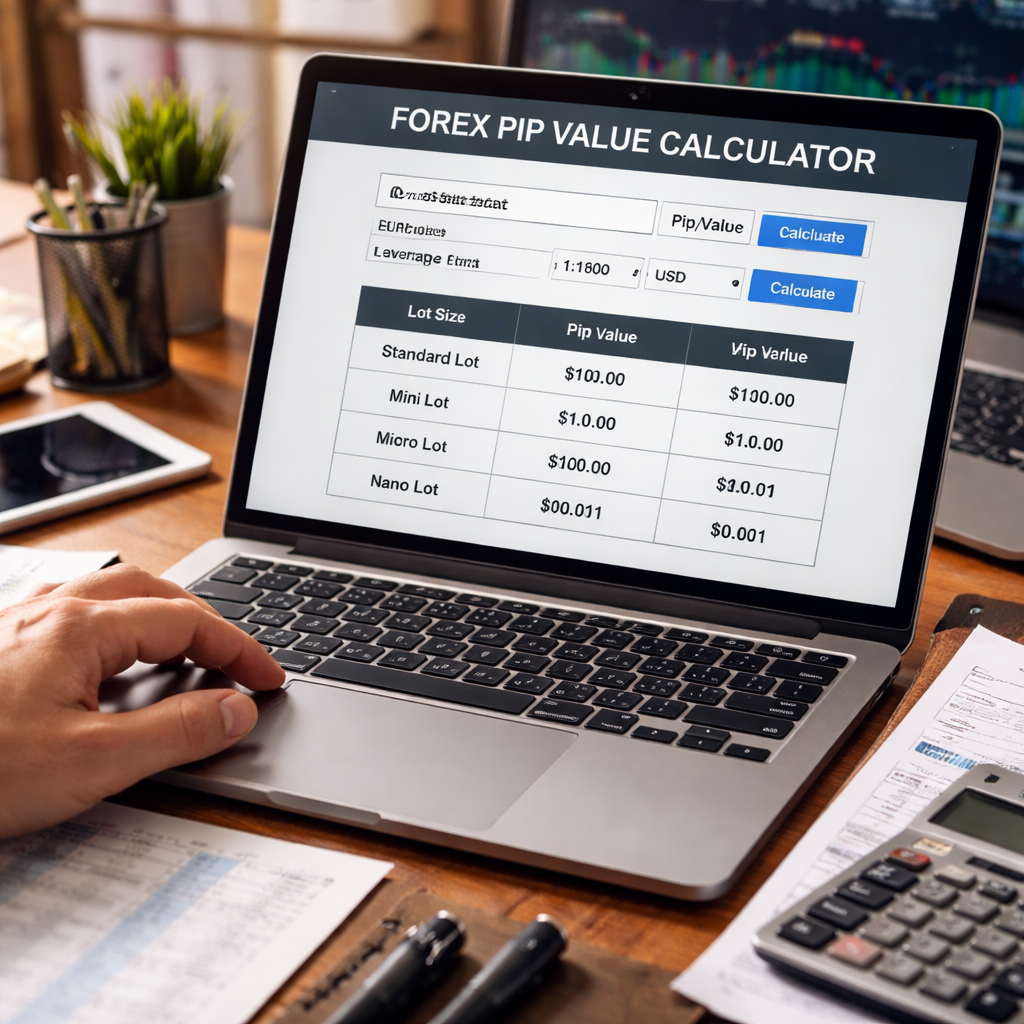
Forex brokers let you trade in four common lot sizes. A standard lot = 100,000 units, a mini lot = 10,000, a micro lot = 1,000, and a nano lot = 100. You can read about lot sizes explained by BabyPips lot sizes explained by BabyPips. Think of each lot as a box of eggs; the bigger the box, the more eggs (or currency) you move.
Take EUR/USD at 1.2000. The pip size is 0.0001. For a standard lot the value is (100,000 × 0.0001) ÷ 1.2000 ≈ $8.33 per pip. Cut the lot to a mini (10,000) and the same math gives about $0.83 per pip. Drop to a micro (1,000) and you’re looking at $0.083 per pip. Nano lots shrink it further to roughly $0.0083.
Pairs that quote the yen use a pip of 0.01 instead of 0.0001. Say USD/JPY sits at 110.00. A standard lot (100,000) now yields (100,000 × 0.01) ÷ 110 ≈ $9.09 per pip. Mini, micro and nano lots follow the same proportion, just divide the $9.09 by 10, 100, or 1,000 respectively.
Tip: before you lock in a stop‑loss, plug your lot size, pair and current rate into a pip calculator. It spits out the exact dollar amount so you don’t have to run the math in your head each time.
Quick checklist:
- Know your lot type (standard, mini, micro, nano).
- Use the correct pip size (0.0001 for most pairs, 0.01 for JPY pairs).
- Apply the formula: (lot × pip size) ÷ quote rate.
- Verify the number with a pip calculator.
When you practice these steps with live quotes, the numbers become second nature. You’ll know exactly how much each pip will cost before you even place the order.
Step 3: Adjust Pip Value for Varying Currency Pairs and Account Currencies
Now that you know the formula, you need to tweak it when the quote currency or your account base changes.
If your account is funded in USD, a pip that’s quoted in USD is already in your base currency. If your account uses EUR, you must convert the pip value back to EUR.
Say EUR/USD sits at 1.2000 and you trade a standard lot. The raw pip value is (100,000 × 0.0001) ÷ 1.2000 ≈ $8.33. To get the value in EUR, divide $8.33 by the current EUR/USD rate (1.2000) and you end up with about €6.94 per pip.
Now look at USD/JPY at 110.00 with a standard lot. Here the pip size is 0.01, so (100,000 × 0.01) ÷ 110 ≈ $9.09 per pip. If your account is in JPY, you’d divide $9.09 by the USD/JPY rate to get ¥1,000 per pip.
For cross pairs like GBP/CHF the quote currency isn’t USD either. First calculate the pip value in USD using the USD/CHF rate, then convert that amount into your account currency. The two‑step method keeps the math consistent no matter the pair.
The quick reference below shows the key numbers you need for the most common scenarios.
| Pair | Pip Size | Standard‑Lot Pip Value (Base Currency) |
|---|---|---|
| EUR/USD | 0.0001 | $8.33 (≈ €6.94) |
| USD/JPY | 0.01 | $9.09 (≈ ¥1,000) |
| GBP/CHF | 0.0001 | $8.33 (convert via USD/CHF) |
And always double‑check your result with a pip calculator that lets you set the account currency. A tiny error can swing your risk by a lot, so treat the check as part of your trade prep.
But remember, the market rate you use must be the same tick you plan to trade on. Rates can shift a few pips in seconds, so pull the latest quote right before you calculate.
So, when you switch pairs or trade on a non‑USD account, just adjust the pip size and apply the conversion step. You’ll always know exactly how much each pip costs, and that confidence feeds better risk management.
Step 4: Practical Example and Quick‑Use Video Tutorial
Now that you’ve seen the formula, let’s walk through a live‑look example so you can see the numbers in action.
Imagine you trade EUR/USD at a rate of 1.2150 and you want to risk a half‑standard lot (50,000 units). The pip size for this pair is 0.0001.
Step 1: multiply the lot size by the pip size – 50,000 × 0.0001 = 5. Step 2: divide that product by the current rate – 5 ÷ 1.2150 ≈ $4.11. That means each pip moves your account about $4.11.
If your account is in euros, you’ll need one more conversion. Take the $4.11 and divide it by the EUR/USD rate (1.2150) → about €3.38 per pip. Now you know exactly how much a one‑pip swing costs in your base currency.
Take a second scenario with a JPY pair. Say USD/JPY sits at 109.80 and you trade a mini lot (10,000 units). Pip size is 0.01. Multiply: 10,000 × 0.01 = 100. Divide: 100 ÷ 109.80 ≈ $0.91 per pip. In a JPY‑denominated account you’ll then divide $0.91 by 109.80 again, landing near ¥83 per pip.
Watch the short video tutorial below for a visual walk‑through of these steps. The clip shows the calculator screen, the numbers being entered, and the final pip‑value result. It’s a quick way to see the process without pausing your reading.
Quick checklist to lock in the right value:
- Grab the latest quote for the pair you plan to trade.
- Use the correct pip size (0.0001 or 0.01).
- Apply (lot × pip size) ÷ quote rate.
- If needed, convert the USD result to your account currency.
- Verify with an online pip calculator before you set your stop‑loss.
Follow this routine each time you open a new trade and the math will become second nature. Soon you’ll be able to pull the numbers in your head, but the calculator is a safe safety net until then.
Conclusion
Now you’ve seen how to calculate forex pip value step by step. You know the formula, how lot size and pair type change the result, and how to convert it to your account currency.
When you pull a fresh quote, plug the numbers into (lot × pip size) ÷ rate, and double‑check with a pip calculator, the math becomes a habit. That habit lets you size stops and targets with confidence, no guesswork.
What’s the next move? Take a live pair, run the calculation, and write the pip value in your trade journal. Over a few trades you’ll spot patterns and avoid costly slips. Keep the checklist handy and treat the calculator as a safety net until the numbers feel natural.
Remember, mastering pip value is a small step that builds stronger risk control and smoother trading.
If you want a quick reference, the FX Doctor guide on position size walks you through linking pip value to risk rules. Bookmark it and come back whenever you set a new trade.
The more you practice, the faster the numbers will stick, and the less you’ll rely on guesswork. Keep this simple process in your routine and watch your confidence grow.
Every pip you measure adds a layer of precision to your trading plan, turning abstract price moves into concrete numbers you can manage.
Happy calculating!
FAQ
What is a pip and why does its value matter?
A pip is the smallest price move a currency pair can make. For most pairs it’s 0.0001, for JPY pairs it’s 0.01. Knowing the pip’s monetary worth tells you exactly how much a trade will gain or lose per tick. That lets you set stop‑losses and position sizes that match your risk plan, instead of guessing. It also helps you compare different pairs side by side.
How do I calculate forex pip value for a standard lot?
To work out how much one pip is worth for a standard lot, multiply the lot size (100,000 units) by the pip size (0.0001) and then divide by the current quote rate. The formula looks like (100,000 × 0.0001) ÷ rate. If EUR/USD trades at 1.2000, the result is about $8.33 per pip. That means each one‑pip swing moves a $100,000 position by roughly eight dollars, giving you a clear picture of risk.
How does the formula change for mini, micro, or nano lots?
Mini, micro and nano lots use the same formula, but the lot size changes. A mini lot is 10,000 units, so you replace 100,000 with 10,000; a micro lot is 1,000 and a nano lot is 100. The pip value drops by a factor of ten each time, making it easier to trade with a small account while still knowing the exact cost per pip.
How do I adjust the pip value when my account currency differs from the quote currency?
When your account is not in the quote currency, you first calculate the pip value in USD using the standard formula, then convert that amount into your base currency by dividing by the current exchange rate for the base‑to‑USD pair. For example, if you trade EUR/USD and your account is in euros, you’d take the USD pip value and divide it by 1.2000 to get the euro‑denominated pip value.
Is there a quick way to check my pip value without doing the math each time?
The fastest way to avoid manual math is to use an online pip calculator. You simply enter the lot size, the pair’s quote, and your account currency, and the tool returns the pip value instantly. Most calculators also show the result in both the quote and base currencies, so you can double‑check your conversion without pulling a spreadsheet. It’s a handy habit to keep in your trading checklist before you hit the order button.
How often should I recalculate pip value during a trading session?
Because pip values shift with every tick, you should recalculate them each time you open a new trade or when the quote moves significantly – say more than a few pips from the rate you used. For day traders who hold positions for a few hours, a quick check before each entry is enough. Swing traders may want to refresh the value at the start of each trading day.