
Most new traders jump straight into charts and think the big win will come from a perfect entry. The truth? Your risk stays hidden until you size each trade.
If you don’t know how to calculate position size in forex, a single loss can wipe out weeks of progress. That’s why getting the math right matters more than any fancy indicator.
Imagine you have a €10,000 account and you’re willing to risk 2% on a trade. That means you’ll only lose €200 if the market moves against you. The next step is to turn that €200 into a lot size that matches your stop‑loss distance.
Here’s a quick walk‑through: 1) Decide your risk percent. 2) Multiply it by your account balance to get the risk amount. 3) Find the pip value for the pair you trade. 4) Divide the risk amount by the stop‑loss size in pips. 5) The result is the number of lots you can trade. It sounds simple, but the numbers can slip if you skip a step.
Many traders use a spreadsheet or a calculator to avoid manual errors. Our own Forex Position Sizing Calculator: A Complete Educational Guide walks you through each field and shows a live example, so you can see the exact lot size for a EUR/USD trade with a 50‑pip stop.
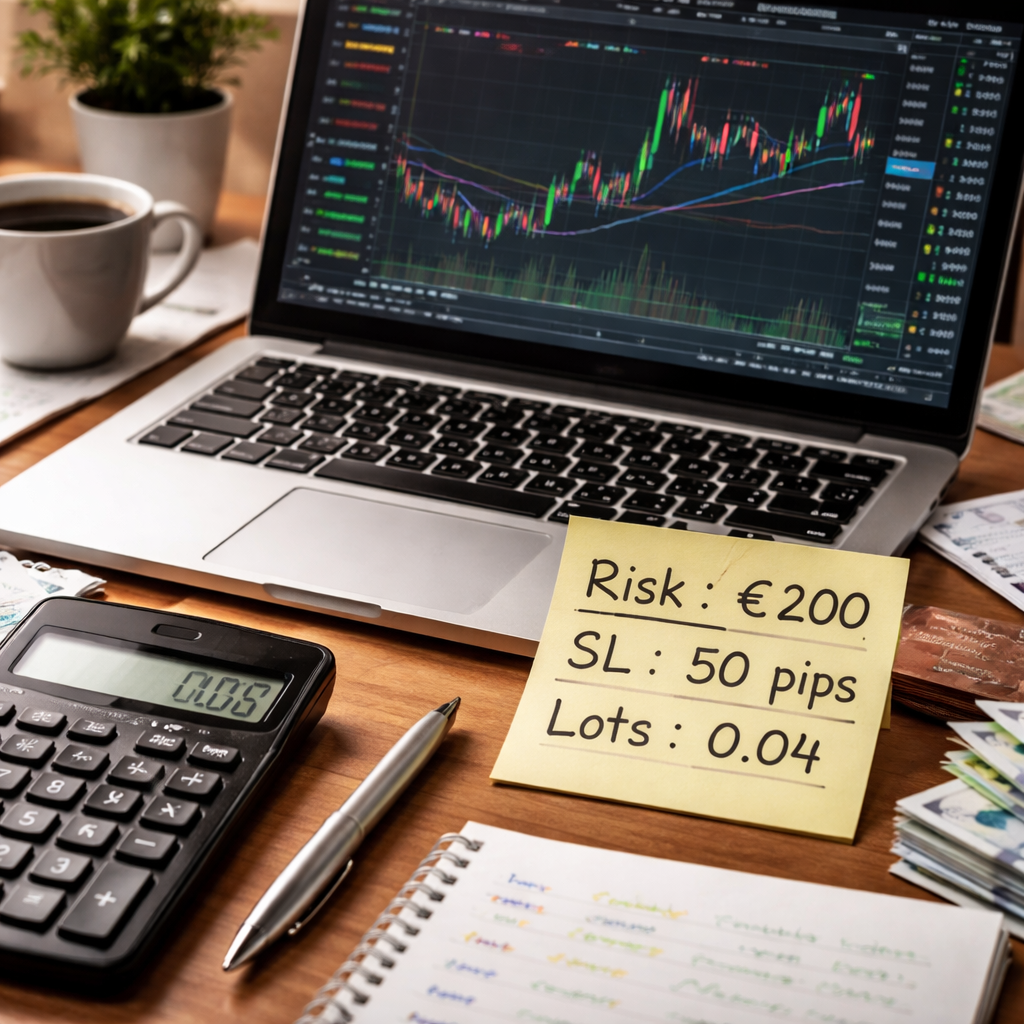
Tip: before you open any position, write the risk amount, stop‑loss distance, and calculated lot size on a sticky note. That tiny habit forces you to double‑check the math and keeps emotions out of the trade.
Once you get comfortable with the formula, you’ll notice your account swings shrink. Less stress means clearer thinking, and clearer thinking leads to better setups. That’s the real power of proper position sizing.
Step 1: Determine Your Risk Per Trade
First thing you need to know is how much of your account you’re willing to lose on a single trade. Most traders pick a flat percent, like 1 % to 2 %, and stick to it every time.
Take that percent and multiply it by your account balance. If you have €10 000 and you risk 2 %, the risk amount is €200. That €200 is the max you’ll let the market take before you exit.
Now you need the pip value for the pair you trade. For a standard lot on EUR/USD a pip is roughly $10, but it changes with lot size and account currency. Divide your €200 risk by the stop-loss distance in pips, say 50 pips, and you get the lot size you can safely trade.
Think of this like setting a clear budget before you start a negotiation. Good procurement negotiation tactics keep you from over-committing, and the same idea applies to risk.
Seeing the numbers in action helps a lot. Below is a quick video that walks through the math step by step.
When you’re ready to run the calculation, try a short focus burst. A Pomodoro timer lets you work for 25 minutes, jot the lot size, then step back before you place the trade.
And remember, a clear mind supports good risk decisions. Sites like XL R8 Well share simple wellness tips that can keep stress low while you trade.
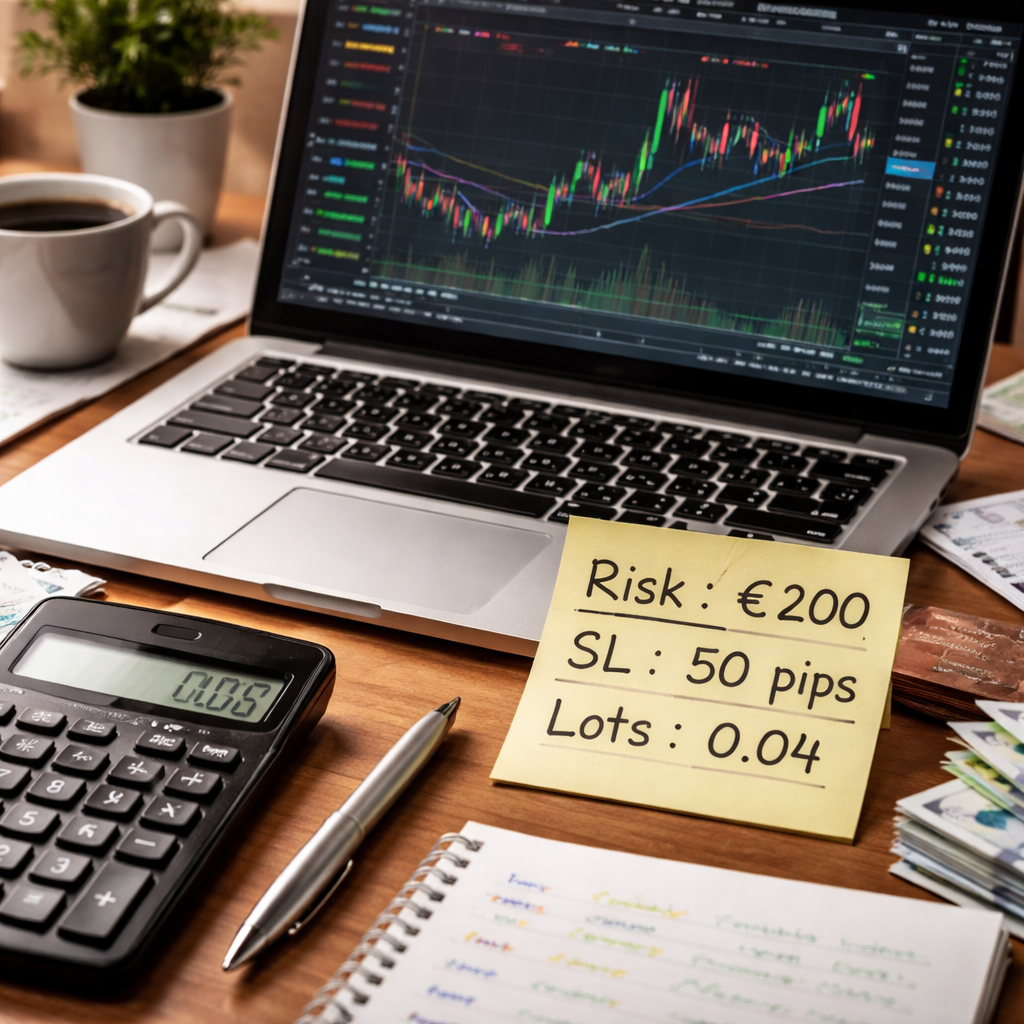
Quick tip: write the risk amount, stop-loss distance, and lot size on a sticky note and keep it in view. The note acts as a reality check and stops emotion from sneaking in.
Step 2: Calculate Your Account’s Dollar Risk
Before you size a trade, you need to know how much money you’re willing to lose in dollars.
Take your account balance and multiply it by the risk percent you set in step 1.
If you have €10,000 and you choose a 2 % risk, the math is simple: €10,000 × 0.02 = €200. That €200 is your dollar risk.
The next piece you need is the pip value for the pair you plan to trade.
Standard lots, mini lots and micro lots each have a different pip worth. A standard lot on EUR/USD moves about $10 per pip, a mini lot about $1, and a micro lot about $0.10. You can see the full table on TradingFinder forex position size guide.
Now divide your dollar risk by the product of pip value and stop‑loss distance. The formula looks like this: Dollar risk ÷ (pip value × stop‑loss pips) = lot size.
Using the €200 risk, a 50‑pip stop and a standard‑lot pip value of $10, you get 200 ÷ (10 × 50) = 0.4 lots.
Round the result to two decimals. Most platforms won’t accept more than that, and a tiny rounding error can shift your risk.
If your account currency differs from the pair’s quote currency, convert the pip value first. For a USD‑based account trading EUR/USD, the pip value in dollars equals the euro pip value multiplied by the current EUR/USD rate.
Write the three numbers – risk amount, stop‑loss pips, lot size – on a sticky note before you click “buy” or “sell.” It forces a double‑check and keeps emotions out.
Double‑check every input before you hit enter. A typo in the risk percent or stop‑loss distance can double your exposure without you noticing.
Once you’ve nailed the dollar risk, the rest of the position‑size formula falls into place, and you can trade with confidence.
Step 3: Apply the Position Size Formula
Now that you know your risk amount and pip value, it’s time to plug them into the formula. This step turns theory into a number you can trade with.
The position‑size formula is simple: Risk ÷ (Stop‑loss pips × Pip value per lot) = Lots. Just replace each term with the numbers you just calculated.
Say you risk €200, you set a 50‑pip stop, and the pip value for a standard lot on EUR/USD is $10. First, convert the €200 to dollars if needed – assume €1 = $1.10, so your risk is $220. Then plug in: 220 ÷ (50 × 10) = 0.44 lots. Most platforms will round down to 0.43.
What if your account is in pounds and you trade a JPY pair? In that case you first find the pip value in JPY, then divide by the USD/JPY rate to get a dollar pip value, and finally convert pounds to dollars. The same division works once all units match.
Always round down to the broker’s lot‑step. A tiny extra 0.01 lot can add a few dollars of risk you didn’t plan for.
| Input | How to get it | Quick check |
|---|---|---|
| Risk amount | Your dollar or account‑currency risk from step 2 | Matches the number on your sticky note |
| Stop‑loss pips | Distance between entry price and stop price, measured in pips | Keep it exact, no rounding |
| Pip value per lot | Check platform’s live pip value or use a calculator | Use the same unit as your risk currency |
Before you hit send, glance at your note: risk amount, stop distance, lot size. A quick glance catches a typo that could double your exposure.
Make this a habit. Write the three numbers on a sticky note, or paste them into a one‑line calculator on your desktop. When the numbers match, you can place the trade with confidence. For a deeper walk‑through, see Trader Detector’s guide. A handy tool for checking pip values is the Babypips position size calculator.
Step 4: Adjust for Leverage and Currency Pair Volatility
Now that you know your raw lot size, you have to shrink or grow it based on the broker’s margin multiplier and how wobbly the pair moves.
Understand the margin multiplier
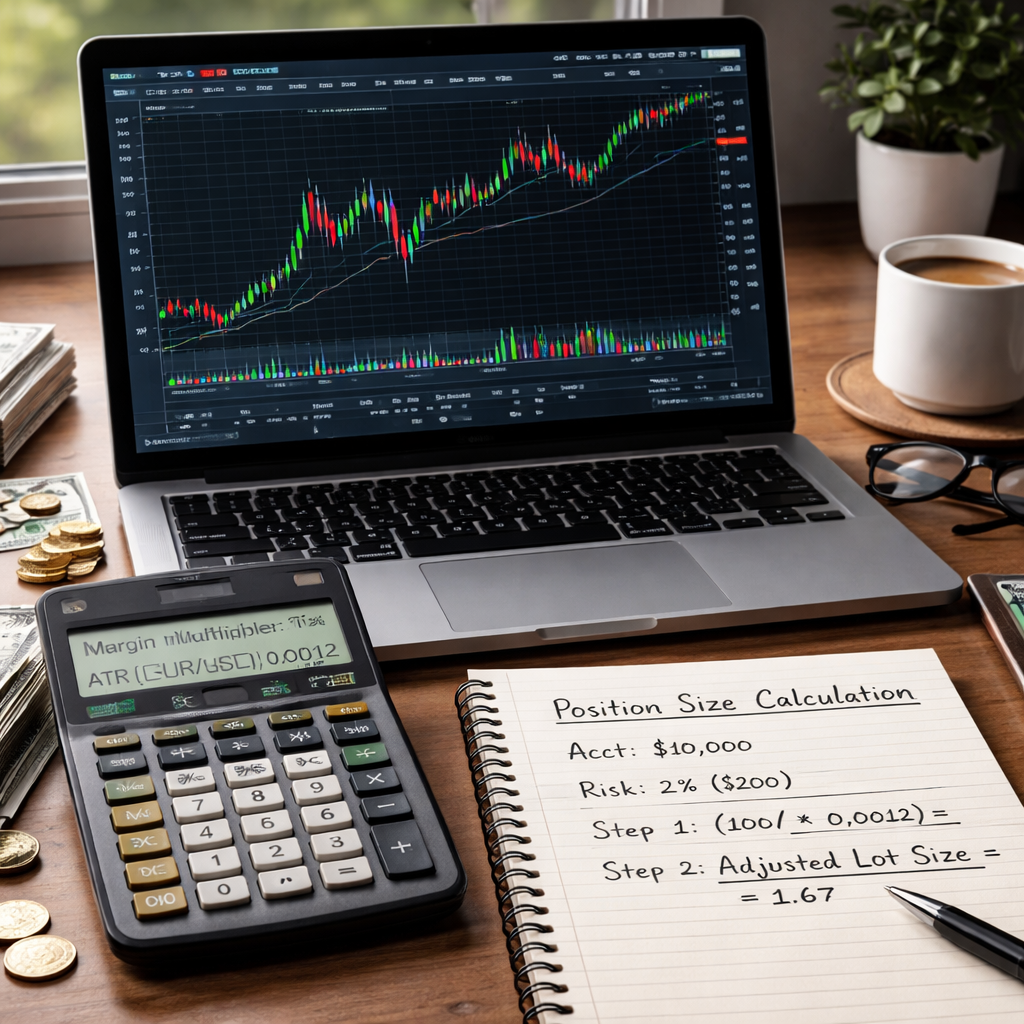
Most brokers let you control a larger position than the cash you put down. If the multiplier is 1:100, every $1 you risk actually backs $100 of notional value. To keep risk honest, divide the lot size you got in step 3 by the multiplier.
For example, a 0.5‑lot trade on a 1:100 account becomes 0.005 lots of real exposure. That tiny number may look odd, but it’s what keeps your $200 risk from blowing up.
Factor in pair volatility
Pairs like GBP/JPY swing a lot more than EUR/USD. A higher‑volatility pair means each pip is worth more in your account currency.
One way to adjust is to look at the average true range (ATR) of the last 14 days. If the ATR is 120 pips, you might cut your lot size by about half compared to a low‑vol pair with an ATR of 60 pips.
So, take the lot size from step 3, apply the margin divisor, then scale it by the ratio of a “normal” ATR (say 60 pips) to the pair’s current ATR.
Quick sanity check
Grab a calculator. Plug in:
• Raw lot size
• Broker multiplier (e.g., 100)
• Pair ATR (e.g., 120)
• Standard ATR reference (60)
Result = (Raw lot ÷ 100) × (60 ÷ 120). If the final number is 0.002 lots, that’s the size you should actually trade.
Does this feel like extra work? It’s a tiny step that saves you from a surprise loss when the market jumps.
Write the three numbers – adjusted lot, stop‑loss pips, and risk amount – on your sticky note. A quick glance before you click “buy” catches errors that could cost you dollars.
Conclusion
Getting the math right when you learn how to calculate position size in forex can mean the difference between steady growth and a sudden loss.
Remember the four steps: set your risk percent, turn that into a dollar amount, find the right pip value, then adjust for the margin multiplier and volatility. Write those three numbers on a sticky note before you click “buy” or “sell.” A quick double‑check keeps emotion out of the trade.
So, what’s the next move? Take a few minutes tonight to run the formula on a demo account. When the numbers line up, you’ll feel more in control and ready for real trades.
FX Doctor keeps the guide simple and free of hype. Keep practicing, and the habit will become second nature.
FAQ
What is position size and why does it matter?
Position size is the amount of lots you trade for one trade. It tells the broker how big your order will be and sets the money you could lose if the market moves against you. By sizing each trade right, you keep any single loss small compared to your whole account. This stops big swings and lets you trade many times without wiping out.
How do I figure out my risk amount per trade?
First pick a percent of your account you’re ok to lose on any trade – most traders use 1 or 2 %. Multiply that percent by your account balance. The result is the dollar (or euro) amount you can risk. For example, with a €10,000 account and a 2 % risk, you’d risk €200. Write that number down before you set a stop‑loss.
How do I find the pip value for a currency pair?
The pip value shows how much one pip moves your account money. For a standard lot on most majors, one pip is about $10 (or €10). If you trade a mini lot, it’s $1; a micro lot is $0.10. You can also use a calculator that asks for the pair, lot size and your account currency. The calculator will give the exact pip value for you.
What is the exact formula to calculate position size?
Take your risk amount, divide it by the product of pip value and stop‑loss distance. In formula form: Position size = Risk ÷ (Pip value × Stop‑loss pips). The result is the number of lots you can trade. If the number has more than two decimals, round down to match your broker’s lot step. Always check the final lot size against your note before you click “buy” or “sell”.
How does the margin multiplier affect my position size calculation?
Margin multiplier lets you control a larger notional amount with a small cash outlay. It does not change the risk amount you set – that stays the same. What changes is the exposure you actually put on the market. To keep risk honest, divide the raw lot size you got from the formula by the margin multiplier (for 1:100, divide by 100). That gives the true lot you should trade.
How can I double‑check my numbers before I trade?
Write the three key figures – risk amount, stop‑loss pips and lot size – on a sticky note or in a simple spreadsheet. Then run the numbers through a free position‑size calculator to see if they match. Check that the pip value matches your account currency and that you’ve applied the correct margin multiplier. A quick glance at the note right before you hit “buy” catches most mistakes.
[…] How to Calculate Forex Pip Value: A Step‑by‑Step Guide Forex Trading Plan Example: A Step‑by‑Step Guide for Beginners Forex Trading Certification: A Step‑by‑Step Guide for 2026 How to Use an Economic Calendar for Forex Trading: A Step‑by‑Step Guide How to Calculate Position Size in Forex: A Step‑by‑Step Guide […]