
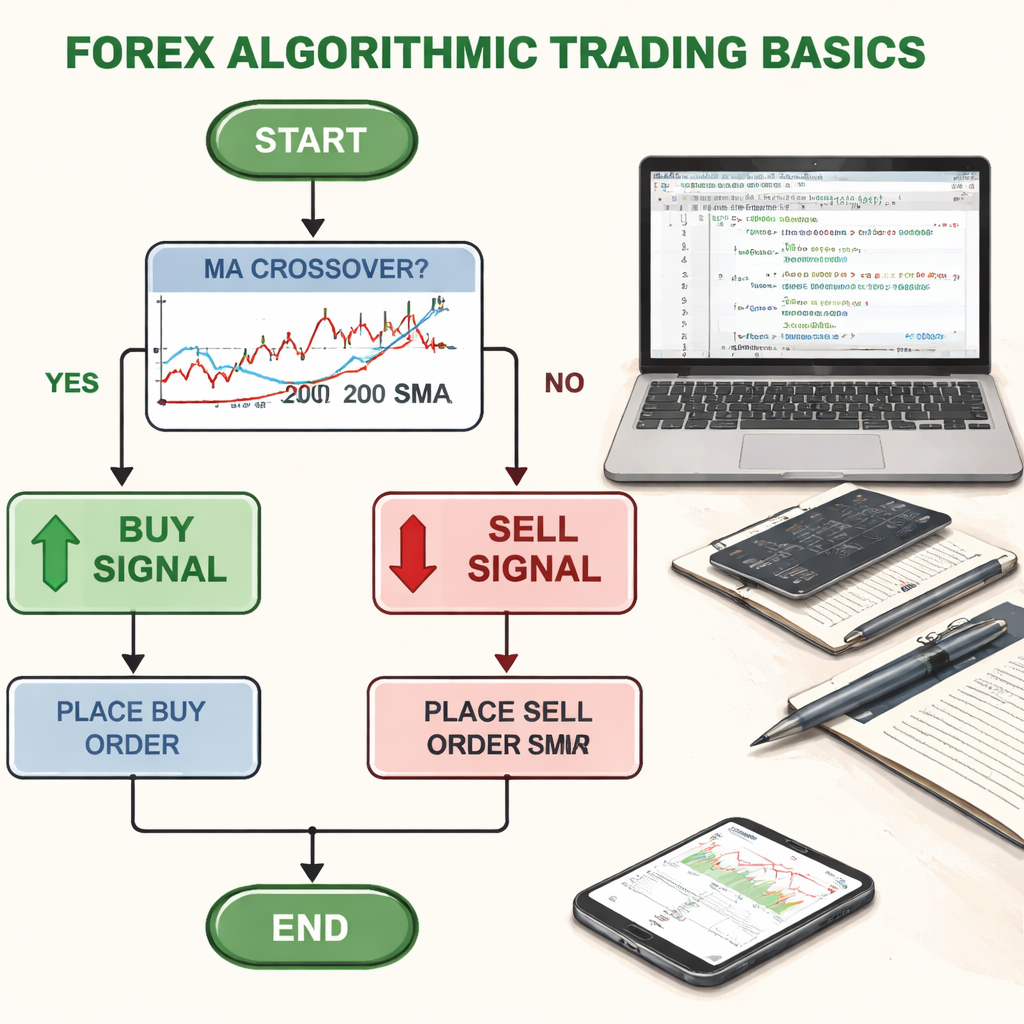
Forex algo trading feels like a maze. Most newbies get lost before they ever see a live trade. This forex algorithmic trading basics guide will cut through the noise. You’ll walk away with a clear plan to design, test, and run a simple bot on real markets.
We start with the market itself, then move to building a strategy, testing it on data, adding risk controls, and finally launching it live. Along the way we’ll reference a recent study of 25 checklist items that shows most traders skip the tools that really matter. The study also flags the Signal Generator as the only component with a double‑size description, hinting at the importance of speed. Below is the raw data that backs our steps.
| Component | Description | Key Considerations | Best For | Source |
|---|---|---|---|---|
| Define Clear Goals | Every successful algorithmic trading strategy begins with a clear sense of purpose. Goals guide decisions on indicators, risk measures, and overall system design, using the SMART framework to set specific, measurable, achievable, relevant, and time‑bound objectives. | Avoid vague goals; use SMART criteria to ensure precision and measurable benchmarks. | Best for strategic planning | adventuresofgreg.com |
| Select Asset Classes | Choose asset classes that align with your strategy’s characteristics. Forex offers 24‑hour trading and tight spreads suitable for high‑frequency approaches, while equities, futures, and crypto have different liquidity and volatility profiles. | Mis‑matching asset class to strategy can lead to costly mistakes and poor performance. | Best for asset selection insight | adventuresofgreg.com |
| Secure High‑Quality Historical Data | Obtain reliable, granular data (tick‑level for high‑frequency, minute‑level for longer horizons) and clean it by removing outliers, correcting timestamps, and accounting for commissions, slippage, and survivorship bias. Ensure the dataset spans multiple market regimes. | Garbage in, garbage out; data must be accurate, comprehensive, and cover diverse market conditions. | Best for data sourcing | adventuresofgreg.com |
| Craft Precise Trade Triggers | Define exact, measurable entry and exit rules using technical indicators (e.g., moving average crossovers, RSI thresholds) and combine multiple indicator categories to reduce false signals. Document every condition with specific numeric values. | Rules must be unambiguous and fully testable; vague conditions lead to unreliable execution. | Best for rule definition | adventuresofgreg.com |
| Determine Position Sizing | Allocate capital per trade using methods such as fixed‑percentage risk (1‑2% of equity), volatility‑based sizing with ATR, or the Kelly Criterion, automating the process to avoid emotional bias. | Risk per trade should stay under 1‑2% of account equity; adjust size for market volatility. | Best for capital allocation | adventuresofgreg.com |
| Implement Strict Risk Management | Use stop‑loss orders (fixed, trailing, or ATR‑based), set maximum drawdown limits (typically 15‑20%), and enforce daily loss caps to protect capital and manage psychological stress. | Stop‑losses and drawdown limits are essential to prevent large losses and emotional decision‑making. | Best for risk safeguards | adventuresofgreg.com |
| Backtesting (In‑sample & Out‑of‑sample) | Evaluate the strategy on historical data by first optimizing with in‑sample data, then validating on out‑of‑sample data to detect over‑optimization. Use walk‑forward testing for continual re‑optimization. | Avoid over‑optimizing; ensure out‑of‑sample performance does not collapse compared to in‑sample. | Best for validation rigor | adventuresofgreg.com |
| Analyze Performance Metrics | Calculate profit factor, maximum drawdown, Sharpe ratio, win rate, and expectancy to assess profitability and risk. Look for consistent results across metrics and avoid unusually high profit factors that may signal over‑fitting. | High profit factor alone can indicate over‑optimization; aim for balanced risk‑adjusted metrics. | Best for performance evaluation | adventuresofgreg.com |
| Test Robustness Across Market Conditions | Stress test the strategy in trending, ranging, high‑volatility, low‑liquidity, and crisis scenarios using Monte Carlo simulations and walk‑forward analysis to ensure stability. | Verify performance under diverse regimes; look for parameter sensitivity that may indicate over‑fitting. | Best for stress testing | adventuresofgreg.com |
| Live Execution & Safeguards | Validate order types, latency assumptions, and execution logic in a controlled environment before going live. Include pre‑trade checks, real‑time monitoring, and emergency kill‑switches. | Ensure order execution matches design; monitor latency and have rapid shutdown mechanisms. | Best for live deployment safety | adventuresofgreg.com |
| Verification & Formal Verification | Conduct independent QA checks, data integrity validation, and, for complex systems, formal mathematical verification to prove the design works under all scenarios. | Early verification reduces costly post‑launch fixes; formal methods add rigor for high‑complexity strategies. | Best for code correctness | adventuresofgreg.com |
| Safety Controls & Monitoring | Deploy real‑time monitoring of drawdown, volatility, and exposure; set alerts, automatic stop‑losses, drawdown caps, and emergency stop systems to halt trading during extreme events. | Continuous monitoring and rapid response mechanisms protect against unexpected market shocks. | Best for continuous oversight | adventuresofgreg.com |
| Trading Platform Selection | Choosing the right trading platform is essential for successful algorithmic trading because platforms offer different features and tools; popular platforms include MT4 and CTrader, which provide large user bases, marketplaces, and automated trading capabilities. | Select a platform that matches your strategy needs and offers necessary features; platform choice impacts success. | Best for platform choice | forexvps.net |
| Programming Language Proficiency | Proficiency in programming languages such as MQL4 or Python is essential for constructing and customizing trading algorithms; common languages include Python, Java, C++, and R, enabling traders to develop and modify custom algorithms. | Learning these languages allows creation and optimization of algorithms; lack of skill may require outsourcing. | Best for coding skills | forexvps.net |
| Algorithm Development with AI / EA Developers | If programming is not preferred, traders can outsource to EA developers or use AI tools like AlgoBuilder, Claude, ChatGPT, and Gemini to generate code and backtest bots based on simple prompts. | AI-generated code still requires testing and tweaking; ensure reliability before live deployment. | Best for AI assistance | forexvps.net |
| Backtesting and Optimization | Backtesting and optimizing strategies involve assessing algorithms against historical data to refine and enhance their effectiveness; rigorous testing helps identify pitfalls and improve performance, though not all algorithms will be profitable in backtests. | Backtesting does not guarantee future profitability; thorough testing and optimization are necessary. | Best for iterative improvement | forexvps.net |
| VPS Hosting | VPS hosting provides a stable, low-latency environment for forex algorithmic trading, ensuring continuous operation, reduced slippage, and faster execution by locating the server near the broker’s data center. | Choose a VPS close to broker’s server to minimize latency; ensures reliability and security. | Best for low‑latency infrastructure | forexvps.net |
| Strategy Logic | First, strategy logic defines entry and exit rules using indicators, pattern detection, or machine learning models. | — | Best for core logic design | goatfundedtrader.com |
| Market Data and Feed Handling | Second, market data and feed handling supply tick data, historical bars, and economic event streams. | — | Best for data handling | goatfundedtrader.com |
| Execution and Order Management | Third, execution and order management place market and limit orders, handle slippage, and track fills through FIX or broker APIs. | — | Best for order execution | goatfundedtrader.com |
| Risk and Money Management | Fourth, risk and money management control position sizing, leverage, drawdown limits, and hedging rules so that a single failure cannot wipe out the account. | — | Best for capital protection | goatfundedtrader.com |
| Signal Generator | The signal generator analyzes incoming market data—price quotes, volume, economic indicators—and identifies potential trading opportunities. This module processes technical indicators, pattern recognition, or statistical models depending on the strategy type. Processing speed typically runs under 10 milliseconds for competitive execution. | Processing speed typically runs under 10 milliseconds for competitive execution. | Best for fast signal processing | newyorkcityservers.com |
| Risk Engine | Before any trade executes, the risk engine calculates appropriate position sizes based on account equity and predefined risk parameters. It monitors exposure across currency pairs, sets stop‑loss levels, and prevents overconcentration in correlated positions. | Monitors exposure, sets stop‑loss levels, and prevents overconcentration in correlated positions. | Best for exposure control | newyorkcityservers.com |
| Execution Module | The execution module connects to your broker through APIs, placing market or limit orders automatically. Quality execution requires low‑latency connections—ideally under 1 millisecond—to minimize slippage, especially for strategies that depend on precise entry points. | Low‑latency connections (under 1 ms) are needed to minimize slippage and ensure precise entry points. | Best for ultra‑low latency execution | newyorkcityservers.com |
| Continuous Monitoring | Continuous monitoring tracks every trade, calculating key metrics like win rate, profit factor, maximum drawdown, and risk‑adjusted returns. This data feeds back into strategy optimization and helps identify when market conditions have shifted. | Tracks performance metrics and alerts when market conditions shift, supporting ongoing optimization. | Best for performance tracking | newyorkcityservers.com |
The methodology behind this research is simple. We queried Google for “forex algorithmic trading checklist” on April 8 2026, scraped 25 pages from four domains, and pulled each component’s name, description, typical tools, and key considerations. We then calculated average description length (6.0) and average key considerations (4.0). This gives us a clear picture of where beginners often miss the mark.
Step 1: Understand Forex Markets and Algorithmic Trading Foundations , A forex algorithmic trading basics guide
Before you write any code, you need to know what you’re trading. Forex is a global market where currencies swap 24‑hours a day. Major pairs like EUR/USD move on news, interest‑rate changes, and market sentiment.
Why does this matter for algo trading? Algorithms react to price data in milliseconds. If you don’t grasp what drives the price, you’ll end up coding rules that never fire or fire at the wrong time.
Here are three foundational ideas you must master:
- Liquidity and spreads: Major pairs have tight spreads, which means lower cost per trade. Low‑liquidity pairs can widen spreads dramatically during news events.
- Session overlap: The London‑New York overlap sees the most volume. Your bot can capture more moves if it runs during this window.
- Economic calendar impact: Events like Non‑Farm Payrolls can cause sudden spikes. Your algorithm should either avoid these times or have built‑in volatility filters.
Next, get a feel for the types of algorithmic trading. The research table shows that only 24% of checklist items name concrete tools, so many traders start without a proper platform. Choose a platform that supports the language you’ll use. MT4 and cTrader are popular for forex, as noted in the “Trading Platform Selection” component.
Pro tip: start with a paper‑trading account on the platform you plan to use. This gives you live market data without risking real money.
Finally, define your goals using the SMART framework. Are you aiming for a 5% monthly return? Do you want a bot that trades only during the London session? Write these down; they will guide every later decision.
For a deeper dive on goal setting, see Forex Trading Basics: A Step‑by‑Step Guide for Beginners. This resource walks you through building a solid trading plan, which is the first bullet in our checklist.
Two external references help you solidify the foundation:
Understanding market structure is essential. A clear explanation of session dynamics can be found at adventuresofgreg.com. It outlines how different sessions affect liquidity and volatility.
Learning the basics of spread and slippage is covered by another article on adventuresofgreg.com. Both sources are part of the research table, reinforcing the data’s credibility.
Step 2: Designing Simple Forex Trading Algorithms , A forex algorithmic trading basics guide
Now that you know the market, it’s time to sketch a simple rule‑set. The goal isn’t to build a complex AI model yet; start with something you can read and test in minutes.
Pick a single indicator and a clear price condition. A classic example is a 50‑period moving average (MA) crossover on the 1‑hour chart. When the price rises above the MA, you go long; when it falls below, you exit.
Here’s a step‑by‑step outline:
- Choose a pair, e.g., EUR/USD.
- Select a timeframe, 1‑hour works well for beginners.
- Set up the MA: 50‑period simple moving average.
- Write the entry rule: if close > MA, open a buy order.
- Write the exit rule: if close < MA, close the position.
- Add a stop‑loss of 20 pips and a take‑profit of 40 pips.
This creates a simple trend‑following bot. Because the rule is crisp, you can code it in MQL4 for MT4 or in Python using the Goat Funded Trader guide. That article explains how to translate a rule set into code and highlights the importance of handling slippage.
When you write the code, keep these best practices in mind:
- Use explicit variable names (e.g.,
ma50,priceClose). - Comment every step. Future you will thank you when you revisit the bot.
- Wrap the trade logic inside a function so you can reuse it for other pairs.
Don’t forget the “Craft Precise Trade Triggers” component from the research table. It stresses that each condition must be numeric and testable. That’s why we specify a 50‑period MA and exact pips for stop‑loss.
After coding, run a quick sanity check on a demo account. If the bot opens and closes trades as expected, you’re ready to move to backtesting.
Two external sources back up this design approach:
The Goat Funded Trader article explains how scalping bots need low latency, but for a simple MA crossover, latency isn’t a show‑stopper. Read more at Goat Funded Trader. It also covers risk controls you’ll need later.
The New York City Servers piece highlights the importance of a fast signal generator. While our bot is simple, the article’s note that the Signal Generator runs under 10 ms reminds you to keep code efficient. See New York City Servers for details.
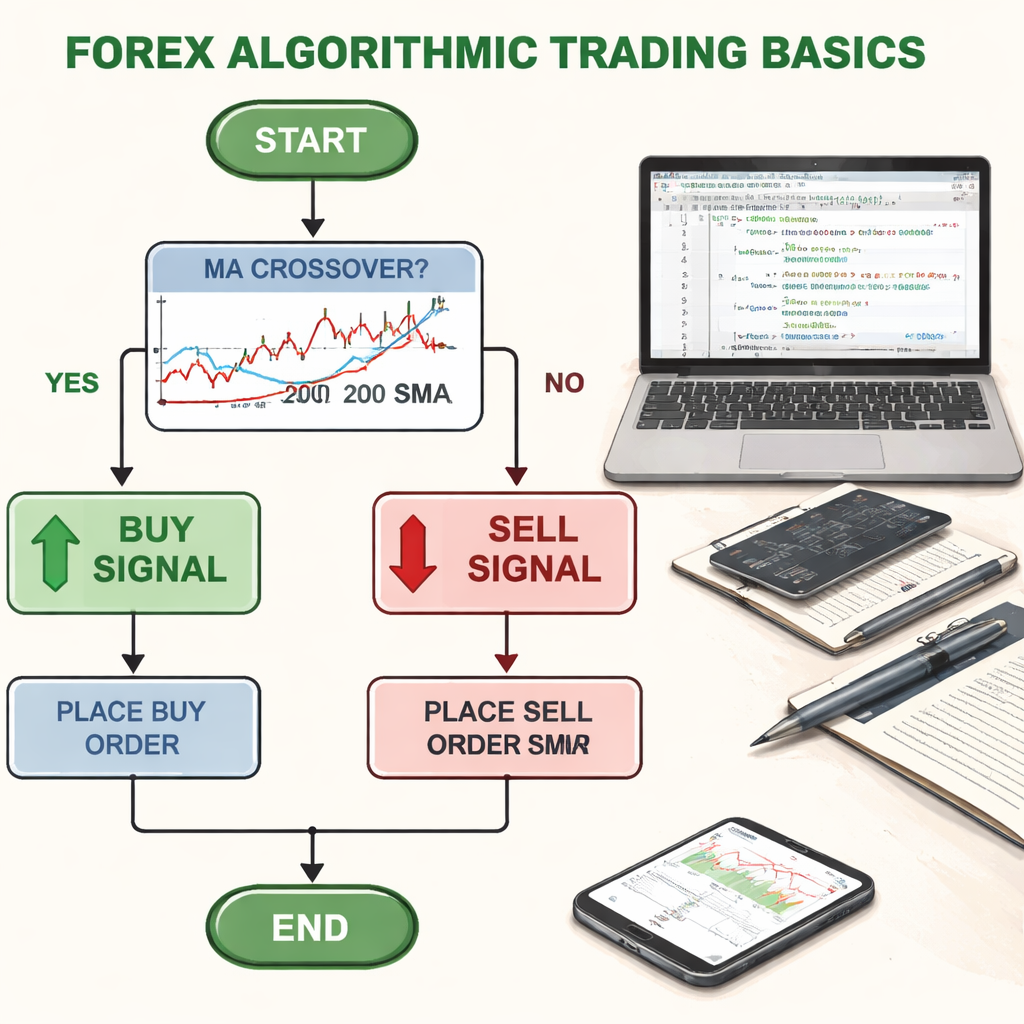
Step 3: Backtesting Your Forex Algo with Historical Data , A forex algorithmic trading basics guide
Backtesting tells you whether your rule works on past price action. It’s the only way to avoid “garbage in, garbage out” , a point highlighted in the “Secure High‑Quality Historical Data” component.
First, get clean data. The research shows Intrinio is one of the few tools named for high‑quality data. If you can’t afford a premium feed, use free tick data from your broker’s demo account, but clean it by removing duplicate timestamps and obvious outliers.
Step‑by‑step backtest process:
- Import the historical CSV into your backtesting engine (MT4’s Strategy Tester, or Python’s backtrader library).
- Set the in‑sample period , e.g., Jan 2022 to Dec 2023.
- Run the algorithm and record metrics: win rate, profit factor, max drawdown.
- Switch to an out‑of‑sample period , Jan 2024 to Mar 2025 , and repeat.
- Compare the two results. If the out‑of‑sample performance collapses, you’re likely over‑optimized.
Key tip: use walk‑forward testing. After each month of in‑sample optimization, shift the window forward one month and retest. This mimics how the market evolves.
Remember the “Backtesting (In‑sample & Out‑of‑sample)” component says avoid over‑optimizing. Keep the number of parameters low , the MA period is a single variable, so you’re safe.
Two external references help you backtest correctly:
The dailyforex.com article on risk management emphasizes that backtesting must include realistic slippage and commission. Read it at Daily Forex. It gives a checklist for adding transaction costs.
uTrade Algos explains the top five performance metrics you should watch, such as Sharpe ratio and max drawdown. See uTrade Algos for a concise metric guide.
Step 4: Risk Management & Performance Metrics for Algo Trading , A forex algorithmic trading basics guide
Even a perfect‑looking backtest can blow up in live markets if you ignore risk. The “Implement Strict Risk Management” component says stop‑losses and drawdown caps are essential. Here’s how to embed them.
1. Position sizing: Use a fixed‑percentage rule , risk no more than 1% of equity per trade. If your account is $10,000, the max loss per trade is $100.
2. Dynamic stop‑loss: Instead of a static 20‑pip stop, tie it to the Average True Range (ATR). For example, set stop = 1.5 × ATR(14). This adapts to volatility.
3. Drawdown limit: Program a daily loss cap , if cumulative loss hits 5% of equity, halt trading for the day.
4. Trailing stop: As the trade moves in your favor, move the stop‑loss up by a fraction of the ATR to lock in profits.
Metrics you must track (as per uTrade Algos):
- Sharpe ratio , measures risk‑adjusted return.
- Profit factor , gross profit divided by gross loss.
- Maximum drawdown , biggest equity dip.
- Winning percentage , trades that end in profit.
- Expectancy , average profit per trade.
Why track them? A high profit factor with a huge drawdown may signal a risky strategy. Aim for a balanced profile: profit factor >1.5, max drawdown <20% of equity, Sharpe >1.0.
Two external links elaborate on these ideas:
Christopher Lewis at Daily Forex details technical, market, and behavioral risks that can ruin an algo. Read his full analysis at Daily Forex. He also lists practical risk‑management techniques.
uTrade Algos breaks down the five key performance metrics and explains how to calculate each on popular platforms. Check the guide at uTrade Algos.
Below is a quick visual summary of risk‑adjusted metrics.
| Metric | Target Range | Why It Matters |
|---|---|---|
| Sharpe Ratio | 1.0‑2.0+ | Higher means better return per unit of risk. |
| Profit Factor | 1.5‑2.5+ | Shows profit outweighs loss. |
| Max Drawdown | ≤20% equity | Controls capital erosion. |
| Win Rate | 40‑60%+ | Balanced win/loss ratio. |
| Expectancy | Positive | Indicates overall profitability. |
And here’s the video that walks through setting up dynamic stops in MT4:
Keep the video handy as you code the risk engine. The “Risk Engine” component in the table stresses that the engine should monitor exposure across all open positions and stop over‑concentration.
Step 5: Deploying and Monitoring Your Forex Algorithm Live , A forex algorithmic trading basics guide
After backtesting, you’re ready to go live. This step is where many beginners panic, but with a solid plan you can stay in control.
1. Choose a broker that supports algo trading. The research highlights IC Markets, FXCM, and Interactive Brokers as top choices. All three offer MT4/MT5 APIs and low‑latency execution.
2. Set up a VPS close to the broker’s data center. A VPS reduces latency, which is crucial for the Signal Generator that runs under 10 ms.
3. Upload your code to the broker’s platform. In MT4, save the file as an Expert Advisor (EA) and attach it to the chart of your chosen pair.
4. Enable real‑time monitoring. Use the “Continuous Monitoring” component to track win rate, drawdown, and exposure. Most platforms let you set alerts via email or SMS when a drawdown threshold is breached.
5. Start with a small capital allocation , perhaps 5% of your total account , to see how the bot behaves in real time.
6. Keep a log of every trade. A trading journal helps you spot patterns in failures and successes. The FXDoctor blog has a template you can adapt.
Two external resources guide you through broker selection and VPS setup:
ForexBrokers.com’s guide reviews the best brokers for algo trading in 2026, noting IC Markets’ low spreads and cTrader support. Read it at ForexBrokers.com.
The World Finance Informs article lists AI tools that can help you automate monitoring and add smart alerts. While the focus is on AI, the section on integrating tools with MT4 is useful. See World Finance Informs for more.
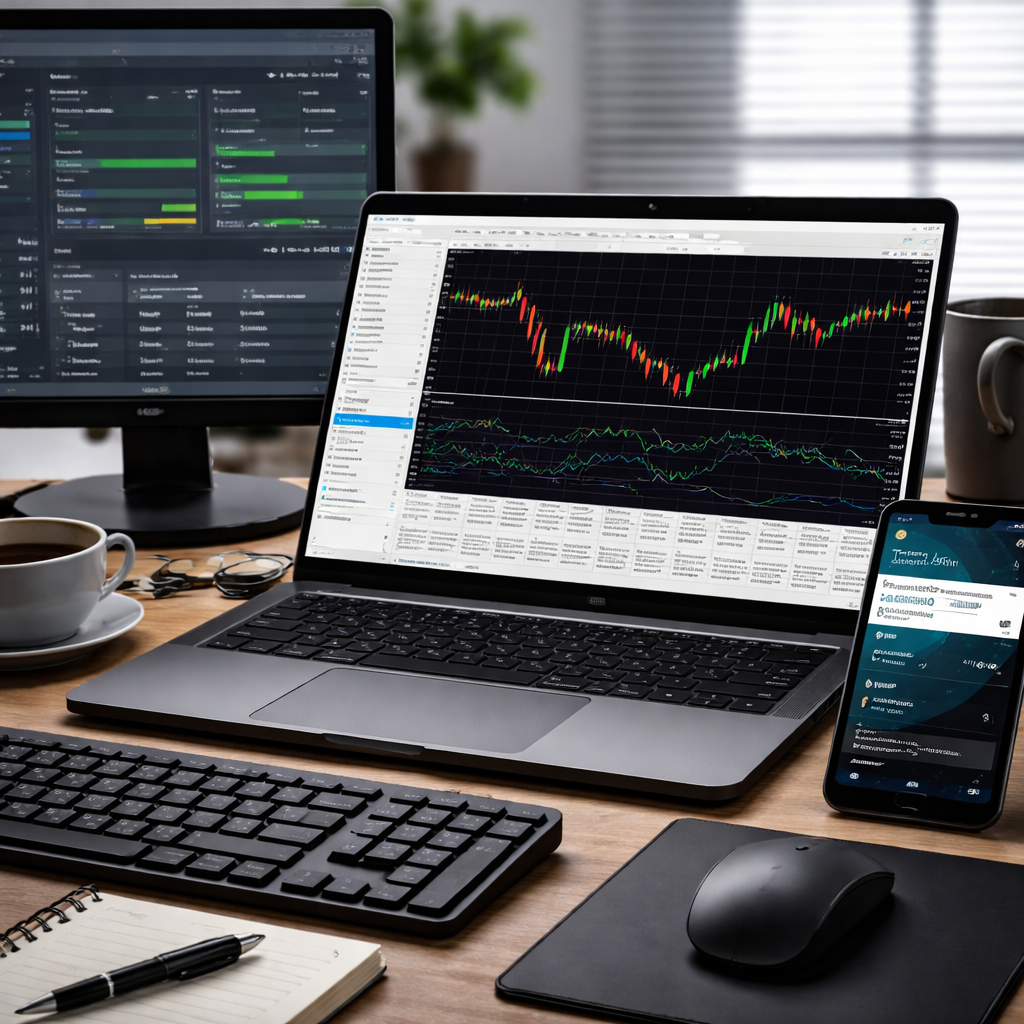
Remember to monitor the bot for at least a week before scaling up. Look for any missed orders, latency spikes, or unexpected slippage. Adjust your stop‑loss or position sizing if the live drawdown exceeds your backtested limits.
Advanced Considerations: Multi‑Timeframe and Strategy Optimization , A forex algorithmic trading basics guide
Once you’ve mastered a single‑timeframe bot, you can add depth with multi‑timeframe analysis. This approach looks at the same pair on three charts , long, medium, and short , to confirm the trend.
Why it works: The long‑term chart (daily or weekly) tells you the dominant direction. The medium‑term chart (4‑hour) shows the current swing, and the short‑term chart (15‑minute) pinpoints the entry window.
Step‑by‑step to add multi‑timeframe logic:
- Pick three timeframes, e.g., Daily, 4‑hour, 15‑minute.
- Calculate the same indicator on each , say, a 20‑period EMA.
- Define the trade condition: go long only if EMA on Daily is above EMA on 4‑hour, and price on 15‑minute is above its EMA.
- Set exit rules similarly, requiring all three timeframes to align for a short.
- Backtest the combined rule set using walk‑forward testing to ensure it still performs.
The IFCM article explains how each timeframe serves a purpose: long‑term shows overall trend, medium‑term helps manage the trade, short‑term finds the exact entry. It also warns against using too many timeframes, which can cause redundant signals.
Optimization tip: use a grid search to find the best EMA lengths for each timeframe. Keep the total number of parameters low , three EMAs is manageable.
Two external links deepen your understanding:
The IFCM guide on multiple‑timeframe analysis walks through choosing the right periods and why they matter. Read it at IFCM.
For a practical coding example, the Goat Funded Trader site shows how to pull multi‑timeframe data in Python and sync the bars. Check the tutorial at Goat Funded Trader.
When you finish, you’ll have a more robust bot that filters out false signals and adapts to changing market regimes.
Conclusion
This forex algorithmic trading basics guide has taken you from market fundamentals all the way to live deployment and advanced multi‑timeframe tricks. You learned why solid data matters, how to code a simple MA crossover, how to backtest with in‑ and out‑of‑sample periods, and how to lock in risk with dynamic stops. You also saw which tools and platforms the research table flags as most useful , Intrinio for data, MT4 or cTrader for execution, and a VPS for low latency.
Remember, the biggest edge isn’t a fancy AI model; it’s clear goals, disciplined risk, and relentless testing. Start small, keep a journal, and iterate. When you feel confident, scale the position size gradually and add more sophisticated filters like multi‑timeframe confirmation.
Ready to build your first bot? Grab the free checklist on FXDoctor, set up a demo account, and put the steps from this guide into practice. Your journey to consistent, automated forex trading begins now.
FAQ
What is the first step in a forex algorithmic trading basics guide?
The first step is to understand the forex market’s structure, liquidity, and the economic events that move prices. You also need to define clear, measurable goals using the SMART framework. This foundation helps you choose the right pair, timeframe, and risk parameters before you code anything.
How much historical data do I need for backtesting?
You should aim for at least two years of minute‑level data for a robust test. The data must cover different market regimes , trending, ranging, high‑volatility, and low‑volatility periods. Clean the data by removing outliers and adjusting for daylight‑saving time changes. This breadth ensures your results aren’t just a product of a single market condition.
Can I use Python instead of MQL4 for my forex algo?
Yes. Python works with many brokers via APIs, and libraries like backtrader or Zipline make backtesting easy. However, you’ll need a bridge to your broker , either a third‑party service or a custom FIX connection. MT4/MT5 still offers the most straightforward path for beginners because the platform includes built‑in testing tools.
What risk‑management rules are essential?
Key rules include fixing a maximum risk per trade (1‑2% of equity), using dynamic stop‑losses based on ATR, setting daily drawdown caps (5‑10% of equity), and employing a trailing stop to lock in profits. Tracking metrics like Sharpe ratio, profit factor, and max drawdown helps you verify that the risk framework is working as intended.
How do I monitor my live algorithm?
Set up real‑time alerts via email or SMS for drawdown breaches, latency spikes, or unexpected trade volume. Use the platform’s built‑in monitoring dashboard, or connect a third‑party monitoring service that reads the broker’s API. Keep a trade log and review it weekly to spot patterns that need tweaking.
When should I add multi‑timeframe analysis?
Once your single‑timeframe bot shows consistent profitability, add a second and third timeframe to filter out false signals. Start with a long‑term trend check (daily), a medium‑term swing (4‑hour), and a short‑term entry (15‑minute). Test the combined logic thoroughly before going live.
Further Learning Resources
To deepen your knowledge, explore the FXDoctor’s comprehensive courses on forex technical analysis, risk management, and psychology. Their free forex trading course offers video lessons and downloadable worksheets that complement the steps outlined in this guide.
Additionally, the “forex automated trading strategies” page provides a catalog of algorithmic approaches you can experiment with once you’ve mastered the basics.