

Ever sat in front of a screen, watching those currency pairs dance, and thought, “How do I actually turn this chaos into a plan?”
Most of us start with that exact feeling – a mix of curiosity and a hint of overwhelm. The truth is, forex trading strategies aren’t a secret code hidden in a vault; they’re a collection of tools and mindsets you can build step by step.
In this article we’ll peel back the layers that keep beginners stuck and give you a clear roadmap to craft strategies that actually match your risk tolerance, time horizon, and personality.
But first, let’s acknowledge the frustration of endless YouTube tutorials promising quick riches. Those promises often ignore the fundamentals: market structure, risk management, and disciplined execution. Without those pillars, any “strategy” is just guesswork.
So, what will you walk away with? By the end you’ll understand how to spot reliable entry and exit cues, how to layer indicators without overcomplicating things, and why a solid risk‑management framework is the backbone of every successful forex trading strategies.
We’ll also point out common pitfalls – like relying on a single time‑frame or chasing every news headline – and show you how to avoid them. Think of it as a friendly workshop where we test ideas together, pause for a coffee break, and keep the conversation real.
Ready to move from “I’m just watching the market” to “I have a plan I trust”? Let’s dive in and start building a strategy that feels as natural as checking the weather before you head out.
Throughout the guide we’ll sprinkle real‑world screenshots, simple checklists, and quick quizzes so you can test each concept as you go – no fluff, just practical steps you can apply today.
If you’re an aspiring trader hungry for a solid foundation, an intermediate player looking to tighten up your edge, or a finance professional wanting a refresher, this roadmap is built for you. Let’s get started.
TL;DR
If you’ve ever felt overwhelmed by charts, this guide breaks down forex trading strategies into clear, actionable steps you can start using today.
We’ll show you how to spot reliable entry and exit cues, layer indicators without overcomplicating, and build a risk‑management framework that keeps your capital safe while you develop a personalized system.
Strategy 1: Trend‑Following Forex Trading Strategy
Ever wonder why some traders seem to glide along with the market while you feel like you’re fighting a current? The secret often lies in simply moving *with* the trend instead of trying to predict every twist.
Trend‑following is the oldest, most intuitive forex trading strategy. It’s built on the idea that price tends to keep moving in the same direction until something fundamentally shifts. Think of it like a river: you either paddle downstream or you get swept away.
1️⃣ Spot the Trend Early
Start by looking at a higher‑timeframe chart—daily or weekly—for the big picture. If the pair is making higher highs and higher lows, you’ve got an uptrend. The opposite pattern signals a downtrend. A quick visual cue? Draw a simple trend line connecting the recent swing lows (or highs) and watch how price respects it.
But don’t stop there. Switch down a notch—say to the 4‑hour or 1‑hour chart—to fine‑tune entry points. This multi‑timeframe check helps you avoid jumping in too early, a common pitfall for beginners.
2️⃣ Confirm with Momentum
Once you think the trend is clear, add a momentum indicator like the RSI or MACD. If the RSI is above 50 in an uptrend (or below 50 in a downtrend) and the MACD line is above the signal line, you have extra confidence that the market’s energy backs your direction.
In our experience, pairing a clean trend line with a single momentum filter keeps the setup simple yet reliable. For deeper dives into which indicators work best, check out our Technical Analysis Resources page.
3️⃣ Enter with Patience
Instead of chasing the next candle, wait for a pull‑back to the trend line or a short‑term support/resistance level. A common entry rule is: when price touches the trend line and the momentum indicator stays in the same zone, place a market or limit order.
And remember, you don’t have to be glued to the screen 24/7. Set alerts for the price level you’re watching; this frees you up for a coffee break without missing the trade.
4️⃣ Protect Your Capital
Every good trend‑following system pairs a clear exit plan. A simple method is to set a stop‑loss just beyond the most recent swing low (for longs) or swing high (for shorts). As the trade moves in your favour, trail the stop‑loss a few pips behind the last swing point. This way you lock in gains while letting winners run.
For a more structured approach, you might read about position sizing on our Risk Management Strategies page—but keep it brief here to stay focused.
5️⃣ Take Profits Strategically
One popular tactic is the 2:1 reward‑to‑risk ratio: aim for a profit target that’s at least twice your stop‑loss distance. If the market keeps marching, you can move your stop‑loss to break‑even and let the trend do the rest.
Alternatively, use a trailing stop based on the same swing‑point logic you used for entry. It’s a hands‑off way to capture most of the trend while protecting you from sudden reversals.
Does this sound like a lot? It’s actually a handful of rules you can write on a sticky note and refer back to before you trade.
Now, a quick side note about the broader landscape: if you’re trading crypto‑linked forex pairs, you might wonder about the legal side. A reliable source for compliance advice is NeosLegal UAE Crypto Lawyers, who specialize in blockchain regulations.
And while you’re sharpening focus for those long chart‑watching sessions, consider a little cognitive boost. Great Bite Supplements offers nootropic gummies designed to support mental clarity—something many traders find handy during intensive analysis.
So, to sum it up: identify the trend on a higher timeframe, confirm with a momentum check, wait for a tidy pull‑back, lock in risk with a stop‑loss, and let the market do the heavy lifting. Follow these steps, and you’ll see how “going with the flow” feels less like luck and more like a repeatable process.

Strategy 2: Breakout Trading Strategy
1️⃣ Spot the real walls – support and resistance
First thing you need to do is draw the levels that have held price for a while. In forex those are often the highs and lows that the market has bounced off of three or more times. When you see a line that’s been respected for weeks on the EUR/USD weekly chart, that’s a pretty solid wall.
Why does this matter? Because a breakout is only powerful when it tears through a zone that traders already consider important.
2️⃣ Look for a consolidation pattern
Most breakouts follow a period of tight price action – think triangles, flags, or simple rectangular ranges. As the range tightens, buying or selling pressure builds under the surface.
Picture the GBP/JPY in early 2026: it squeezed into a descending triangle for a handful of days, then exploded upward. That squeeze‑and‑release is the classic set‑up.
3️⃣ Get volume confirmation
Price alone can be deceptive. A true breakout usually comes with a noticeable jump in volume. If the candle that finally pierces resistance is also heavier than the average of the last ten bars, you’ve got confirmation.
Investopedia explains why volume matters in a breakout scenario: breakout trading basics. That extra activity shows the market is committing to the new direction.
4️⃣ Define your entry and stop‑loss
Once you’ve got the confirmation, decide how you’ll get in. Many traders wait for the close of the breakout candle to avoid fakeouts, then enter on the next bar. Your stop‑loss should sit just beyond the opposite side of the broken level – either a tick below the old resistance (now support) for a long trade, or above the old support for a short.
Remember, the old barrier becomes a “line in the sand.” If price slips back through it, the trade is likely dead.
5️⃣ Set a realistic profit target
One quick way to estimate a target is to measure the height of the prior consolidation range and project it upward (or downward) from the breakout point. If the range was 80 pips, aim for roughly 80‑100 pips beyond the breakout.
Another method is to watch where the next major support or resistance sits on a higher time‑frame. That gives you a natural place to take partial profits or move your stop‑loss to break‑even.
6️⃣ Manage the trade – ride the momentum, protect the downside
Breakouts can be fast‑moving, so keep an eye on the trade. If the price continues to pull away, consider trailing your stop with a short‑term moving average or a fixed pip distance. If the market hesitates and retests the broken level, you might tighten the stop or exit early.
For aspiring traders, the biggest pitfall is staying in a losing breakout too long. Stick to the plan you wrote before you entered – it’s the safety net that keeps emotions from taking over.
In summary, a breakout trading strategy is all about three things: a well‑defined price barrier, a clear signal that the barrier is finally giving way, and a disciplined exit plan. When you line those up, you capture the kind of volatility that can move a modest account forward without relying on guesswork.
Strategy 3: Swing Trading with Video Overview
Ever felt like the market is a roller‑coaster and you’re just holding on for the ride? Swing trading is the middle ground between day‑trading adrenaline and long‑term patience. It lets you capture those tasty price “swings” without staring at the screen every minute.
1️⃣ Identify the dominant trend first
Before you chase any swing, ask yourself: is the market generally moving up or down? A simple moving average on a higher timeframe (like the 50‑period on a daily chart) can tell you whether you’re in an up‑trend or down‑trend. When price sits comfortably above the MA, you’re looking for “buy the dip” opportunities; below the MA, you’re hunting “sell the rally.”
Think of it like walking up a hill – you’ll want to step on the upward parts, not waste energy walking downhill.
2️⃣ Spot swing highs and swing lows
Swing highs are those peaks where price struggled to move higher, and swing lows are the troughs where it found support. Mark them on your chart; they become the natural “entry zones” for your trades. In an up‑trend, you’ll aim to enter near a swing low and target the next swing high.
It’s okay if you miss the exact low – the goal is to catch as much of the move as possible, not the perfect bottom.
3️⃣ Use momentum to time the entry
Momentum indicators like RSI or Stochastics can confirm that the price is ready to swing back in your favor. For example, when RSI climbs out of oversold territory (below 30) in an up‑trend, that’s often a green light to go long. Conversely, a pull‑back into overbought territory (above 70) during a down‑trend can cue a short entry.
These signals help you avoid jumping in too early, which is a common pitfall for aspiring traders.
4️⃣ Place a logical stop‑loss
Risk management is the backbone of any forex trading strategies. For a long swing, set your stop just below the most recent swing low; for a short swing, place it just above the swing high. This way, if the market flips, your loss is limited to a predictable amount.
Remember, a stop isn’t a punishment – it’s a safety net that protects you from a larger trend reversal.
5️⃣ Define a realistic profit target
One easy method is to measure the distance between the swing high and swing low you just identified, then project that distance forward from your entry. If the swing was 80 pips, aim for roughly 80‑100 pips beyond your entry point. Adjust for volatility – tighter markets may need a smaller target.
Trailing a portion of your profit with a moving average can also lock in gains as the trend continues.
6️⃣ Review the trade with a quick checklist
Before you hit “enter,” run through a mental checklist: trend direction confirmed? Swing low/high identified? Momentum signal in place? Stop‑loss set? Target calculated?
Doing this in a demo account first can give you confidence without risking real capital.
If you want a visual walk‑through, check out this concise swing trading guide from IG. It breaks down the same steps we’ve just discussed, with clear chart examples.
For a quick video recap, the YouTube community has put together a short overview that mirrors these points – you can find it here. It’s a handy supplement when you’re reviewing your notes on the go.
Swing trading fits nicely into a broader toolbox of forex trading strategies. It gives you the flexibility to hold positions for a few days to a few weeks, while still staying aligned with the larger market picture. By mastering the swing‑high/low framework, you’ll add a reliable, low‑stress approach to your trading repertoire.
Strategy 4: Carry Trade – Comparing Key Currency Pairs
Ever wonder why some traders seem to earn a little every night without watching the charts? That’s the charm of the carry trade – you’re basically borrowing a low‑rate currency and earning interest on a higher‑rate one.
But before you jump in, you need to know which pairs actually pay you, and which ones just look pretty on paper. Let’s break it down like we would for any of our forex trading strategies lessons.
1️⃣ What makes a good carry pair?
Three things matter most:
- Interest‑rate differential – the bigger the gap, the bigger the potential carry.
- Swap cost – brokers add a fee or credit; a low‑cost broker can turn a modest differential into real income.
- Volatility – you want enough movement to stay in the trade, but not so much that it wipes out your interest earnings.
Think of it like choosing a savings account: you want the highest rate, low fees, and a stable balance.
2️⃣ Top‑performing pairs (as of the latest data)
Below is a quick snapshot of the most liquid pairs that consistently deliver a net positive yield. The numbers come from the carry trade currency pair yields table, which aggregates broker‑average spreads and swap rates.
| Currency Pair | Net Annual Yield (%)* | Approx. Daily Income (USD) per 1 lot |
|---|---|---|
| AUD/JPY | ≈5.2 | $9‑$12 |
| NZD/JPY | ≈4.8 | $8‑$11 |
| USD/TRY | ≈8.0 | $15‑$18 |
*Yields are indicative and can shift with central‑bank policy changes. Daily income figures assume a standard 100,000‑unit lot and the best‑available broker rate.
Notice how the “exotic” USD/TRY pair tops the list. That’s because the Turkish lira often carries a very low (or even negative) policy rate, while the US dollar still offers a solid interest return.
3️⃣ How to pick the right pair for your style
If you’re an aspiring trader just learning the ropes, start with the more “stable” pairs like AUD/JPY or NZD/JPY. They tend to have smoother price action, which means you can focus on the interest credit without fighting massive spikes.
Experienced traders who enjoy a bit of spice might look at USD/TRY or EUR/TRY. The higher yields are tempting, but the price can swing dramatically on political news, so you’ll need tighter risk controls.
And for finance professionals building a personalized system, consider diversifying across three buckets: a low‑volatility pair, a medium‑volatility pair, and an occasional high‑yield exotic. That way you capture steady income while still having room for upside when the market is calm.
4️⃣ Practical checklist before you go live
- Confirm the current net yield on your broker’s swap schedule – rates change daily.
- Calculate the implied daily income for your intended lot size.
- Set a stop‑loss that reflects the pair’s typical volatility (e.g., 50‑pips for AUD/JPY, 100‑pips for USD/TRY).
- Keep an eye on central‑bank meetings – a surprise rate cut can flip the carry in minutes.
- Use a broker with low swap spreads; the table above shows the “broker average” versus the “highest yield” provider.
Following that list keeps the trade disciplined and prevents the carry from turning into a hidden cost.
5️⃣ Common pitfalls and how to avoid them
One mistake newbies make is assuming the carry will always outweigh any price move. In reality, a sudden swing can erase weeks of interest. That’s why we always recommend pairing the carry with a modest trend filter – for example, only stay long when the 50‑day moving average on the higher‑timeframe is upward.
Another trap is ignoring rollover timing. Some brokers credit swaps at the end of the trading day, others at 5 pm GMT. Knowing when you’ll receive (or pay) the swap helps you plan your cash flow.
Finally, never overlook the tax angle. In many jurisdictions, swap income is treated as ordinary interest, which may be taxed differently from capital gains. A quick chat with a tax adviser can save you surprise bills later.
So, does the carry trade still make sense in 2026? Absolutely – as long as you respect the interest differential, manage volatility, and stay on top of broker costs.
Strategy 5: Counter‑Trend (Mean Reversion) Strategy
Ever felt like the market is a rubber band that keeps snapping back after you stretch it? That’s the feeling behind a mean‑reversion approach – you’re betting the price will drift toward its average after a short‑term extreme.
1️⃣ Spot the overbought/oversold signal
Start by checking a momentum oscillator. When the RSI climbs above 70, the pair is likely overbought; when it drops below 30, it’s oversold. Those thresholds aren’t magic, but they give you a concrete cue that the market may be due for a correction.
We often pair RSI with a simple visual cue: Bollinger Bands. If price is touching the upper band while RSI is screaming over 70, that’s a classic “price is stretched” scenario.
2️⃣ Measure the distance from the mean
Next, calculate how far the current price sits from a moving average – a 20‑period SMA works well on a 1‑hour chart for most majors. If EUR/USD is 1.5% above its SMA in a ranging market, you’ve got a high‑probability fade opportunity.
Some traders prefer a Z‑score for extra precision. A Z‑score of +2 means the price is two standard deviations above the mean, which aligns nicely with the Bollinger‑Band logic.
3️⃣ Filter with a range‑bias indicator
Mean reversion shines when the market is flat. Use the ADX: readings below 20‑25 suggest a non‑trending environment. If ADX spikes above 30, you might want to sit this one out because a new trend could be forming.
Timing matters, too. Asian session hours (23:00‑07:00 GMT) often produce tight ranges for EUR/USD and USD/JPY, giving you clean setups without news‑driven spikes.
4️⃣ Define entry and stop‑loss
Enter when price retraces toward the SMA or the middle Bollinger Band. Place your stop just beyond the extreme – for a long trade, a stop a few pips above the upper band, and for a short, a few pips below the lower band. This gives the trade room to breathe while capping the worst‑case loss.
Many traders risk 1‑2% of account equity per trade. If you’re risking $50 on a $5,000 demo account, that translates to a stop of roughly 50‑pips on a standard lot, depending on the pair.
5️⃣ Set a realistic profit target
Mean‑reversion trades rarely chase the full swing. Aim for the mean – the SMA or the centre of the Bollinger Band. If you entered 40 pips above the SMA, a 30‑pip profit back to the mean is often enough.
For extra safety, you can scale out: close half the position at the mean, then trail the rest with a short‑term moving average.
6️⃣ Keep a rule‑based journal
Document every entry: pair, time‑frame, indicator values, stop, target, and outcome. Over time you’ll see which pairs revert most reliably. EUR/CHF and AUD/NZD, for example, have a reputation for tight ranges during calm sessions.
Back‑testing on historical data is a must before you risk real capital. A quick spreadsheet can help you tally win‑rate, average R, and max drawdown.
Want a deeper dive into overbought and oversold mechanics? IG breaks down how RSI and Stochastic signal these conditions and why they work best in ranging markets here.
For a concise explanation of why price tends to revert to its average, check out the mean‑reversion overview from New York City Servers here. It covers the statistical logic behind Bollinger Bands, Z‑scores, and the importance of a clear rule‑set.
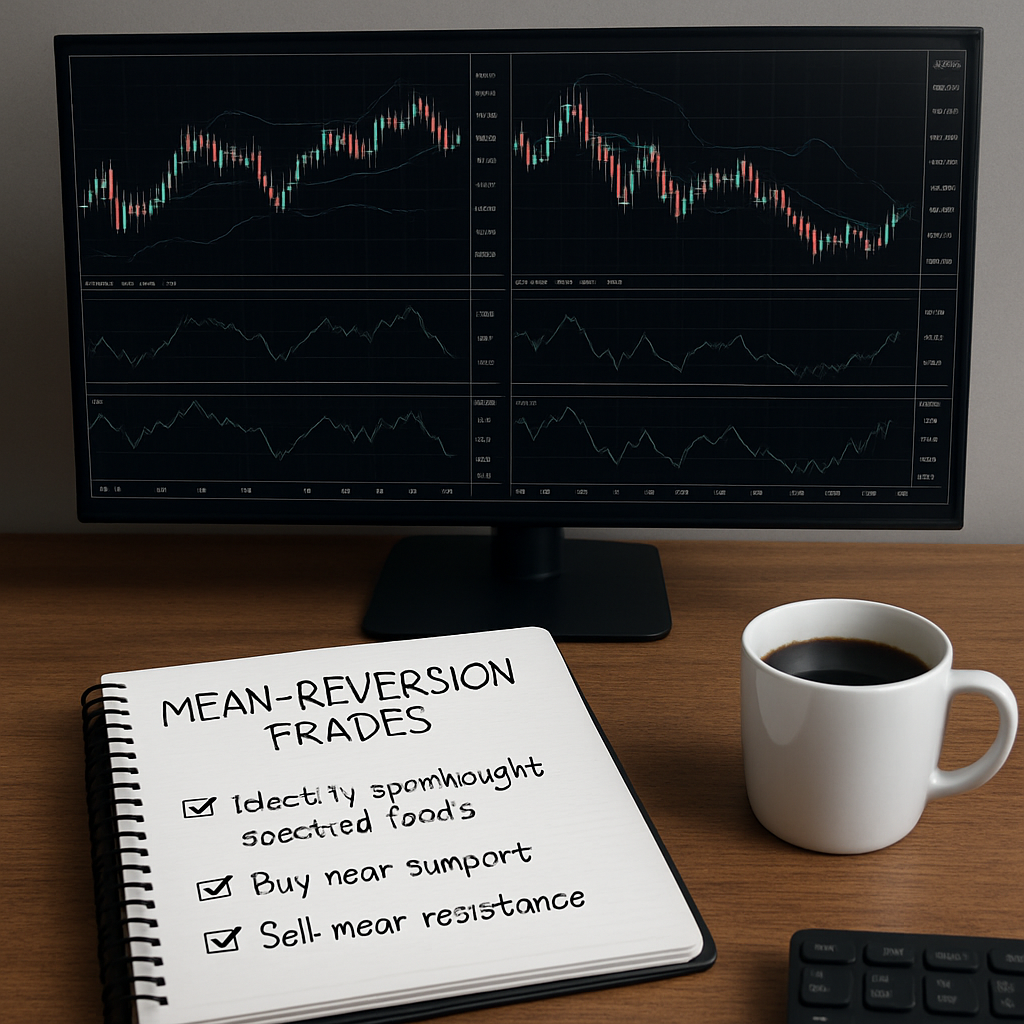
Bottom line: mean‑reversion is a statistical cousin of trend‑following. It thrives in sideways markets, offers frequent small wins, and requires disciplined risk control. If you blend it with a simple trend filter, you get a versatile tool that fits nicely into any toolbox of forex trading strategies.
FAQ
What are the most important factors to consider when choosing a forex trading strategy?
First, think about your own risk tolerance – are you comfortable with a few big swings or do you prefer many small wins? Next, look at the market condition you’ll be trading in; a trend‑following approach shines in strong moves, while mean‑reversion works best in sideways periods. Finally, match the time‑frame to the amount of time you can spend in front of the charts. If you only have an hour a day, a longer‑term setup will feel less stressful.
How do I know if a strategy is suitable for a ranging market?
One quick test is to check the Average Directional Index (ADX). Values below 20‑25 usually signal a lack of strong trend, which is a green light for range‑based tactics like Bollinger‑Band fades or RSI overbought/oversold fades. You can also glance at recent price action: if the pair bounces between the same support and resistance levels for several days, that’s a classic sideways pattern. In those moments, keep your stop‑loss tight and aim for the mean.
Can I combine trend‑following and mean‑reversion without overcomplicating my setup?
Absolutely – think of it as a two‑layer filter. Start with a high‑timeframe trend check (e.g., 50‑day moving average) to decide the overall direction. Then, on a lower time‑frame, look for a mean‑reversion signal that aligns with the trend bias, like a pull‑back to the 20‑period SMA. This way you ride the larger wave but still capture the small bounce, and you avoid entering against the dominant market flow.
What risk‑management rules should I apply to any forex trading strategy?
Never risk more than 1‑2 % of your account on a single trade – that keeps a string of losses from wiping you out. Place your stop‑loss just beyond a logical technical level (the last swing low for a long, the swing high for a short). Use a risk‑to‑reward ratio of at least 2:1, and consider a trailing stop once the trade moves in your favour. Consistency in these rules matters more than any single winning trade.
How often should I review and adjust my forex trading strategies?
Schedule a brief review after each trading week. Look at win‑rate, average profit per trade, and whether your stop‑losses were hit too often. If you notice a pattern – for example, losing more on news‑heavy days – tweak the entry filter or add a news‑avoidance rule. A quarterly deep‑dive is also useful: re‑back‑test the strategy on the latest data and adjust parameters if market dynamics have shifted.
Is back‑testing really necessary, and what’s a simple way to do it?
Yes, back‑testing gives you a reality check before you risk real capital. A simple spreadsheet can do the trick: export historical price data, mark your entry and exit rules, then calculate profit, loss, and maximum drawdown. Even a basic Excel model will reveal whether your edge holds up over dozens of trades. The goal isn’t perfection, just enough evidence that the idea isn’t pure luck.
Where can I find reliable educational resources to deepen my understanding of forex trading strategies?
FX Doctor’s blog offers step‑by‑step guides that cover everything from basic candlestick patterns to multi‑timeframe confluence. Their free basic education section is perfect for beginners, while the professional trader course dives into advanced technical analysis and psychology. Pair those lessons with reputable, non‑promotional sources like central‑bank releases or academic papers on market microstructure to round out your knowledge.
Conclusion
We’ve walked through five core forex trading strategies, from trend‑following to the carry trade, and you now have a toolbox you can start testing.
The common thread? Every approach relies on clear entry rules, disciplined risk management, and a willingness to review performance.
If you’re an aspiring trader, start with the simplest pattern – a moving‑average trend filter – and add a stop‑loss a few pips below the last swing low.
More experienced traders can layer a secondary indicator, like RSI, to catch overbought or oversold conditions before committing capital.
Remember the carry trade isn’t a free lunch; you still need a trend bias and a stop that respects the pair’s volatility.
Mean‑reversion works best when the ADX stays under 20, signaling a flat market where price tends to bounce back toward the mean.
A quick checklist before you hit ‘enter’ can keep emotions out of the equation: trend direction, entry signal, stop placement, and target.
Set a reminder to journal each trade – noting why you entered, what the market did, and what you’d tweak next time.
Over weeks, look for patterns in your win‑rate and drawdown; small adjustments often yield big consistency gains.
The big picture? No single strategy dominates forever – the markets evolve, and so should your approach.
So, what’s the next step? Pick one of the strategies you resonated with, set up a demo account, and run a two‑week trial.
When the trial feels solid, transition slowly to a live account, always keeping your risk per trade under 2 %.
And if you ever need a deeper dive, FX Doctor’s structured courses break each concept down step‑by‑step, so you can keep sharpening your edge.
Further Reading & Resources
If you’ve soaked up the five core forex trading strategies and still want more depth, there’s a solid library of resources you can dive into right now.
FX Doctor’s free basic education hub walks you through every building block—from candlestick anatomy to multi‑timeframe confluence—without any sales pressure.
The Professional Trader Course adds structure, covering advanced risk‑management, trading psychology, and the back‑testing rigor that separates hobbyists from serious players.
Looking for an all‑in‑one path? The Master Course bundles all core modules—trend‑following, breakouts, swing, carry, mean‑reversion—into a cohesive curriculum, so you can switch between strategies without missing a beat.
If you learn best by watching, our curated video playlists isolate single concepts like reading RSI divergences or sizing optimal stop‑loss distances, letting you replay the exact part that feels fuzzy.
Don’t forget the community forum, where real traders post trade‑journals, post‑mortem analyses, and answer the exact questions you’re asking right now. It’s a low‑stakes way to test ideas before you risk real capital.
Pick one resource, spend 15 minutes exploring, and then apply a single tweak to your next demo trade—you’ll see the difference instantly.
Remember, the best learning habit is consistency: schedule a quick review of one concept each day, and you’ll build a toolbox that adapts as markets evolve.
[…] Swing trading sits right between day‑trading’s frantic pace and long‑term investing’s slow burn. It lets you ride price waves that last a few days to a couple of weeks, giving you enough time to analyze, adjust stops, and still keep a day‑job or other commitments. […]
[…] This is education first, execution second. If you want a deeper dive into concrete approaches, Forex Trading Strategies: 5 Proven Approaches for Beginners and Beyond provides a well-structured view you can compare against your own […]