

Ever found yourself staring at an economic calendar, wondering if today’s headlines will actually move the market?
You’re not alone – most aspiring traders feel that mix of excitement and uncertainty when a fresh news release pops up.
In this intro we’ll unpack why a solid forex news trading strategy matters and how you can start building one without drowning in data.
Think about the last time a surprise rate decision hit the EUR/USD pair.
Did you see the price swing and wish you’d known exactly how to react?
That moment is the spark that shows us news isn’t just background chatter; it’s a catalyst you can trade with discipline.
A good forex news trading strategy blends three core ideas: timing the release, gauging the market’s sentiment, and protecting your capital.
Timing means you’re ready a few seconds before the data drops, not scrambling after the fact.
Sentiment comes from reading not just the number but the tone of central‑bank statements, employment reports, and geopolitical headlines.
But there’s a catch – news can be noisy, and without a framework you risk chasing false moves that leave a bruised account.
That’s why we always start with a clear plan: define which news events you’ll trade, set entry‑trigger rules, and pre‑determine stop‑loss and profit targets.
For beginners, focusing on the most liquid pairs – like EUR/USD, GBP/USD, and USD/JPY – gives you tighter spreads and clearer reactions.
Experienced traders often add cross‑currency pairs to capture secondary effects, but the underlying principle stays the same: let the news dictate the trade, not the other way around.
So, what’s the first step?
Grab a reliable economic calendar, pick one headline event per day, and write down exactly how you’ll enter, exit, and manage risk before the clock hits zero.
When you treat the news release like a scheduled appointment rather than a surprise, you turn uncertainty into an edge.
TL;DR
Mastering a forex news trading strategy means timing releases, reading sentiment, and protecting capital, all in a plan you can apply before each headline drops. Follow our step-by-step framework to turn economic surprises into disciplined opportunities, manage risk precisely, and stay consistent without chasing noise for your trading journey today.
Step 1: Understand How Forex News Impacts Markets
Let’s be honest: forex news releases can feel like a storm you didn’t ask for. Prices swing, spreads widen, and you’re left guessing whether to chase a move or sit on the sidelines.
What you’re really after is a clear picture of how those headlines actually move the market, so you can trade with signal, not noise. It’s not about predicting every number; it’s about understanding the mechanics behind the moves and building a simple plan that fits your risk tolerance.
What actually moves the market when news hits
Two big ideas drive the volatility around releases: surprise versus expectations and how the crowd has positioned themselves beforehand. If the actual figure beats expectations, you’ll often see a sharp price reaction; if it misses, you’ll see the opposite. The magnitude depends on the surprise and the market’s cumulative positioning going into the release.
Another piece is liquidity. In the moments before and after a release, banks, funds, and algorithmic traders pile into or pull out of the market, which can widen spreads and cause rapid price shifts. That’s why many traders avoid larger risk just at the headline moment and instead look for a disciplined setup after the initial spike settles down.
So, what should you do before the data arrives? Build a simple, repeatable framework you can apply consistently, no matter the headline. Define which events you’ll trade, set entry rules, and pre-determine stop-loss and take-profit targets so you’re not making it up on the fly.
Pre-release preparation you can put into practice
First, pick one or two high‑impact releases that typically move liquid pairs like EUR/USD, GBP/USD, or USD/JPY. Second, decide your time window—often the first 1–2 minutes after release contains the cleanest setups once initial noise dies down.
Third, establish a clear entry trigger tied to price action, such as a confluence of a candlestick pattern, a brief retrace, and a break of a defined level. Fourth, set a strict risk cap—perhaps 0.5–1% of your account per trade—so a single surprise won’t erase your entire day. And fifth, plan your exit: a fixed target or a volatility-adjusted target that adaptively responds to the size of the move.
To keep learning, check a derivation of sentiment alongside price action. Forex market sentiment indicators: A practical guide for traders helps you understand how the mood in the market reinforces or contradicts price moves. And remember, diversification matters; for some readers, exploring other assets can balance FX risk. For example, How to invest in mortgage notes: a practical step-by-step guide offers a different perspective on risk and returns, which can inform how you think about risk in FX trading.
Video time.
Before we wrap, a quick recap: know which events matter, set a tight window, use a price-action filter to confirm entries, and stick to your risk plan. So, what’s your first release to study today?

Step 2: Build a News Calendar and Identify Key Economic Releases
Now that you’ve seen how news can move the market, the next logical move is to stop guessing and start planning.
A solid forex news trading strategy begins with a reliable economic calendar. Think of it as your trading weather map – it tells you when the storms are coming so you can decide whether to stay put, set up a shelter, or ride the wave.
Why a Calendar Matters
If you’ve ever entered a trade only to watch a surprise data point smash the price a few seconds later, you know the feeling of being blindsided. A calendar removes that blind spot by laying out every high‑impact release, its time, and its expected influence. You go from reacting to reacting with confidence.
Choosing the Right Tool
Not every calendar is created equal. The one we rely on at FX Doctor is fast, intuitive, and flags impact levels clearly. You can check out a good example here: how to use an economic calendar for trading. It shows the event, country, forecast, previous value, and a three‑star impact rating – exactly what you need to triage the day.
Step‑by‑Step Checklist
- Mark high‑impact events. Filter for three‑star releases like U.S. CPI, Non‑Farm Payroll, ECB rate decisions, and GBP employment data.
- Note the time zone. Convert release times to your trading session so you’re not caught off‑guard by a midnight pop.
- Record the consensus. Jot down the forecast figure; the bigger the gap between forecast and actual, the larger the potential move.
- Identify pre‑release bias. Look at the order flow or price range a few minutes before the event – a tight range with a slight tilt often hints at the direction of the upcoming spike.
- Plan entry, stop, and target. Write these numbers on a sticky note or in your journal before the clock hits zero.
Once you have the list, map the week on a simple spreadsheet or a whiteboard. Highlight the days with multiple three‑star releases – those are your “high‑volatility windows.” On quieter days, you can focus on technical setups instead of news.
Identify the key releases that matter to the pairs you trade. For example, if you’re a EUR‑USD specialist, the ECB press conference and U.S. CPI are non‑negotiable. If you trade GBP‑JPY, the Bank of England’s minutes and Japan’s Tankan survey become your focus points.
Watch the video above for a quick walkthrough of setting up alerts on a popular calendar platform. The visual guide saves you a few clicks and shows exactly where to toggle the impact filter.
Putting It All Together
Every morning, spend five minutes scanning your calendar, updating your “must‑watch” list, and noting any surprise‑risk events (like unscheduled speeches). Then, when the release hits, you’ll already have a pre‑planned pending order or a clear decision to wait for the post‑event pull‑back.
Quick tip: on days with back‑to‑back high‑impact releases, consider scaling down your lot size or trading only one of the events. This protects your capital while still letting you capture the volatility you’re after.
Step 3: Combine News with Technical Analysis
So you’ve got your calendar locked and your news list ready – great. The next question is what you actually do with those numbers once they hit the screen. The magic happens when you let a solid technical framework filter the raw noise.
Imagine you’re watching EUR/USD minutes before a U.S. CPI release. The price is stuck in a tight range, the 50‑period SMA is flat, and the order flow hints at a slight bullish tilt. That little picture is your launchpad – it tells you where the market might sprint once the data lands.
Step 1: Spot the pre‑release technical story
Start by scanning the chart for a clear pattern: a breakout zone, a triangle, or a well‑tested support line. If the pair is respecting a horizontal resistance and the higher‑timeframe trend is up, you’ve already got a bias.
Ask yourself: “Does the price respect this level right now?” If the answer is yes, you can plan a pending order just beyond it. If the market is already choppy, you might skip the trade and wait for the post‑event pull‑back.
Step 2: Align timeframes with the news window
High‑impact releases can move markets in seconds, so you need a fast‑reacting timeframe – usually the 1‑minute or 5‑minute chart. Flip to the higher‑timeframe (15‑minute or hourly) to confirm the broader trend. That dual‑timeframe view prevents you from getting whiplashed by a fleeting spike that goes against the larger market direction.
Think about it like checking the weather on a satellite image before you decide whether to bring an umbrella for a sudden shower.
Step 3: Use support and resistance as entry filters
When the news drops, the first few seconds are often a liquidity vacuum. Instead of chasing the initial spike, wait for the price to respect the nearest support or resistance you identified earlier. A bounce off that level is a cleaner entry point and usually comes with tighter spreads.
Does that mean you ignore the first move? Not necessarily – you can set a stop‑order a few pips beyond the level and let the market decide if it holds.
Step 4: Choose the right order type
Pending stop‑orders work best for breakout‑style entries, while limit orders are handy for pull‑back entries. The key is to avoid market orders right at the headline; they often suffer from slippage and widened spreads.
Tip: If you’re a newer trader, start with a modest lot size for news trades – the volatility can be unforgiving.
Step 5: Lock in risk before the release
Set your stop‑loss based on the average true range (ATR) of the last 14 periods or a multiple of the breakout distance. Your profit target can be the next logical structure – a swing high, a Fibonacci extension, or the next major support.
Remember, the goal isn’t to catch every pip, but to protect your capital while you let the market do the work.
| Analysis Element | What to Watch | Action |
|---|---|---|
| Pre‑release price pattern | Consolidation, bias in order flow, nearby support/resistance | Place pending order just beyond the breakout zone |
| Immediate spike | Liquidity void, widened spread, erratic ticks | Stay out; monitor for a pull‑back to a clean level |
| Post‑event trend | Retest of breakout level, continuation candle, higher‑timeframe alignment | Enter with tight stop, aim for next structure or ATR‑based target |
Let’s walk through a quick example. You’ve marked the 1.0800 resistance on EUR/USD as a breakout point before the ECB rate decision. You set a buy‑stop at 1.0803, with a stop‑loss 15 pips below the resistance and a profit target at the next swing high around 1.0850. The rate decision surprises to the upside, the price rockets past 1.0803, respects the new support at 1.0805, and you’re in the trade with a tidy risk‑to‑reward ratio.
On the flip side, if the decision disappoints, the price falls back through the resistance, hits your stop‑loss, and you’re out before the market can swing wildly. That’s a clean, disciplined outcome – no panic, no over‑trading.
Bottom line: marrying news with technical analysis gives you a roadmap through the chaos. You’re not guessing; you’re following a pre‑planned structure that tells you when to enter, where to protect, and how to exit.
Give it a try tomorrow. Scan your calendar, plot the key levels, set those pending orders, and watch how the market behaves when the headline drops. You’ll notice the difference between reacting to noise and trading with a clear edge.
Step 4: Develop a Trade Execution Plan Using News Events
We’ve talked through spotting the moves and pairing news with technical analysis. Now the real work happens—creating a plan you can actually execute when the headlines drop. A solid plan turns volatility into a repeatable process, not a gut‑check in the moment.
Does this actually work in practice? Yes—when you predefine your rules and stick to them. In 2026, with frequent high‑impact releases, a disciplined approach isn’t optional, it’s essential. This section lays out a pragmatic, step‑by‑step plan you can adapt to your trading style.
Step 1: Pre‑event alignment
Before the clock hits zero, scan your calendar for high‑impact events on the pairs you trade. Note the time, the expected consensus, and the potential drift between forecast and actual. This isn’t crystal ball stuff; it’s about bias management. If consensus shows a wide gap, expect a bigger move. If the number is a near‑replica of forecasts, volatility may be muted.
Ask yourself: where is the likely liquidity? Which levels look most relevant for a breakout or a pullback? This is where you decide whether you’ll place pending orders, go in on a pullback, or sit the trade out entirely. A clear stance now saves you from frantic decisions during the spike.
Step 2: Entry criteria using order types
Next, translate your bias into a concrete entry method. If you anticipate a clean breakout with momentum, a stop order just beyond a known resistance can capture the move with controlled risk. If you expect a retracement after the spike, a limit order on the pullback can give you a better price. If you truly need to participate immediately, a market order is an option—provided you’ve set a tight stop and accepted the possibility of slippage in fast markets.
Use trailing stops to protect gains if the market keeps running. For price precision, a stop‑limit order can reduce slippage, though it might miss the move if price whips beyond your limit. For a quick refresher on these concepts, see this forex order types guide.
In our experience, a well‑chosen mix of order types aligns with your strategy—scalps, breakouts, or trend followers. Platforms like FX Doctor make it easier to study and test these approaches in a structured way without relying on luck.
Forex order types guide provides a concise reference you can consult as you build your rules. It’s not a substitute for your plan, but it helps ground your choices in proven execution logic.
Step 3: Risk controls and exit plan
Define your risk per trade and your exit criteria before the data hits. Use a fixed percentage of capital (for example, 1–2%) or an ATR‑based distance to set stops. Link your take‑profit targets to structure—previous swing highs, Fibonacci levels, or ATR‑based projections—to keep risk and reward aligned with your plan.
Document a clean exit scenario for both winning and losing trades. A 1:1.5 or 1:2 risk‑to‑reward ratio is a solid starting point for news trades, but adjust to your backtested results and comfort level. The goal is consistency, not chasing big, uncertain moves.
Step 4: Execution protocol during the news window
Activate your plan with pre‑placed orders ahead of the release whenever possible. Avoid market orders at the moment the headline hits unless you’ve already calibrated your risk and know slippage is manageable. If volatility spikes past your thresholds, be prepared to pause and reassess rather than forcing a fill.
Use an orderly sequence: confirm bias, trigger the position, manage the stop, and watch for the post‑event pullback. If the move extends, consider a trailing stop to lock in gains while letting the trend run. A disciplined routine now reduces the chaos later.
Step 5: Post‑event review and journaling
After the dust settles, review what worked and what didn’t. Note your entry price, slippage, execution time, and whether the exit matched your plan. Use this data to refine your rules, not to rewrite them after every headline. This iterative approach is how you build a durable forex news trading strategy.
In practice, follow this routine tomorrow: scan the calendar, confirm your plan, place your orders, and record the results. You’ll notice the difference between reacting to noise and trading with a clear edge.
Step 5: Implement Risk Management for News Trades
Let’s get real: in a forex news trading strategy, risk management isn’t a nice-to-have. It’s the backbone that keeps you in the game when headlines swing the market. You control the loss, not the headlines controlling you.
We start with a simple truth: define your maximum risk per trade before the data hits. A common starting point is 1–2% of your account. This isn’t a guess—it’s your floor, your guardrail, the thing that prevents a single volatile moment from wiping out days of careful work.
Pre‑event risk framing
Before the release, decide how much you’re willing to lose on that specific trade. Translate that into a stop distance using an ATR or a fixed pip count you’re comfortable with. The key isn’t the exact number; it’s having a preplanned boundary so you’re not forced into snap decisions when the market explodes.
Does this really work? Yes. It creates psychological safety and a repeatable process, which is exactly what you want in a chaotic moment.
Position sizing that respects your risk
Your position size should be calculated so that a move to your stop would equal your predefined risk. The general approach looks like this: position_size = (account_risk) / (stop_distance_in_pips) × pip_value. In practice, use your broker’s calculator to convert pips to dollars for your chosen lot size.
For example, with a $10,000 account, a 1% risk carve-out ($100), and a 25‑pip stop, you’ll scale the trade so that a 25‑pip move costs about $100. The exact number of lots will depend on the instrument and your broker’s pip value. Always verify with a live calculator—never approximate under pressure.
Protective stop rules
Place stops where they respect structure, not just a number on the chart. If you’re expecting a breakout, set the stop beyond a nearby support or resistance so you’re not knocked out by a false breakout. If the market runs in your favor, consider a trailing stop to lock in gains while letting the trend breathe.
After the spike, be disciplined: if the price posts a clear post‑event pullback, resist the urge to chase. Wait for a clean setup, then reengage with the same risk rules.
Order types and execution plan
Use pending stop orders for breakouts and limit orders for pullbacks. Avoid placing market orders right at the release—the spread can widen and slippage can bite hard. If volatility spikes beyond your comfort, pause, reassess, and only re-enter when the plan remains intact.
In FX Doctor’s approach, this execution discipline is what separates a well‑designed plan from a chaotic gamble. A calm routine now saves you from frantic decisions later.
Journaling and post‑trade review
After the dust settles, capture the numbers: entry price, slippage, execution time, and whether the exit matched your plan. Note your emotional state and any decision that felt rushed. This is how you refine your rules and strengthen your forex news trading strategy over time.
So, what should you do next? Prep a pre‑event risk plan for tomorrow’s headlines, then run a quick demo to validate your risk calculations under simulated pressure. Tomorrow is your chance to trade with intention, not impulse.
For practical context, you can explore additional risk‑management perspectives in forex trading from respected industry resources like top risk management strategies in forex trading.
Step 6: Review and Refine Your News Trading Strategy
After a news release you’ve either walked away with a tidy profit or a lesson you’ll remember at the next headline. That moment is the perfect trigger to ask yourself: did the plan work, or did you have to improvise?
Reviewing isn’t a boring audit – it’s a chance to tighten the bolts on a machine that’s already humming. The goal is simple: turn every trade into a data point that guides the next one.
Why a systematic review matters
Even the best‑crafted forex news trading strategy can drift if you don’t check the assumptions behind each trade. Market dynamics shift, spreads widen, and the way you react to volatility evolves as you gain experience.
Think about a time you chased a post‑event pull‑back and got sliced. That sting isn’t just a loss; it’s a clue that your entry filter might be too loose or your stop placement too tight.
Create a review checklist
Grab your journal – the same one you used to note entry price, slippage, and emotions. Run through these questions:
- Did the entry price match the pending order level I set?
- Was the slippage within the range I considered acceptable?
- Did the stop‑loss protect the trade, or did it get hit too early because the level was too close to market noise?
- How did the post‑release price behave – did it respect the support or resistance I identified?
- What was my emotional state? Did fear or excitement push me to adjust the plan?
Write a quick note on anything that felt off. One sentence is enough to capture the feeling – “felt rushed after the spike” or “confidence in the breakout was high.”
Use backtesting to validate adjustments
Once you’ve flagged a pattern – say, you’re consistently getting stopped out on the first 10 pips after a spike – it’s time to test a tweak. That’s where backtesting comes in. By running your updated rules on historical news events, you can see whether the change improves win rate without over‑optimising.
For a solid, step‑by‑step guide on how to backtest a forex strategy, check out this article on forex strategy backtesting. It walks you through importing price data, setting parameters, and interpreting the equity curve, all without risking real capital.
Remember, backtesting isn’t a crystal ball. It’s a sandbox where you can experiment safely, then bring the refined rules back to the live market.
Iterate with your journal
After you’ve run the test, update your journal with the new metrics: average profit per trade, drawdown, and any new emotional notes. Compare these side‑by‑side with the original figures. If the numbers look healthier and you feel more comfortable with the entry timing, lock the tweak into your pre‑event checklist.
When you notice a recurring theme – for example, “spread spikes above 5 pips on high‑impact releases” – consider adding a conditional rule: pause orders if the spread exceeds that threshold. That tiny addition can shave off a handful of bad fills.
And don’t forget to celebrate the small wins. Spotting a pattern that reduces slippage by 2 pips may feel minor, but over dozens of trades it adds up.
Make the review a habit
Schedule a 15‑minute “post‑news debrief” after every trading day that includes a headline. Put it on your calendar like any other trade‑execution step. Consistency turns a one‑off reflection into a habit that compounds over weeks and months.
Ask yourself at the end of each week: what did I learn about my forex news trading strategy, and what will I change for next week?
By treating review as an integral part of the strategy, you’ll keep the edge sharp and avoid the trap of drifting into vague, untested habits.
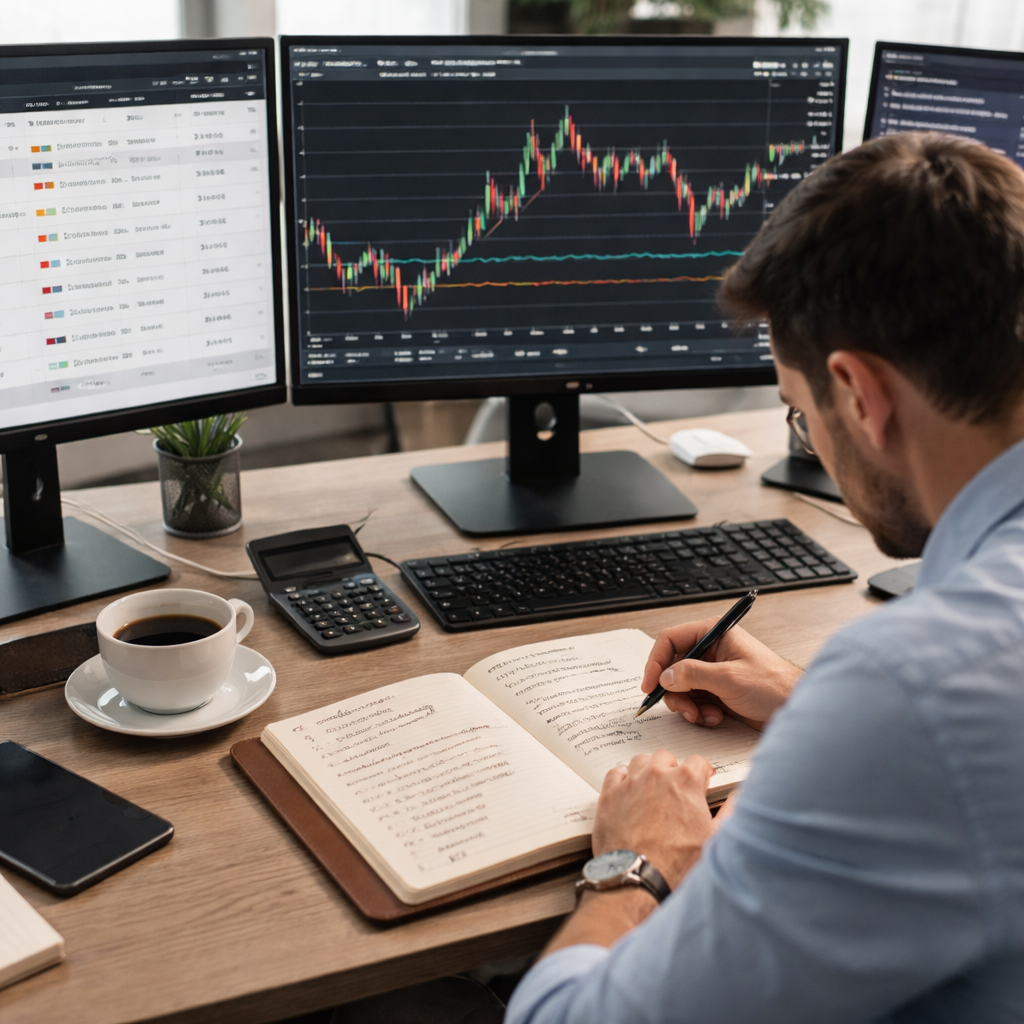
Conclusion
We’ve walked through every piece of the puzzle, from spotting the news‑driven spike to wiring a disciplined trade‑execution plan. If anything felt overwhelming, remember: the strategy lives in the habit you build, not in a single perfect trade.
So, what should you do right now? Grab your economic calendar, highlight the three‑star events for the week, and jot down one level of support or resistance for each pair you trade. That simple checklist turns a chaotic headline into a clear entry trigger.
And when the release hits, trust the pre‑set pending order you placed. Let the market do the work while you sit back with a stop‑loss that respects the structure you identified. If the price respects that level, you’ll see a tidy risk‑to‑reward ratio; if not, the trade closes without a dent to your capital.
Finally, treat the post‑trade journal as non‑negotiable. A few bullet points on entry price, slippage, and how you felt will sharpen your edge faster than any textbook.
Stick to this routine, and over weeks you’ll watch consistency replace guesswork. Ready to give your forex news trading strategy the disciplined finish it deserves? Remember, every review is a step toward mastering the market, and consistency is the real profit.
FAQ
How do I decide which economic releases are worth trading?
First, scan your economic calendar for the three‑star, high‑impact events – things like U.S. non‑farm payrolls, ECB rate decisions, or major CPI releases. Those tend to move the most pips and give a clear bias. Next, check whether the pair you trade actually reacts to that data; EUR/USD usually feels U.S. numbers, while GBP/JPY reacts to UK employment stats. Finally, ask yourself if you have a clean technical story (a support, resistance, or breakout zone) to anchor a pending order. If the answer is yes, the event is a good candidate for your forex news trading strategy.
What’s the most reliable way to set a stop‑loss for a news‑driven trade?
Start by measuring the recent average true range (ATR) on the 5‑minute chart – that gives you a sense of the normal volatility around the event. Place your stop a little beyond that range, preferably just past a strong support or resistance level you identified before the release. By anchoring the stop to a market structure rather than a fixed pip distance, you protect yourself from false breakouts. Remember to size your position so that, if the stop is hit, the loss stays within your 1‑2% risk tolerance.
Can I run a forex news trading strategy on a part‑time schedule?
Absolutely, as long as you focus on the few high‑impact releases that fall within your available trading window. Pick the events that happen during your active hours – for example, the U.K. CPI at 08:30 GMT or the U.S. Fed minutes at 14:00 GMT if you’re in Europe. Prepare your pending orders in advance, then let the market do the work while you’re away. When you return, just review the trade journal and adjust your plan for the next session.
How do I minimize slippage when the market spikes right after a headline?
One trick is to use stop‑limit orders instead of plain market orders; the limit part caps the worst price you’ll accept. Another habit is to watch the spread a few seconds before the release – if it widens beyond a threshold you set (say, 5 pips), pause and wait for the post‑spike pull‑back. Also, keep your lot size modest during news windows; smaller orders are filled more predictably. Combining these steps helps you stay in the trade without getting blown out by the initial chaos.
Should I try to trade every high‑impact release or be more selective?
Being selective usually pays off. Not every high‑impact number creates a clean, tradable move – sometimes the market has already priced in the expectation, leaving only a tiny wiggle room. Look for a confluence: a clear technical setup, a noticeable gap between forecast and actual, and a reasonable spread. If two of those three line up, you have a higher‑probability trade. Otherwise, it’s wiser to sit on the sidelines and preserve your capital for the next opportunity.
What details belong in my post‑trade journal after a news trade?
Record the exact entry price, the stop‑loss level, and the profit target you set before the release. Note the actual economic figure, the spread at the moment you entered, and any slippage you experienced. Add a short note on how you felt – was anxiety pulling you toward a premature exit? Finally, write a brief “what worked / what didn’t” line so you can spot patterns when you review weeks later.
nuhrswnopqqxryljyghkjvxxwznzyz