

Ever sat in front of your trading platform and felt the market’s mood was a mystery, like trying to read a crowd at a concert without hearing the music?
If you’ve ever wondered why price sometimes spikes even when the news looks calm, you’re not alone. That invisible vibe is what we call forex market sentiment, and the tools that try to capture it are known as forex market sentiment indicators.
These indicators translate collective trader behavior into numbers or charts. The Commitments of Traders (COT) report, for example, shows how large speculators are positioned on a currency pair. A bullish COT reading often precedes an up‑move, while a sudden shift to net shorts can signal a reversal. Another popular gauge is the Retail Sentiment Index, which aggregates data from dozens of broker‑client accounts. When 80 % of retail traders are long on GBP/JPY, you’re likely seeing an extreme contrarian signal.
Here’s a quick three‑step routine you can start using today:
- Pick two sentiment sources – the COT report and a broker‑provided sentiment gauge.
- Overlay them on a clean price chart and look for divergence: sentiment turning bullish while price is still falling, or vice‑versa.
- Set an alert for the moment the sentiment line crosses a predefined threshold (e.g., 70 % long), then evaluate entry criteria such as support level or candlestick pattern.
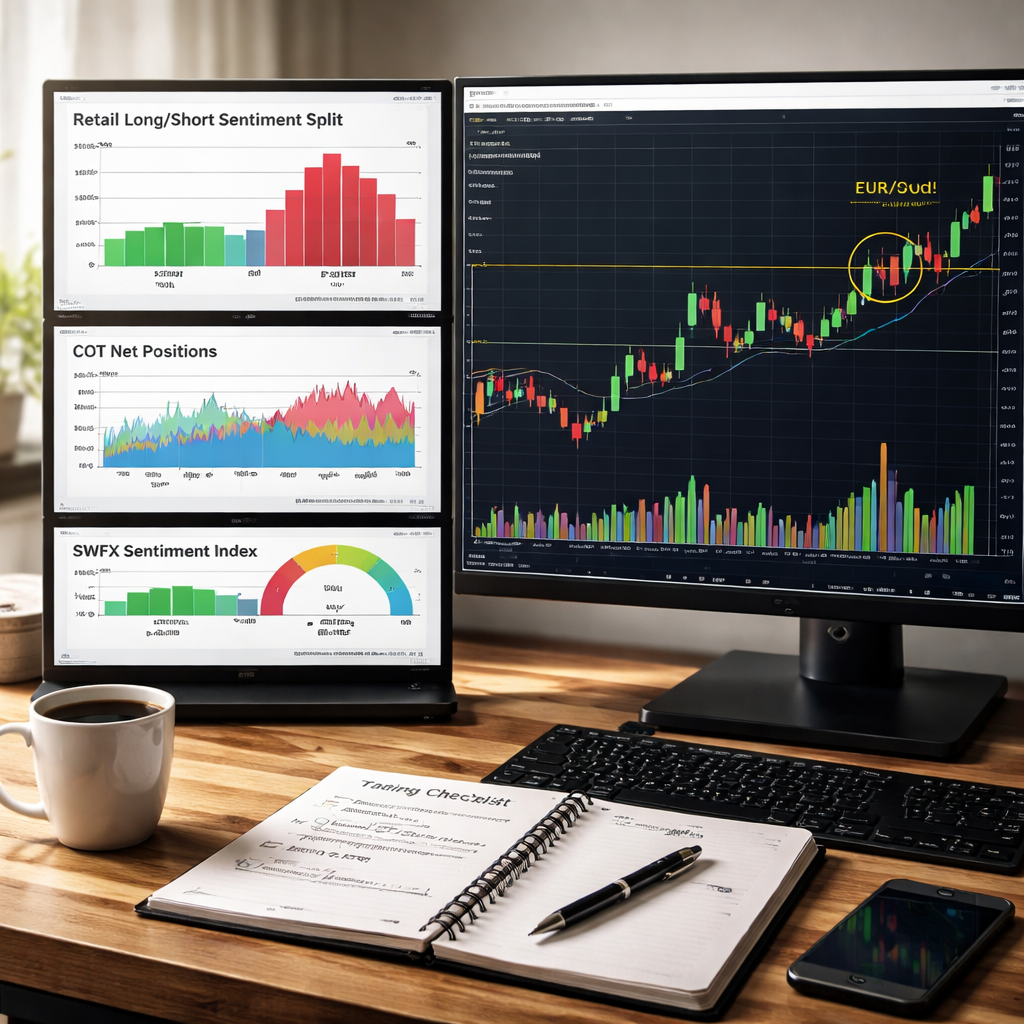
Take the EUR/USD breakout on the 2026 ECB rate decision as a real‑world illustration. The COT data showed a rapid swing from net short to net long within hours, while the retail sentiment gauge spiked above 75 % bullish. Traders who watched those signals entered just as price broke the previous day’s high and captured a 50‑pip swing.
Want a deeper dive into how these tools fit into a broader trading plan? Check out our Comprehensive Forex Trading Guide for Beginners and Beyond, where we walk through setting up sentiment dashboards step by step.
One thing to remember: when you apply sentiment analysis to crypto‑FX pairs, regulatory nuances can creep in. For guidance on staying compliant while exploring crypto‑linked forex strategies, see the advice from NeosLegal UAE Crypto Lawyers.
By blending sentiment indicators with solid price action, you add a layer of context that helps filter out noise and focus on moves that have broader market backing. Start experimenting with the simple routine above, and you’ll soon feel more in tune with the market’s collective heartbeat.
TL;DR
Forex market sentiment indicators let you gauge the collective bias of traders, turning vague crowd feelings into actionable clues for better entry and exit decisions.
By monitoring tools like the COT report and retail sentiment gauges, you can spot divergences early, filter noise, and build a more disciplined trading routine.
Step 1: Understanding Market Sentiment Basics
Let’s start with the feeling behind price moves. When you look at charts, you’re not just seeing lines and candles—you’re reading a crowd’s mood in real time. That mood is what we call market sentiment, and it’s perched right at the edge between psychology and price action.
In forex, sentiment indicators translate that mood into numbers you can actually work with. But what exactly are they telling you, and how should you use them without getting overwhelmed?
Think about it this way: sentiment is the wind. Price is the sail. The wind can push you forward, stall you, or turn you sideways. Your job is to see where the wind is coming from and how strong it is, then decide your course.
Two common types we rely on are large-player positioning data and crowd behavior signals. Commitments of Traders (COT) data shows how big speculative forces are positioned on a currency pair. Retail sentiment gauges reveal how the masses are leaning. When these sources align with price action, you often see stronger moves. When they diverge, you might get a pullback or reversal. Here’s the practical truth: extremes aren’t guarantees, but they’re often a nudge toward the next move.
Now let’s walk through a simple setup. You pull a COT reading and a broker-provided retail sentiment index onto a clean chart. You’re looking for divergences—sentiment turning bullish while price is still falling, or vice versa. The moment you spot one, pause your reflex to chase and check your price structure, nearby support, and your risk controls before you act.
Does this really work? It depends on discipline. Use sentiment as a contextual layer, not as the sole signal. It helps confirm what your price action already suggests, or warn you when the market looks overbought or overextended.
Here’s how to start framing it: pick two sentiment sources—the COT data and a retail sentiment gauge—and overlay them with a straightforward price chart. Track divergences, but always tie them back to your plan: entry criteria, stop placement, and a clear exit rule based on price action and risk management.
Does that make sense so far? If you’re a beginner, don’t overcomplicate it. The goal is to add context, not to replace your price-based decisions with a sentiment-only rule. You’ll refine this as you gain experience and see how sentiment behaves across different pairs and sessions.
As you build this into your routine, remember: consistency beats intensity. Start with a simple, repeatable workflow and scale up as you gain confidence in how sentiment interacts with price action.

Step 2: Key Sentiment Indicators Overview
Now that you’ve got the basics of sentiment covered, it’s time to meet the actual tools that turn that vague crowd feeling into something you can plot, compare, and act on.
Ever wonder why some traders seem to know a swing is coming before the price actually moves? More often than not, they’re looking at the same set of numbers you’ll be using in this step.
Retail sentiment gauges
Most brokers publish a simple long‑short split for each major pair. The figure is usually expressed as a percentage of client accounts that are net long versus net short. When you see 75 % of traders long on EUR/USD, that’s a classic over‑extended signal – the crowd may have already priced in the next leg of the move.
How to read it:
- Open your broker’s sentiment dashboard.
- Note the current long/short ratio for the pair you’re analysing.
- Mark the level on your price chart (e.g., a horizontal line at 70 % long).
- Watch for the ratio to reverse or cross a critical threshold – that’s often the moment price starts to respect the new bias.
Tip: keep a small notebook of “extreme” readings (above 80 % long or below 20 % long). Those extremes are where contrarian ideas tend to blossom.
Commitments of Traders (COT) report
The CFTC’s weekly COT report gives you a macro‑level view of how big speculators, commercial hedgers, and other categories are positioned in futures markets. Unlike retail gauges, it’s a snapshot of the “big players” rather than everyday retail accounts.
Steps to integrate the COT data:
- Download the latest COT PDF from the CFTC website (usually released every Friday).
- Locate the net position column for the currency you care about – you’ll see “Net Long” or “Net Short” numbers expressed in contracts.
- Convert the net figure into a percentage of total open interest (most analysis tools do this automatically).
- Overlay that percentage on the same time‑frame chart you use for price – weekly works well because the COT updates weekly.
When the net long % starts climbing while price is still in a downtrend, you’ve spotted a potential divergence that often precedes a reversal.
SWFX Sentiment Index (Dukascopy)
Dukascopy’s SWFX Sentiment Index aggregates transaction flow from both liquidity consumers (individual traders, brokers, hedge funds) and liquidity providers (banks, centralised markets). The index is updated every 30 minutes and shows the net long‑short balance as a single percentage point.
For example, a reading of +20 % means 60 % long versus 40 % short – a bullish tilt. A negative reading flips the story. Because the index updates intraday, you can use it to confirm or reject short‑term signals from price patterns.
Check out the live widget on Dukascopy’s sentiment page to see the numbers in real time.
How to make the SWFX Index work for you:
- Set a 30‑minute alert when the index crosses a pre‑defined threshold (e.g., +15 % or –15 %).
- Combine the alert with a price‑action trigger – a break of a key support/resistance level, a bullish engulfing candle, etc.
- If the index is extremely bullish while price is still range‑bound, consider holding off on new long entries until you see a confirming chart pattern.
Putting the three together
The real power comes when you line up retail gauges, the COT net position, and the SWFX Index on a single chart. If all three point bullish, you have a strong consensus – you might decide to “go with the crowd.” If they diverge, that’s a signal to dig deeper, maybe look at fundamentals or risk‑manage more tightly.
Quick checklist for Step 2:
- Grab the retail sentiment split from your broker.
- Download and plot the weekly COT net‑position %.
- Add the live SWFX Sentiment Index as a 30‑minute series.
- Mark extreme levels (≥70 % long, ≤30 % long, COT net > 60 %, SWFX ±15 %).
- Look for alignment or divergence before you take a trade.
By treating these numbers as complementary lenses rather than isolated “magic bulbs,” you’ll start to see the market’s mood in higher resolution. That’s exactly what forex market sentiment indicators are meant to do – give you a clearer, more confident view of where the crowd is headed.
Step 3: How to Interpret Sentiment Data
Now that you’ve got the retail split, the COT net‑position and the live SWFX index on the same chart, it’s time to ask yourself what the numbers are actually trying to tell you. Numbers alone are quiet – they need a story.
Think about the last time you watched a crowded stadium. When most of the fans start chanting one chant, you know something big is about to happen on the field. Forex market sentiment indicators work the same way: the louder the crowd, the more likely the market will move in that direction – but only if you read the crowd correctly.
Read the numbers, then read the story
Start with the raw percentage. A retail gauge showing 78 % long isn’t a magic ticket to go long; it’s a clue that the majority of retail traders are already betting on that side. Ask yourself: is the crowd getting ahead of price, or is price already confirming the bias?
Next, look at the COT net‑position. If speculators have shifted from a net‑short of 45 % to a net‑long of 55 % over a few weeks, that’s a sign the “big kids” are changing their minds. Combine that with the retail extreme and you either see a consensus (both bullish) or a clash (retail bullish, COT still short).
Finally, glance at the SWFX index. Because it updates every 30 minutes, it can catch short‑term mood swings that the weekly COT can’t. A sudden jump from +5 % to +18 % while price is still flat often precedes a breakout.
So, what should you do with those three slices? Look for alignment first, then investigate divergence.
Spotting extremes and turning points
Extreme levels are your early‑warning lights. For most traders, retail readings above 70 % long or below 30 % long are “over‑extended” zones. When the crowd hits those zones, history shows a higher chance of a reversal – the market often needs a breather.
With the COT, a net‑long percentage above 60 % (or net‑short below –60 %) is usually a strong directional bias. If that number climbs quickly, it can act as a catalyst for price to finally follow.
The SWFX index’s own extremes are a bit tighter – many traders treat ±15 % as a meaningful tilt. A swing from +12 % to +20 % in a short span suggests that liquidity consumers are becoming aggressively bullish.
When any of these gauges breach their extreme thresholds, pause. Ask yourself whether the move feels “earned” by price or whether it looks like pure speculation.
Cross‑checking with price action
Sentiment without price is like listening to a crowd without seeing the field. Look for a price‑action trigger that matches the sentiment shift – a breakout, a bullish engulfing candle, or a clear support bounce.
If the retail gauge flips from 75 % long to 55 % long while price is forming a higher‑low, that could be the moment the crowd is finally catching up with the chart. Conversely, if sentiment turns bullish but price is still making lower‑highs, you’ve probably spotted a false‑positive.
Timeframe matters, too. The COT moves slowly, so a weekly price pattern is a better match. The SWFX index reacts fast, so pair it with intraday candles. Align the rhythm of each indicator with the appropriate chart window.
Do you ever wonder why a bullish sentiment reading sometimes leads to a sudden drop? It’s often a “crowd exit” – the long‑biased traders rush to lock in profits, flipping the sentiment quickly. Watching for rapid sentiment reversals can save you from being on the wrong side of that exit.
Building a quick interpret‑checklist
- Note the current retail long/short split. Is it in an extreme zone?
- Check the weekly COT net‑position % – does it support the retail bias?
- Look at the 30‑minute SWFX index – has it crossed a ±15 % threshold?
- Identify any price‑action signal that matches the direction (breakout, candle pattern, trend line).
- If all three indicators align, consider the bias strong. If one or two diverge, treat the move as a caution flag and dig deeper.
- Set an alert for the next sentiment crossing – it gives you a clean entry or exit point.
Remember, interpreting sentiment data isn’t about finding a perfect formula. It’s about building a habit of asking the right questions every time you glance at the gauges. Over time the pattern becomes clearer, and you’ll start to see the market’s mood before the price fully reveals it.
Give this routine a try on a pair you already trade. Track the sentiment readings for a couple of weeks, note how often the extremes line up with price moves, and adjust your thresholds accordingly. The more you practice, the more intuitive the interpretation becomes.
Step 4: Using Sentiment Indicators in Your Analysis
Step 4 builds on the mood you’ve learned to read. Forex market sentiment indicators aren’t crystal balls; they’re context. They help you decide when the crowd is backing a move and when you should pause.
In practice, you don’t rely on a single gauge. You look at retail sentiment, the COT net-position, and the intraday SWFX index, then you ask: are they pointing the same way as price, or is there a mismatch?
Think of the three as a chorus. When all three agree, you have higher conviction. If one lags or contradicts, you slow down and check fundamentals, news, or a different timeframe. This isn’t about predicting the future; it’s about stacking evidence so you trade with a clearer picture.
In our experience at FX Doctor, using the trio together reduces noise and gives you a tighter filter for entry decisions. You’ll still confirm with price action, but sentiment adds that second layer of validation that helps you sleep at night after a trade is placed.
Reading the trio in concert
Think of the chorus idea like this: retail sentiment shows where the crowd currently leans, the COT reveals the big players’ leanings, and the SWFX index adds intraday tempo. When all three align with a price breakout or clear pattern, you’re looking at a higher-probability setup. When they disagree, that’s your cue to pause and reassess.
Does this really work across timeframes? Yes—but you must match the rhythm. The COT moves slowly, so pair it with weekly charts. The SWFX index moves fast, so use intraday candles for confirmation. The retail gauge sits in between, offering a timely read on client sentiment shifts. The key: avoid forcing a trade just because sentiment looks exciting.
A practical workflow you can start today
- Open your sentiment dashboards for the pair you’re watching. Note the current long% for retail, the latest COT net-position, and the 30-minute SWFX reading. Don’t skip any step just because you’re in a hurry.
- Plot those numbers on the same price chart you use for technical analysis. Look for alignment or divergence with the current price action.
- Set alerts for sentiment extremes: retail long% above 75%, COT long% above 60%, or SWFX crossing ±15%. Alerts are your nudge to re-check the chart.
- When alignment occurs with a clean price signal (breakout, candle pattern, or trend continuation), define your entry and a practical stop. Don’t over‑share risk for the sake of chasing sentiment.
- Review after the trade. Document what worked, adjust your thresholds, and refine the timing for future entries.
Now a quick scenario: EUR/USD is trading in a tight range. Retail shows 78% long, COT net-long moves to 62%, and SWFX sits at +16%. Price finally tests a breakout. If price action confirms with a strong bullish candle and a break above resistance, you’ve got a well-supported entry setup—weight of evidence, not a guess.
| Item | Indicator/Tool | Notes |
|---|---|---|
| Retail sentiment | Broker long/short split | Watch for extremes; use as contrarian clue when price diverges |
| COT net-position | Weekly net long % | Anchors longer‑term bias; slower to move |
| SWFX Sentiment Index | 30‑minute net long/short balance | Intraday context; use ±15% as turn‑points |
| Price-action confirmation | Candles, patterns, breakouts | Sentiment alone isn’t enough; always require a price trigger |
For a broader view of how sentiment fits into the bigger market picture, check this guide to market analysis: guide to market analysis.
So, what’s the takeaway? Use forex market sentiment indicators as a confirmation framework, not a sole decision-maker. With practice, you’ll build a repeatable habit that makes sentiment a practical edge in your analysis toolkit.
Step 5: Common Pitfalls and Best Practices
When you first start mixing sentiment gauges with price action, it’s easy to fall into a few traps that can turn a promising edge into a costly habit.
One of the biggest mistakes is treating a sentiment spike as a trade trigger on its own. Remember the last time you saw retail long % jump to 80 % and rushed in, only to watch the market reverse a few candles later? That’s the classic “sentiment‑only” pitfall.
Pitfall #1: Ignoring the price‑action filter
Sentiment tells you where the crowd is leaning, but price tells you whether the crowd is already priced in. If you enter before the chart shows a clean breakout, you’re essentially betting on the crowd’s opinion rather than the market’s willingness to move.
Best practice: always wait for a technical signal – a breakout candle, a swing‑high retest, or a clear support bounce – before you let sentiment confirm the bias.
Pitfall #2: Over‑reacting to short‑term swings
The SWFX Index updates every 30 minutes, which feels tempting to chase. A sudden swing from +5 % to +18 % might look exciting, but it can also be a noise burst caused by a news flash that evaporates quickly.
Best practice: set a threshold (e.g., ±15 %) and combine it with a higher‑timeframe price pattern. If the 30‑minute swing aligns with a weekly trend‑line break, the signal gains credibility.
Pitfall #3: Misreading extremes as guaranteed reversals
Seeing retail sentiment above 75 % long or COT net‑long above 60 % doesn’t guarantee a flip. Markets can stay extreme for weeks if the underlying fundamentals keep supporting the move.
Best practice: treat extremes as warning lights, not as “sell‑now” orders. Look for a weakening price structure – lower highs, shrinking volume – before you consider a contrarian entry.
Pitfall #4: Forgetting risk‑on / risk‑off context
Even a perfectly aligned sentiment set‑up can sputter if the broader market mood is risk‑off. In a risk‑off environment, even bullish sentiment may struggle as traders flock to safe‑haven assets.
We’ve found that checking the overall market bias – for example, the VIX or a risk‑on/risk‑off gauge – helps you decide whether to stay on the sidelines. A concise guide on reading risk sentiment is available at how to trade risk‑on risk‑off sentiment.
Pitfall #5: Not documenting and reviewing your trades
Without a post‑trade journal, you’ll repeat the same errors – chasing sentiment spikes, ignoring price, or mis‑timing alerts.
Best practice: after every trade, note the sentiment levels, the price trigger, and the outcome. Over time you’ll see patterns, like whether you tend to over‑trade on the SWFX Index or ignore COT lag.
Here’s a quick checklist to keep you on track:
- Verify that retail, COT, and SWFX all point in the same direction.
- Confirm a price‑action signal that matches the bias.
- Check the broader risk‑on/risk‑off environment.
- Enter only if all three conditions are met.
- Set a stop loss based on recent swing points, not on sentiment levels.
- Log the trade and review the sentiment‑price interaction later.
By following these habits, you turn sentiment from a flashy widget into a disciplined part of your trading system.
And remember, the market will always throw you curveballs. The goal isn’t to avoid every loss – it’s to make sure sentiment isn’t the sole reason you end up on the wrong side of a trade.
Conclusion
We’ve walked through the why and how of forex market sentiment indicators, from the basics of retail splits to the nuance of the COT report and the intraday pulse of the SWFX Index.
So, what does that mean for you? It means you now have a three‑layer checklist that turns a vague crowd feeling into a concrete edge.
First, capture the retail long/short ratio and note any extreme reading. Next, pull the latest COT net‑position and see if the big players are moving in the same direction. Finally, glance at the SWFX Index for a quick intraday confirmation.
If all three line up with a clear price‑action trigger – a breakout candle, a support bounce, or a trend‑line violation – you’ve got a higher‑probability setup. If they diverge, treat it as a warning sign and dig deeper before you risk capital.
Remember, sentiment is a tool, not a crystal ball. Keep a trade journal, track how often the extremes actually precede moves, and adjust your thresholds over time.
Ready to put the routine into practice? Start with one currency pair you already trade, log each sentiment reading, and let the pattern speak for itself. The more you practice, the more intuitive the market’s mood becomes.
FAQ
Got questions about forex market sentiment indicators? Below you’ll find the most common ones, answered in a down‑to‑earth way that works for aspiring traders and seasoned pros alike.
What are forex market sentiment indicators and why should I care?
In plain English, sentiment indicators measure how the crowd feels about a currency pair – whether traders are mostly long, short, or sitting on the fence. That collective mood often shows up before price moves, giving you a heads‑up on potential swings. By watching the crowd you can avoid fighting the market and increase the odds that your entry lines up with the prevailing bias.
How often should I check sentiment indicators?
It depends on the tool. Retail sentiment gauges update throughout the trading day, so a quick glance every few hours keeps you in the loop without over‑monitoring. The weekly COT report only changes once a week, so you can treat it as a longer‑term barometer. The SWFX Index refreshes every 30 minutes, which is handy for intraday setups – just set an alert and check when it crosses your chosen threshold.
Which sentiment indicator is best for beginners?
Most new traders start with their broker’s retail long/short split because it’s easy to read and appears right on the platform. Look for a simple percentage – 70 % long or 30 % long are good reference points. Pair that with the weekly COT net‑position for a bigger‑picture view. Once you’re comfortable, you can add the SWFX Index for finer intraday nuance.
Can sentiment indicators predict reversals?
They’re not crystal balls, but extreme readings often act as warning lights. When retail sentiment spikes above 80 % long, the market may be overdue for a pull‑back because most traders are already on the same side. Similarly, a sudden swing in the COT net‑long percentage can signal that “big kids” are changing their minds, which frequently precedes a price reversal. Always confirm with a clear price‑action pattern.
How do I combine sentiment with price action?
First, note the sentiment reading – retail, COT, or SWFX – and mark the level on your chart. Next, wait for a technical trigger that matches the direction, such as a breakout candle, a bullish engulfing, or a bounce off a strong support. When the sentiment and the price signal line up, you have a higher‑probability setup; when they diverge, treat the trade with extra caution.
What thresholds indicate extreme sentiment?
For most retail gauges, anything above 75 % long or below 25 % long is considered extreme. On the COT report, a net‑long percentage above 60 % (or net‑short below –60 %) signals a strong bias. The SWFX Index tends to be meaningful around ±15 %; a jump from +10 % to +18 % in a short span often precedes a short‑term move. Use these levels as alerts, not as automatic entry orders.
What common mistakes should I avoid when using sentiment indicators?
Don’t let a sentiment spike dictate a trade without a price‑action filter – the crowd can be wrong. Avoid over‑reacting to the fast‑moving SWFX Index; set a reasonable threshold and stick to it. Ignoring the broader risk‑on/risk‑off environment is another pitfall – even extreme bullish sentiment can stall when investors flee to safe‑haven assets. Finally, keep a journal so you can see how often your sentiment‑based ideas actually work.
Additional Resources
Now that you’ve got the three‑layer checklist for forex market sentiment indicators, you might be wondering where to dig deeper.
First, the CFTC’s weekly Commitment of Traders report is the gold standard for big‑player positioning. Download the PDF straight from the CFTC website and bookmark the “Net Position” tables – they’re the ones we referenced earlier.
Second, most retail brokers publish a live sentiment dashboard. If you haven’t explored yours yet, open the platform, locate the long/short split, and set a simple price alert when the gauge crosses 70 % or 30 %.
Third, Dukascopy’s SWFX Sentiment Index updates every half hour. The widget on their market‑watch page lets you copy‑paste the current % into your own spreadsheet for quick trend spotting.
Want a quick cheat‑sheet? Sketch a three‑column table on a sticky note: Retail % | COT net % | SWFX %. Fill it each morning – the act of writing reinforces the habit.
Finally, keep a small journal. Jot down the sentiment numbers, the price‑action trigger you waited for, and the outcome. Over weeks you’ll spot patterns you can’t see in a single trade.
So, grab those resources, make them part of your routine, and let the crowd’s mood become a reliable piece of your analysis toolbox.
[…] keep learning, check a derivation of sentiment alongside price action. Forex market sentiment indicators: A practical guide for traders helps you understand how the mood in the market reinforces or contradicts price moves. And […]