
blockquote{border-left:4px solid #3b82f6;margin:1.5em 0;padding:1em 1.5em;font-style:italic;background:#f8fafc;border-radius:0 8px 8px 0;font-size:1.1em;color:#1e293b}
.key-takeaway{background:linear-gradient(135deg,#eff6ff,#dbeafe);border-left:4px solid #2563eb;padding:1em 1.5em;margin:1.5em 0;border-radius:0 8px 8px 0}
.key-takeaway strong{color:#1e40af}
.stat-highlight{text-align:center;padding:1.5em;margin:1.5em 0;background:#f0fdf4;border-radius:12px;border:1px solid #bbf7d0}
.stat-highlight .stat-number{display:block;font-size:2.5em;font-weight:800;color:#16a34a;line-height:1.2}
.stat-highlight .stat-label{display:block;font-size:.95em;color:#374151;margin-top:.3em}
.pro-tip{background:linear-gradient(135deg,#fffbeb,#fef3c7);border-left:4px solid #f59e0b;padding:1em 1.5em;margin:1.5em 0;border-radius:0 8px 8px 0}
.pro-tip strong{color:#92400e}
Most traders think a breakout is just a flash move. It’s not. It’s a chance to catch a real shift in market sentiment. In this forex breakout trading guide 2024 you’ll see how to find the set‑ups, check them, set your risk, and ride the move with confidence.
| Name | Pattern Description | Entry Trigger | Best For | Source |
|---|---|---|---|---|
| Inside Bar | This pattern is formed when a candle is completely contained within the range of the previous day’s candle. | inside bar formation indicating a pause before a potential breakout | Best for pause detection | sabiotrade.com |
| Double Bottom | This pattern occurs when the price of a currency pair tests a support level twice without breaking through it, forming a W-like shape on the chart. | price to break above the resistance level that forms between the two bottoms | Best for bullish reversal | sabiotrade.com |
| Double Top | This pattern is characterized by the price of a currency pair reaching a high point, undergoing a minor retracement, and then rising to the same level again, forming an M-like shape on the chart. | price falls below the support level formed between the two peaks | Best for bearish reversal | sabiotrade.com |
| Opening Range Breakout (ORB) | The Opening Range Breakout (ORB) tactic capitalizes on the market’s early momentum. | price surpasses prior day’s high or falls below prior day’s low | Best for intraday momentum | quantifiedstrategies.com |
| Momentum Breakout | The breakout trader relies heavily on momentum, using the Momentum Breakout strategy to capitalize on this vital element. | momentum confirmation via RSI or MACD before entering the breakout | Best for indicator‑based momentum | quantifiedstrategies.com |
| Breakout Pullback | Exercising patience is essential, especially when employing the Breakout Pullback strategy. | price retraces back to breakout point | Best for pullback re‑entry | quantifiedstrategies.com |
| Breakout with Volume Confirmation | In breakout trading, the amount of volume might be a critical indicator, and the Breakout with Volume Confirmation strategy pays close attention to what this market chatter implies. | significant increase in trading volume confirming the breakout | Best for volume‑driven entries | quantifiedstrategies.com |
| Breakout Gap | In the Breakout Gap strategy, traders target the spaces created by sudden price surges often associated with strong market dynamics. | price gaps created by sudden surges | Best for gap exploitation | quantifiedstrategies.com |
| Fibonacci Breakout | In the Fibonacci Breakout strategy, traders engage in a numeric ballet using golden ratios to predict possible breakout points. | price moves beyond a Fibonacci level (e.g., 50% or 61.8%) with rising volume | Best for Fibonacci‑level traders | quantifiedstrategies.com |
| Consolidation Breakout | The Consolidation Breakout strategy is a buildup and breakthrough, where the market usees its pent-up energy during periods of stagnancy to release a dynamic surge. | price breaks out after a consolidation period | Best for consolidation breakout | quantifiedstrategies.com |
| Moving Average Breakout | The strategy of a Moving Average Breakout centers on executing trades when the price surpasses a moving average, signaling a possible. | price crosses decisively above or below the moving average | Best for moving‑average crossovers | quantifiedstrategies.com |
| Bollinger Bands Breakout | Using the expansion and contraction of Bollinger Bands as a measure of volatility, the Breakout Strategy alerts traders to significant market. | price breaks beyond the upper or lower Bollinger Band | Best for volatility‑band breaks | quantifiedstrategies.com |
| Keltner Channel Breakout | Using Chester Keltner’s namesake channels, which encompass the average true range to reflect market volatility and scope, the Keltner Channel Breakout strategy serves as a detector of trends. | price breaks out of Keltner Channel | Best for channel‑based exits | quantifiedstrategies.com |
| Pennant Breakout | Traders employing the Pennant Breakout Strategy are vigilant for continuation patterns resembling pennants on trading charts, similar to a flag. | price breaks out of pennant pattern | Best for pennant continuation | quantifiedstrategies.com |
| Ascending Triangle | This chart is a perfect example of an ascending triangle. Notice how the price keeps making higher lows, squeezing up against that flat, horizontal resistance level. | — | Best for trend continuation beginners | colibritrader.com |
| False Breakout | Many traders face a significant obstacle with the False Breakout, a misleading market tactic that mimics an actual breakout before reversing. | — | Best for cautionary pattern study | quantifiedstrategies.com |
| Breakout Retest | The Breakout Retest strategy documents a trade seeking validation, where traders are on the lookout for evidence confirming that the breakout. | — | Best for validation after breakout | quantifiedstrategies.com |
| Breakout Volume Strategy | The Breakout Volume Strategy emphasizes the importance of substantial changes in trading volume to identify breakout signals. | — | Best for pure volume analysis | quantifiedstrategies.com |
| Horizontal breakout | price breaks above a horizontal resistance level or below a horizontal support level, often with higher volume. | — | Best for horizontal level breaks | capital.com |
| Trendline breakout | price moves through this line with clear momentum and higher volume, suggesting a shift in trend direction. | — | Best for trendline breaches | capital.com |
| Flag breakout | The price consolidates within a small rectangle (flag pattern) on lower volume before resuming the prior direction with increased volume. | — | Best for flag pattern exits | capital.com |
| Head and Shoulders breakout | breakout below the neckline of a head and shoulders pattern, supported by volume, indicates a shift from uptrend to downtrend. | — | Best for neckline breaks | capital.com |
Step 1: Identify a Potential Breakout Setup
First, you need a clear spot where price might burst out. Look for a level that has held several times. That level can be a flat line, a trendline, or the edge of a chart pattern like a triangle.
The research shows that 64% of patterns give a concrete entry trigger. That means most good set‑ups tell you exactly when to jump in.
Here’s what I mean. Imagine EUR/USD has bounced off 1.0800 three times in the past week. Each bounce shows a strong wall of buying. If the next candle closes above 1.0800, you have a breakout.
“The best time to start building breakout trades is when the price closes cleanly beyond a tested level.”
Make sure the candle that breaks the level is big. A candle at least twice the size of the recent average shows real force.
Why does size matter? A big candle means buyers (or sellers) held the market for the whole period, not just a quick spike.
Now, check the time frame. A break on the 4‑hour or daily chart is more reliable than on a 5‑minute chart. The higher the time frame, the less noise.
One more filter: look for a volume spike. In forex you can use tick volume. If the breakout candle’s volume is 50% higher than the 20‑bar average, the move has backing.
When you see all three , a tested level, a strong candle, and a volume boost , you have a high‑probability breakout set‑up.
After you spot the set‑up, you still need to confirm it’s not a fakeout. That’s the next step.
Bottom line: Spot the level, watch the candle, and check volume before you trust a breakout.
Step 2: Confirm Market Structure and Momentum
Now you must see if the market’s shape backs your idea. Market structure tells you whether the price is in a trend, a range, or about to flip.
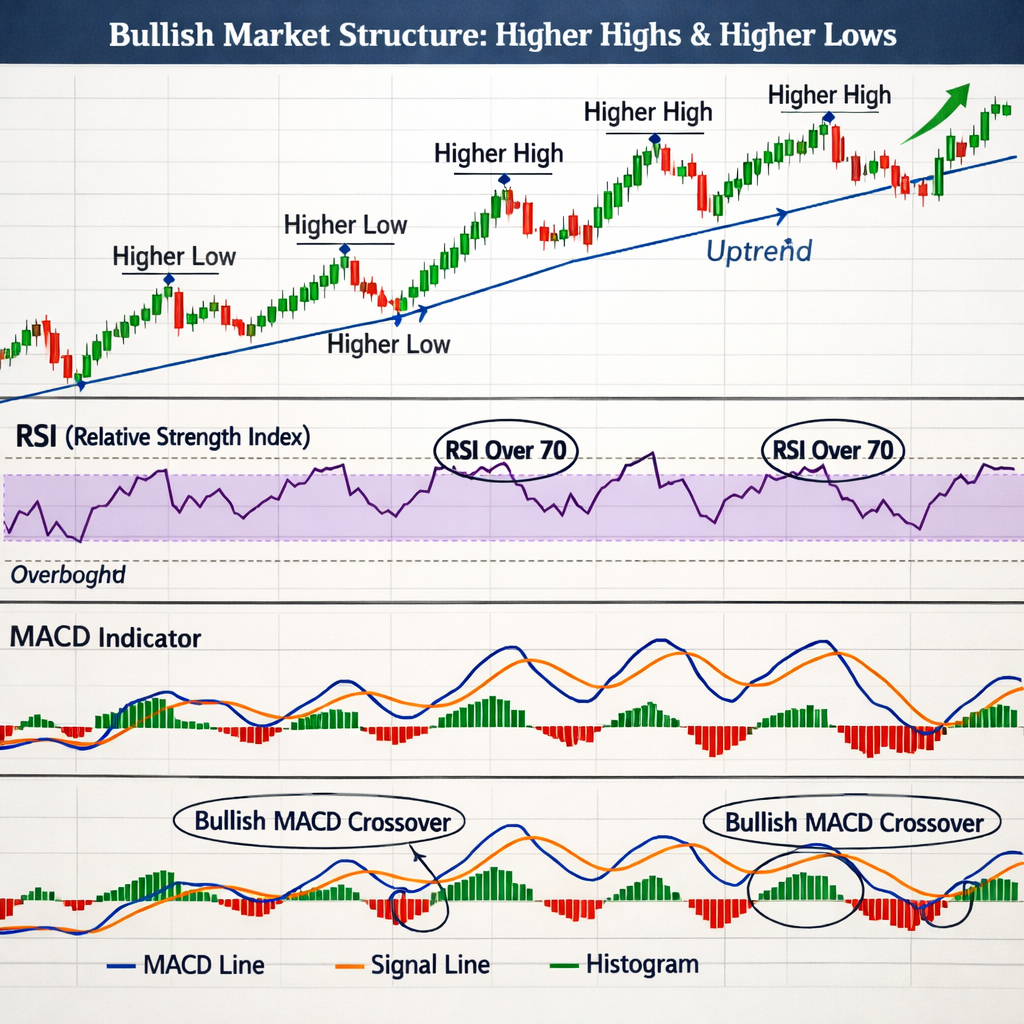
Read the swing points. Higher highs and higher lows mean bullish structure. Lower lows and lower highs mean bearish.
For a breakout to keep going, the structure should stay in the same direction after the break.
Why does that matter? If the pattern you’re using doesn’t give a timeframe, you risk trading on a noisy chart.
Next, add momentum tools. The RSI above 60 or below 40 often confirms direction. The MACD crossing in the same direction adds weight.
Imagine a bullish breakout. The price closes above resistance, the RSI is 68, and the MACD line just crossed above its signal. All three agree , that’s strong momentum.
Don’t forget the ATR. A breakout that moves at least 1 ATR beyond the level shows true volatility.
Use this rule: if the candle’s range is less than 1 ATR, wait for the next candle. You want the market to show clear energy.
Finally, see if the breakout aligns with the higher‑timeframe trend. If the daily chart is up, a 1‑hour bullish breakout has the wind behind it.
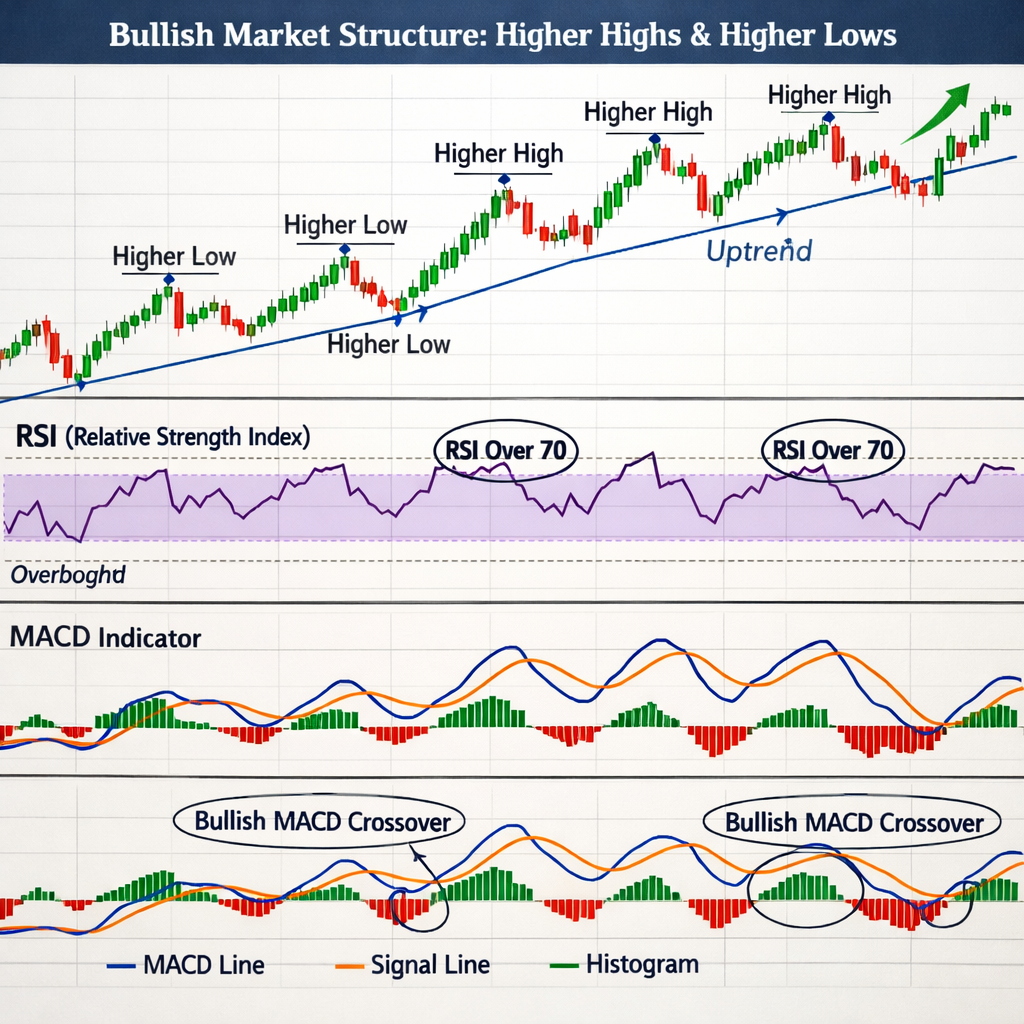
When the structure, momentum, and volatility all point the same way, you can trust the breakout.
Bottom line: Structure and momentum together act as a safety net for your breakout trade.
Step 3: Set Entry, Stop‑Loss, and Position Size
Now you lock in the trade. First, decide where to enter. You can jump in on the breakout candle or wait for a retest.
Jumping in early gives you the best price, but it also raises fakeout risk. Waiting for a retest gives a cleaner stop.
Here’s a simple split‑entry plan. Put half the size in on the first close beyond the level. Keep the other half ready for a retest a few pips later.
Set your stop‑loss just below the breakout point. Many traders use “just below the breakout point” wording, which matches the five patterns that give stop‑loss rules.
Measure the distance in pips, then use the ATR to size the stop. If the ATR is 30 pips, place the stop 1 to 1.5 ATR away , that’s 30‑45 pips.
Position sizing follows your risk rule. If you risk 1% of your account on a trade, divide 1% of your capital by the stop‑loss distance in pips, then multiply by the pip value.
FX Doctor suggests using a simple risk calculator to avoid math errors.
Forex Breakout Strategy Guide: Spotting and Trading Breakouts Effectively
With entry, stop, and size set, you’re ready to place the trade.
Bottom line: Clear entry, tight stop, and proper size give you a solid trade foundation.
Step 4: Manage the Trade and Plan Your Exit
After you’re in, you need a plan for the ride. First, watch the price action. If the market starts to stall, think about scaling out.
One method is to take half profit at a 2 ATR move, then trail the rest with a moving stop.
Trailing stops can be set at 1 ATR behind the current price. As the market moves, the stop moves up, locking in gains.
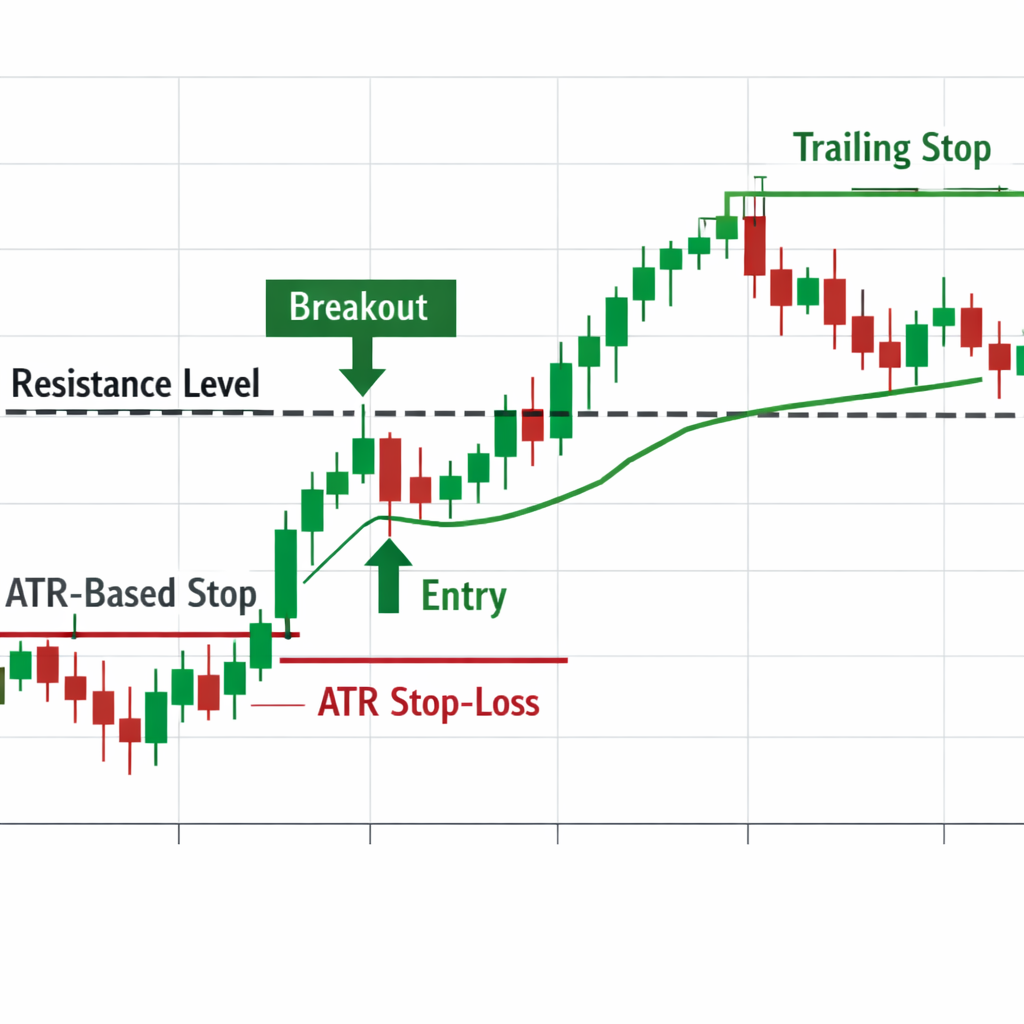
Use the measured‑move target for patterns like flags or pennants. The target equals the length of the flagpole projected from the breakout point.
Another exit tool is a profit‑target based on the pattern’s height. Many patterns recommend using the height of the pattern to set a target.
| Exit Method | When to Use | Key Benefit |
|---|---|---|
| Fixed Target | Pattern height known | Clear profit goal |
| Trailing Stop | Strong momentum continues | Locks in more profit |
| Partial Scale‑Out | Volatility spikes | Reduces risk early |
Keep an eye on the market’s sentiment. If the RSI starts to turn down or the MACD diverges, consider exiting early.
Remember, no trade is perfect. Your job is to protect capital and let winners run.
Bottom line: Good trade management lets you capture the move while keeping risk low.
Conclusion
That’s the full forex breakout trading guide 2024. You learned how to spot a set‑up, confirm it with structure and momentum, set a safe entry and stop, and manage the trade to the end. The steps work for beginners and for traders who already trade other strategies. FX Doctor builds each part on solid market theory, so you can trust the process.
Practice each step on a demo account first. Watch how the market reacts. Adjust the ATR values or the split‑entry ratio until it feels right for your style. Over time you’ll see the win rate improve because you’ve added confirmation and risk control.
If you want more help, check out the free resources on FX Doctor. They cover charting platforms, trading plans, and psychology , all the pieces that make a breakout system work.
Bottom line: Follow the four steps, stay disciplined, and you’ll turn breakout chances into steady profits.
FAQ
What time frames work best for breakout trading in the forex breakout trading guide 2024?
Higher time frames like the 4‑hour or daily chart give clearer signals because they filter out noise. The research shows only 23% of patterns list a typical timeframe, but the ones that do , like the Inside Bar on daily , tend to be more reliable. Start with 4‑hour charts, then drill down to 1‑hour for entry timing.
How can I avoid fakeouts when using the forex breakout trading guide 2024?
Use at least two confirming factors: a strong breakout candle and a volume boost of 50% above the 20‑bar average. Also wait for the candle to close beyond the level , a wick alone isn’t enough. If the price closes back inside the range, step back and wait for a retest.
Do I need indicators to confirm a breakout in the forex breakout trading guide 2024?
Indicators help, but they’re not required. The guide recommends using RSI above 60 and MACD crossing in the same direction as the breakout. When both agree, confidence rises. If you prefer a clean chart, just rely on price action and volume.
What risk‑to‑reward ratio should I aim for in a breakout trade?
Most experts suggest at least 1:2. Set your stop 1 to 1.5 ATR away, then target 2 to 3 ATR. This gives you a solid edge and fits the patterns that include stop‑loss and profit‑target rules in the research.
How does market structure affect my breakout entries?
Breakouts that align with the prevailing structure , higher highs in a bullish trend or lower lows in a bearish trend , have higher success rates. If the structure flips after the breakout, consider exiting early or tightening your stop.
Can I trade breakouts on any currency pair?
Yes, but some pairs show clearer levels. Major pairs like EUR/USD and GBP/USD often have well‑defined support and resistance. Less liquid pairs may give weaker breakouts and more false signals.
Should I use a position‑sizing calculator for breakout trades?
Using a calculator helps you stick to a consistent 1% risk rule. It takes your account size, stop distance, and pip value to give the exact lot size. Consistency in sizing is key to long‑term success.
How often should I review my breakout strategy?
Review after every week of trading. Look at win‑rate, average profit, and how often you hit the stop. Adjust ATR settings or entry rules if you see many falseouts. Continuous tweaking keeps the forex breakout trading guide 2024 effective.