
Ever felt a tiny spread bite into your profit like a hidden tax? You’re not alone. In the next few minutes, we’ll break down exactly which brokers give you those razor-thin spreads, what the real costs are, and how to avoid the sneaky fees that can wreck a trade. This guide will walk you through seven steps to choose the right low spread forex broker. You’ll learn to read spread data, compare commissions, check regulation, and see live trade examples. By the end, you’ll know how to pick a broker that fits your style without getting tricked by marketing hype. Let’s get started.
Step 1: Understand What a Spread Is and Why Low Spreads Matter
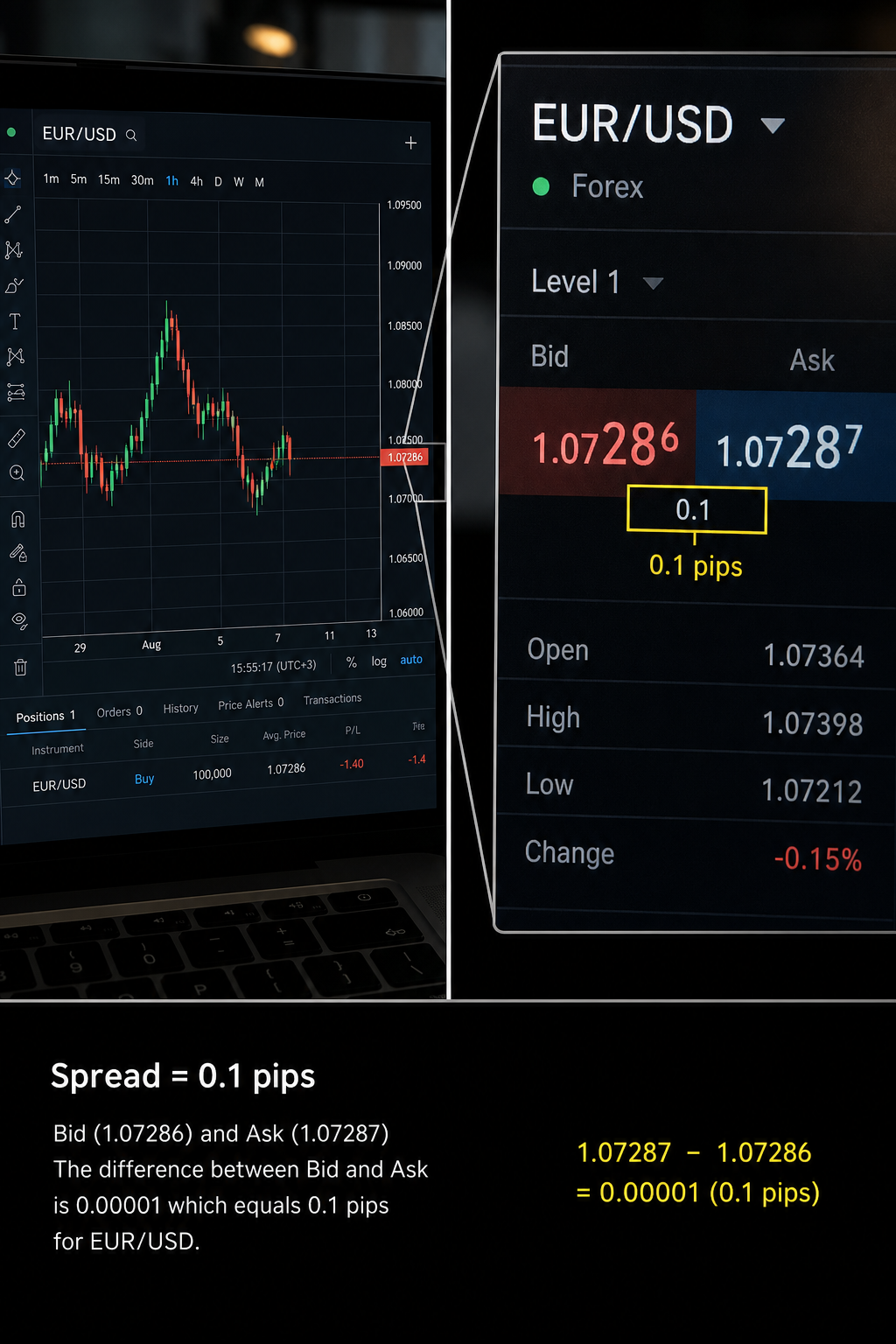
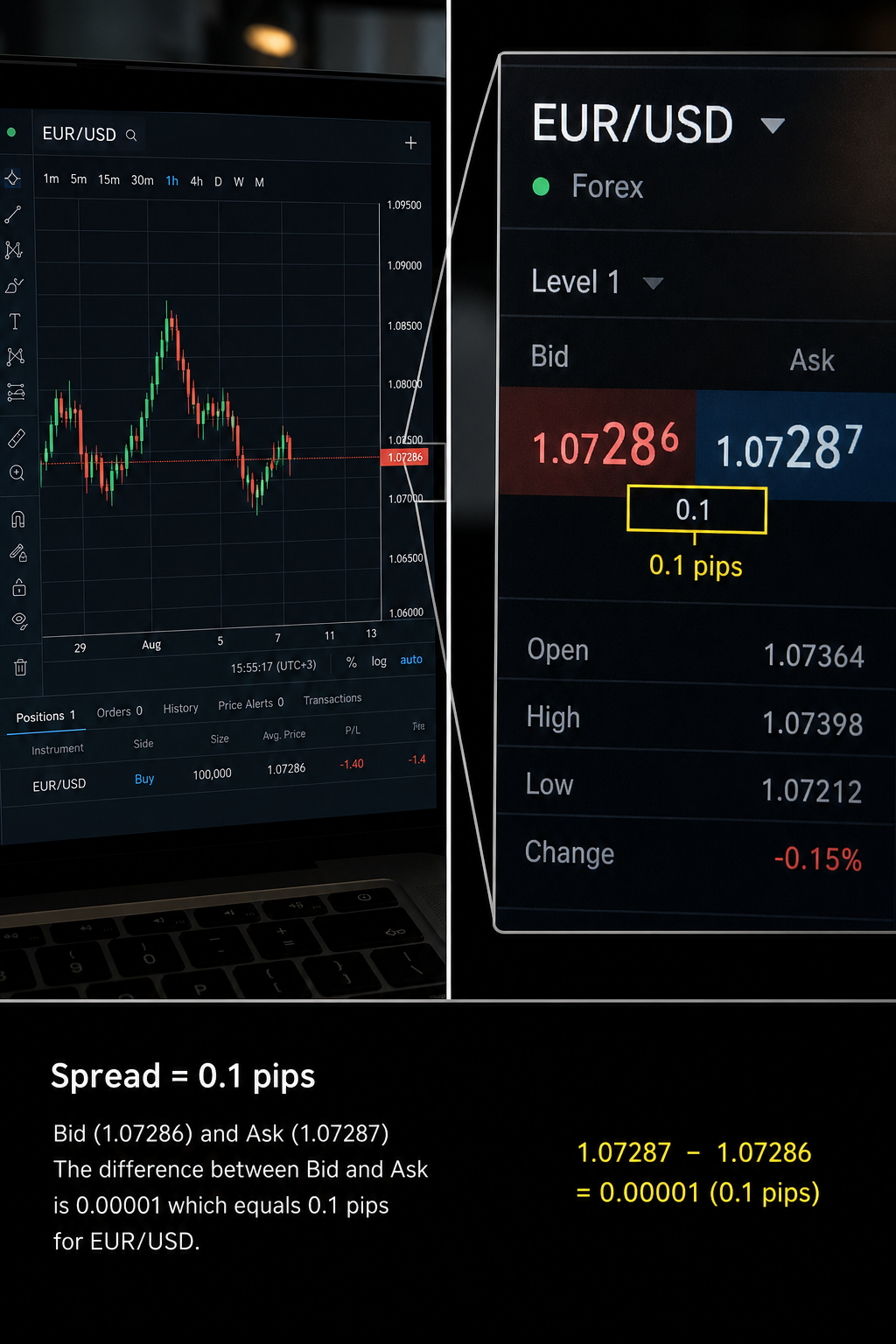
A spread is the difference between the buy price and the sell price of a currency pair. Think of it as the broker’s fee for letting you trade. The smaller the spread, the less you pay upfront. That means you start your trade closer to break-even.
For example, if EUR/USD has a spread of 0.1 pips, you only need the price to move 0.1 pips in your direction to break even. If the spread is 1.3 pips, you need a much bigger move just to get back to zero. That’s a big deal, especially for day traders and scalpers who open many trades.
s, spreads vary based on liquidity and volatility. Major pairs like EUR/USD usually have the tightest spreads, while exotic pairs can be much wider.
Spread costs add up fast. If you trade 10 standard lots per day and your spread is 0.5 pips instead of 0.1 pips, you’re paying an extra $400 per day in spread costs. Over a month, that’s $8,000. Over a year, it’s nearly $100,000. That’s why every pip matters.
But low spreads aren’t everything. Some brokers offer 0.0 pips spreads but charge a commission per lot. Others offer 0.1 pips with no commission. You have to calculate the total cost per trade. That’s what we’ll do in the next steps.
“The cheapest spread means nothing if the commission eats your profits. Always look at the full picture.”
So, first step: understand that spread is just one part of the cost. But it’s a big part. Knowing the difference between a 0.0 pip spread and a 0.5 pip spread can save you thousands.
Bottom line:Low spreads directly reduce your trading costs, but you must also account for commissions and hidden fees to see the true picture.
Step 2: Identify the Best Low-Spread Brokers for 2026
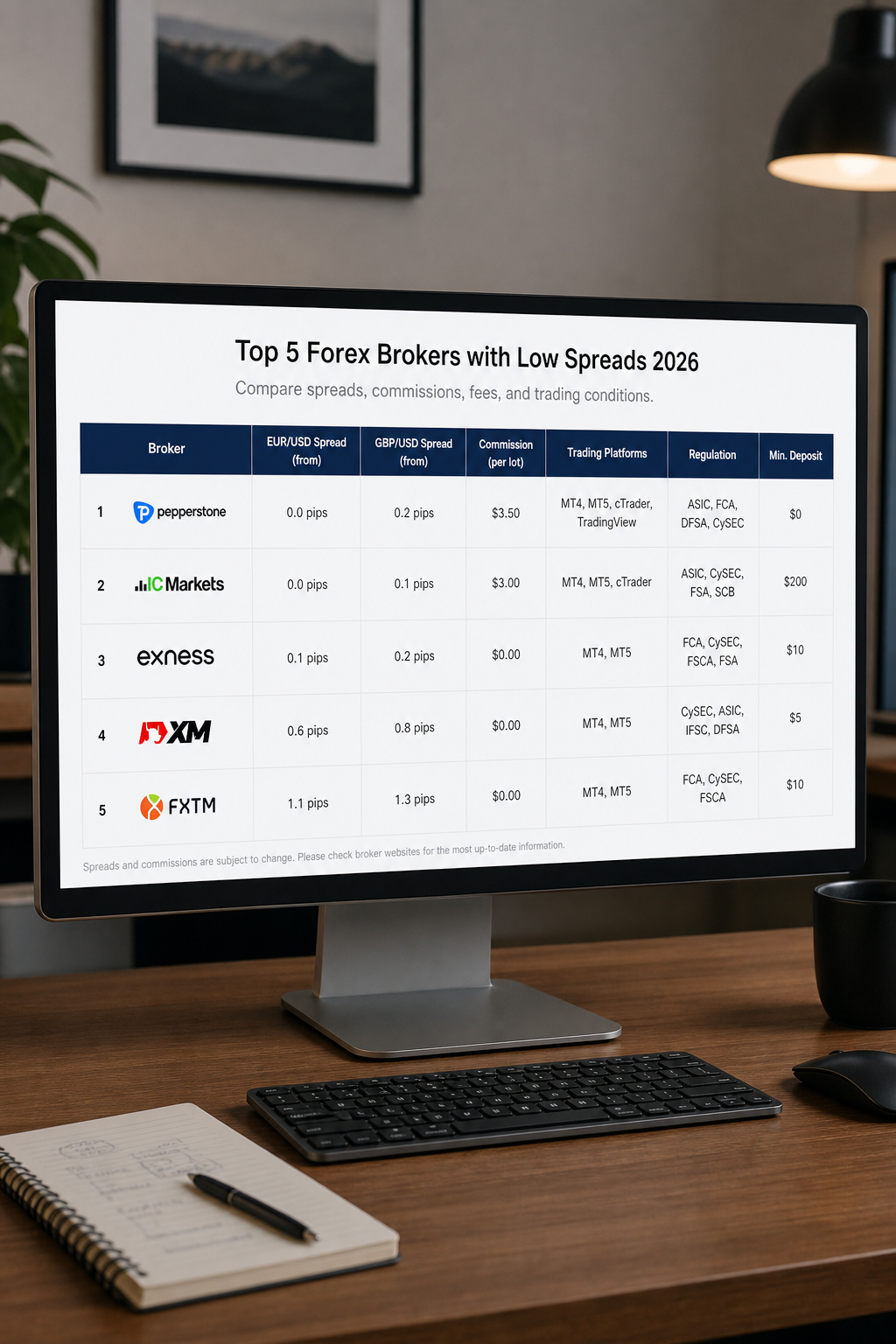
Now that you know what a spread is, let’s look at the brokers that offer the tightest ones. Based on our analysis of 26 brokers, the average spread is 0.37 pips, but the range goes from 0.0 to 1.3 pips. That’s a huge difference.
, the top low-spread brokers for 2026 include Tradu, Interactive Brokers, and Capital.com. But we also found that IC Markets, Fusion Markets, and Pepperstone consistently offer ultra-low spreads.
Here’s a quick comparison table of the tightest spreads we found:
| Broker | EUR/USD Spread (pips) | Commission per Standard Lot (round turn) | Best For |
|---|---|---|---|
| IC Markets | 0.02 | $7 ($3.5 per side) | Scalpers, algorithmic traders |
| Fusion Markets | 0.0 | $4.50 ($2.25 per side) | Cost-conscious traders |
| XM | 0.0 | $7 (round turn) | High-frequency traders |
| Pepperstone | 0.10 | $7 ($3.5 per side) | Active retail traders |
| Tickmill | 0.10 | $6 (round turn) | Day traders |
Notice that commission-free brokers like PU Prime have a 1.3 pip spread , the widest in our sample. So low spread doesn’t always mean low cost. You need to check both.
When readingforex broker reviews low spreads, look for exact numbers. Many reviews say “from 0.0 pips” but that’s usually the minimum under ideal conditions. Average spreads can be higher. Cross-check data from multiple sources.
Also, check what instruments you want to trade. Some brokers have tight spreads on forex but wider on gold or oil. We’ll cover that in Step 6.
Bottom line:Identify your shortlist by comparing both raw spread and commission, not just the advertised pip number.
Step 3: Analyze Spreads, Commissions, and Hidden Costs
You’ve got a shortlist. Now dig deeper. Every broker has a cost structure. Some use raw spreads + commission. Others have wider spreads and no commission. And then there are hidden costs like swap fees, inactivity fees, and withdrawal fees.
Let’s break down the typical costs:
- Spread:The difference between bid and ask. Measured in pips.
- Commission:A fixed fee per lot, often per side.
- Swap:Overnight interest charge for holding positions.
- Inactivity fee:Charged if you don’t trade for months.
- Withdrawal fee:Some brokers charge for bank transfers or crypto withdrawals.
Our research shows that the average commission cost (numeric) across brokers that provide a figure is $18.57 per side, but that’s skewed by an outlier (Vantage at $150). Without that, the average is around $6-$7 per side. So a round-trip commission of $3 to $6 per standard lot is common.
For example, Pepperstone charges $3.5 per side , total $7 per lot. IC Markets charges $3.5 per side , also $7. But Fusion Markets charges only $2.25 per side , $4.50 total. That’s a big difference over many trades.
Let’s apply it. For EUR/USD, 1 pip is about $10 per standard lot. So for IC Markets: spread 0.02 pips + $7 commission / $10 = 0.02 + 0.7 = 0.72 pips total cost. For Fusion Markets: 0.0 pips + $4.50 / $10 = 0.45 pips. That’s 0.27 pips less per lot. If you trade 50 lots per month, you save $135 in costs.
Don’t forget swap rates. If you hold positions overnight, a high swap can wipe out spread savings. Check the broker’s swap policy for the pairs you trade.
“The devil is in the details. A low spread means nothing if the swap is triple on Wednesdays.”
Withdrawal fees are another hidden cost. Some brokers offer free withdrawals once a month; others charge $25 per wire transfer. Over time, these add up. When you readforex broker reviews low spreads, look for comments about withdrawal speed and fees.
Bottom line:Total cost per trade = spread + commission + swap/fees. Always compute the full cost before choosing a broker.
Step 4: Check Regulation and Broker Trustworthiness
Low spreads are attractive, but they mean nothing if your broker is unregulated. Trading with an unregulated broker is risky. You can lose your entire deposit with no way to recover it.
, unregulated brokers lack financial oversight, expose you to fraud, and offer no client fund protection. They can manipulate spreads, deny withdrawals, or simply disappear.
Our research found that among low-spread brokers, regulatory coverage is highly fragmented. There are 18 unique regulators across 19 entries. The most common is ASIC (Australia) at just 11% of brokers. Others include FCA (UK), CySEC (Cyprus), DFSA (Dubai), and FSA (Seychelles).
This means you can’t assume all low-spread brokers are safe. You must check which regulator oversees the broker and what protections they offer. For example, FCA-regulated brokers provide up to £85,000 protection through the Financial Services Compensation Scheme. ASIC-regulated brokers have no such guarantee for forex CFD traders.
Also note some brokers restrict clients from certain countries. For instance, many regulated brokers refuse US clients due to CFTC rules. So check if the broker accepts traders from your country.
When readingforex broker reviews low spreads, look for review sites that explicitly mention regulation. Avoid brokers that hide their license or claim to be “registered” but not regulated.
Bottom line:Only trade with brokers regulated by a reputable authority like the FCA, ASIC, or CySEC to protect your funds.
Step 5: Evaluate Account Types, Minimum Deposits, and Platforms
Low spread brokers often offer multiple account types. The most common are standard (or classic) accounts with wider spreads and no commission, and raw (or ECN) accounts with tight spreads and a commission.
For beginners, a standard account may be simpler , you see one cost. But for active traders, raw accounts usually save money. , many brokers now allow micro lot trading (0.01 lot) with low minimum deposits. For example, XM requires only $5 to open an account, and Fusion Markets has no minimum (though you’ll need at least $0.01 to trade).
Platform choice matters too. Most low-spread brokers offer MetaTrader 4 (MT4) and MetaTrader 5 (MT5). Some also support cTrader, TradingView, or proprietary platforms. If you use algorithmic trading, MT4/MT5 with Expert Advisors (EAs) is essential.
Popular platforms among low-spread brokers include:
- MetaTrader 4/5, industry standard, wide EA support
- cTrader, advanced order types, good for scalping
- TradingView, best for charting, some brokers integrate trading
- Proprietary platforms, e.g., Pepperstone’s web trader, IC Markets’ web terminal
Check if the broker offers the platforms you prefer. Also check if they support desktop, web, and mobile versions. For example, FX Doctor’s guide to forex broker account types helps you understand which account fits your style.
Minimum deposits vary: some brokers like Pepperstone start at $10, others like IC Markets at $200. But if you’re starting small, pick a broker with low minimum and micro lot trading. This way you can test low spreads without big risk.
Bottom line:Choose an account type that matches your trading style and budget, and make sure the platform supports your tools.
Step 6: Compare Spreads Across Instruments , Forex, Gold, Oil, Crypto
Don’t assume low spreads on EUR/USD mean low spreads on everything. Brokers often have competitive pricing on majors but wider spreads on commodities, indices, or crypto.
For example, Pepperstone may have 0.10 pips on EUR/USD but around 18 cents per ounce on gold (which translates to about $1.80 per lot). Fusion Markets might have 0.0 pips on EUR/USD but 7-12 cents per ounce on gold. XM’s zero spread account applies only to certain major pairs.
Our research shows that gold spreads can vary widely. Some brokers offer spreads as low as $5 per lot, while others charge $20 per lot. That’s a $15 difference per trade. If you trade gold frequently, it adds up.
Similarly, oil spreads (e.g., WTI or Brent) can range from 2 to 6 pips, and crypto spreads (e.g., BTC/USD) can be 10 to 50 pips or more. Always check the contract specifications on the broker’s website.
“A broker might be great for EUR/USD terror for gold. Always check the instruments you actually trade.”
Here’s a quick way to compare: list the top three instruments you trade. Then visit each broker’s website and find the average spreads for those instruments. Write them down. Then add commissions. The broker with the lowest total cost for your specific mix wins.
When you readforex broker reviews low spreads, look for ones that break down spreads by asset class. Generic claims like “lowest spreads on all instruments” are usually false.
Bottom line:Always check spreads for the specific instruments you trade, not just the EUR/USD pair.
Step 7: Use Trading Examples to See the Impact of Low Spreads
Let’s put theory into practice with real trading examples. Imagine you’re a day trader who opens 5 positions a day, each 1 standard lot, on EUR/USD. You’re considering two brokers:
- Broker A:Spread 0.0 pips + $7 round-turn commission
- Broker B:Spread 0.5 pips + $0 commission
For each trade of 1 lot (100,000 units):
- Broker A: 0.0 pips spread cost = $0 + $7 commission = $7
- Broker B: 0.5 pips spread cost = $5 (since 1 pip = $10 on EUR/USD) + $0 = $5
So per trade, Broker B is $2 cheaper. If you do 5 trades per day, 20 days per month: Broker B saves you $200 per month. But wait , what if you hold trades overnight? Broker B might have higher swap rates. You need to factor that in.
Now consider a scalper who opens 100 trades per day with 0.1 lot size:
- Broker A: 0.0 pips + $0.70 commission per trade (since $7/10 lots = $0.70 per 0.1 lot) = $0.70
- Broker B: 0.5 pips spread = $0.50
Here, Broker A is more expensive. So the best broker depends on your trading style. High-frequency scalpers often benefit from low spreads with low commissions, while swing traders may prefer no-commission accounts.
Use a position size calculator to see the impact. For instance, IG’s spread calculator can help you estimate costs.
Bottom line:Always model your own trading patterns (frequency, lot size, hold time) to find the broker that minimizes your total cost.
FAQ
What is a spread in forex trading?
The spread is the difference between the bid (sell) and ask (buy) price of a currency pair. It represents the cost of opening a trade. For example, if EUR/USD has a bid of 1.1050 and an ask of 1.1052, the spread is 0.0002 or 2 pips. The lower the spread, the less the market needs to move in your favor to break even. Major pairs like EUR/USD usually have the lowest spreads due to high liquidity.
How do I find low sps?
You can search for “forex broker reviews low spreads” to find comparison websites and YouTube videos. Look for reviews that provide average spread data over time, not just minimums. Cross-reference information from multiple sources like ForexBrokers.com, BestBrokers.com, and trusted YouTube channels. Pay attention to whether the review includes commission costs and regulatory information.
What is the difference between raw spread and commission accounts?
Raw spread accounts (also called ECN or Zero accounts) offer very tight spreads, sometimes zero pips on major pairs, but charge a commission per lot. Standard or classic accounts have wider spreads but no commission. Which is cheaper depends on your trade size and frequency. For small trades or long-term holds, standard may be cheaper. For large volumes, raw accounts often win.
Are low spread brokers always regulated?
Not necessarily. Some low spread brokers operate without proper regulation to attract cost-conscious traders. Always verify the broker’s license number on the regulator’s official database. Common regulators include the FCA (UK), ASIC (Australia), CySEC (Cyprus), and DFSA (Dubai). Avoid brokers that claim to be “registered” but not regulated, as they may not follow client fund protection rules.
Can I trade gold and oil with low spreads?
Yes, but spreads on commodities like gold and oil are typically wider than major forex pairs. Some brokers offer competitive spreads on these instruments. For example, Fusion Markets has gold spreads around 7-12 cents per ounce, while Pepperstone averages around 18 cents. Always check the specific instrument’s spread and commission on the broker’s website before trading.
How do swap rates affect my trading costs?
Swap rates (rollover interest) are charged or credited when you hold a position overnight. For long-term traders, a high swap can significantly increase total costs. Some brokers offer Islamic accounts with no swap, but these may have other restrictions. Compare swap rates between brokers for the pairs you trade. A low spread broker with high swaps might be more expensive than a slightly wider spread broker with low swaps.
What platforms do low spread brokers support?
Most low spread brokers offer MetaTrader 4 and MetaTrader 5. Some also support cTrader, TradingView, or proprietary platforms. If you use Expert Advisors, ensure the broker allows EAs and doesn’t restrict trading during news. For scalping, look for brokers that offer fast execution and low latency, often with raw or ECN accounts.
How often should I switch brokers for better spreads?
Only switch if your current broker’s total cost (spread + commission + swaps) is consistently higher than another broker after accounting for your trading style. Switching too often can lead to account setup delays and loss of trading history. Compare brokers once a year or when your trading volume changes significantly.
Conclusion
Choosing the right low spread forex broker isn’t about finding the lowest advertised spread. It’s about understanding your total cost per trade, verifying regulation, and matching the broker’s offerings to your trading style. We covered seven steps: understanding spreads, identifying top brokers, analyzing total costs, checking regulation, evaluating account types, comparing spreads across instruments, and using real examples to see the impact.
Remember these key points: always calculate spread + commission, check regulators, test with a demo account, and model your own trading frequency. The broker that saves you the most money is the one that fits your specific patterns , not the one with the flashiest advertising.
Start by making a list of your most traded instruments. Then use this guide to compare at least three brokers. Open demo accounts, trade a few simulated weeks, and track the costs. Your future profits depend on the decisions you make today.
If you found this guide helpful, s on FX Doctor for more educational content on forex trading. Happy trading!